The IT services pie is still growing, but the AI-adjusted pricing pool available to Indian IT is shrinking.
FinTech BizNews Service
Mumbai, 25 August, 2026: The latest Kotak Institutional Equities report on IT Services provide useful insights:
The dust settles, but risk-reward in balance
We downgrade Infosys and TCS to ADD from BUY and LTM to SELL from REDUCE after the sharp rally in stock prices from recent lows. We believe four themes have emerged from recent chain of events—(1) high pricing pressure as deals remain insufficient to support growth aspirations for all, (2) concerns related to terminal value of IT services have reduced, providing floor to valuations, (3) debate between open source and closed models continues—open weight models not only raise service intensity but also lead to faster adoption, driving deflation and (4) challengers will continue to gain wallet share. Preferred picks are TechM, Coforge, Hexaware and Indegene.
Risk-reward in balance after recent run-up in stock prices
We believe that the sector’s risk-reward profile has moved from being attractive to balanced, following a ~15-35% increase in stock prices from the recent lows. Infosys and TCS offer a moderate upside of 6 and 7% to our Fair Values, respectively. We downgrade both to ADD from BUY. LTM has become expensive, following the strong rally from recent lows. We downgrade LTM to SELL from REDUCE. We continue to prefer challengers and hybrids over incumbents, with TechM, Coforge, Hexaware and Indegene as our preferred picks.
Concerns about terminal value have reduced, providing a floor
The AI debate in IT services shifted from existential risk to who in the value chain captures value. The creation of FDE organizations by hyperscalers, frontier model labs and consulting firms highlights that models and agents are not plug-and-play in an enterprise. Production deployment still requires data engineering, workflow redesign, security, testing, governance, change management and context of legacy systems. This sustains the role for services and addresses the terminal value concern that dominated the sector debate. However, the FDE model runs on small, senior teams working closely with the business and paid on outcomes, calling for a change of the IT services model.
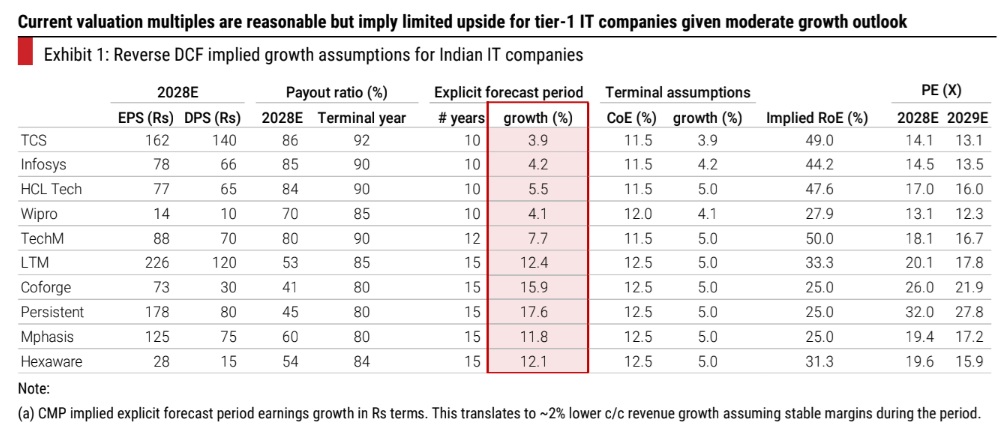
We peg the floor for incumbents at 11-12X earnings, a multiple that assumes no terminal growth. AI-led deflation will, however, constrain meaningful growth acceleration beyond 4-5% up to FY2028. This caps the upsides for incumbents at 17-18X. Exhibit 1 captures the implied long-term growth embedded into stock prices and Exhibit 2 indicates the implied valuation multiple, assuming a certain long-term growth trajectory for incumbents.
Pricing pressure resulting from high competitive intensity is the key risk
AI has intensified competition among Indian IT services companies. The sector previously benefited from periodic execution gaps at large vendors, which created share-gain opportunities for better-performing peers. Most major vendors are now operationally stable and compete for similar deals across the same markets using comparable productivity assumptions. The historical share-gain offset has therefore weakened. Margin pressure should have followed, but currency depreciation has cushioned the impact so far. Another six months of undisciplined pricing could make the pressure visible in margins, particularly as the old book comes up for renewal under more demanding AI-driven productivity assumptions.
Growth will set the valuation ceiling—we believe that is 17-18X
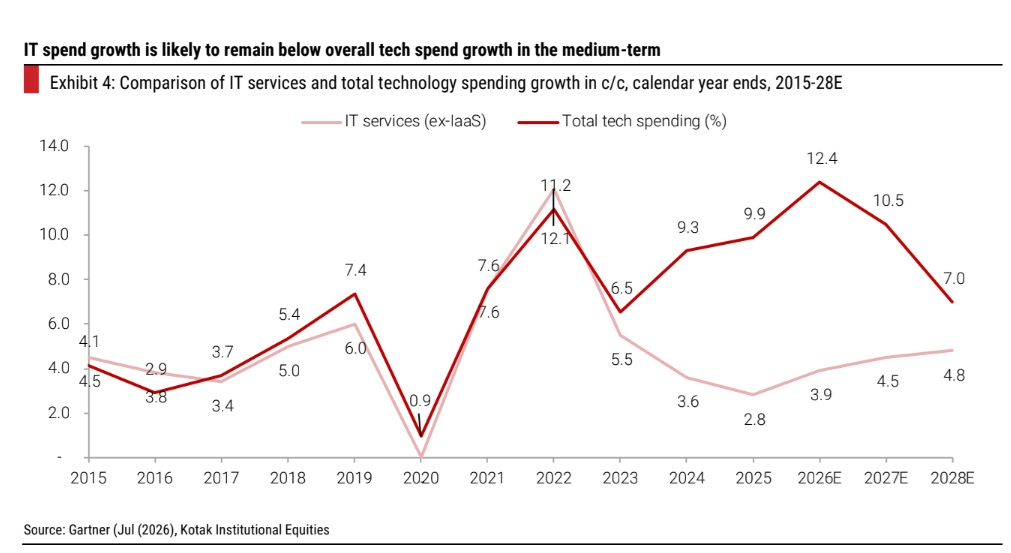
An 18X multiple requires sustainable c/c revenue growth of 4-5%. We do not expect growth to exceed 5% before FY2029. AI implementation work is still small, while deflation applies to a much larger existing revenue base. Technology budgets may grow, but software, cloud, infrastructure and model consumption capture a disproportionate share of incremental spending for the foreseeable future (Exhibit 4). Services companies must first replace the productivity passed through on existing contracts before producing net growth. AI opportunity has to exceed the revenue deflation phase, which may materialize starting FY2029. Until then, we expect stocks to move in a band 11-12X at the lower-end and 17-18X as the higher-end for incumbents (Exhibit 3).
Competitive intensity is intensifying, share gains becoming difficult
Growth dispersion among Tier-1 companies will likely narrow in FY2027E, except for Wipro. The sector benefited for a decade from execution gaps at large vendors. TCS was absent from several mega deals, Cognizant went through a multi-year recovery, TechM suffered a self-inflicted decline and Wipro faced persistent execution challenges. Weak players gifted share to stronger ones. As a result, the industry was in equilibrium.
FY2027 guidance bands and consensus estimates are now clustered at around 0-3% for most Indian Tier-1 companies. TCS is back in mega deals. TechM has executed its turnaround and is winning large telecom contracts. Cognizant is no longer a structural share donor and in fact has started gaining share.
What is even more surprising is that traditional incumbents are growing faster than Indian heritage vendors. Accenture grew 3.0% in local currency in 3QFY26, Capgemini grew 5.1% in organic constant currency in 2QCY26 and Cognizant grew ~3% in organic constant currency in 2QCY26. In contrast, TCS, Infosys, HCLTech and Wipro grew only 2.6% on a revenue-weighted constant-currency basis in their latest reported quarters that included acquisitions and 1.6% on an organic constant-currency basis
The deal market has not expanded enough to absorb everyone’s growth ambitions. The IT services pie is still growing, but the AI-adjusted pricing pool available to Indian IT is shrinking. Clients are embedding productivity concessions into renewals and using competitive intensity to capture a larger share of AI-led savings. Deal wins can therefore protect relevance without delivering growth. This is the biggest shift from the last cycle. Earlier winners gained because competitors were weak. FY2027E will test vendors in a market where most competitors are functional again and global peers are growing faster. Pricing is the key risk. Currency has delayed the margin impact, but another phase of aggressive bidding and old-book repricing will make the pressure visible.
Open weights create more work and faster deflation
It is becoming increasingly clear that the market will not be dominated by closed frontier models due to cost and other considerations. Significant improvement in open source and open weights models are viable alternatives for enterprises.
Open weights are not a simple positive for IT services. Open weights increase activity because enterprises need help choosing models, tuning them, connecting them to proprietary data, setting up guardrails, monitoring performance and embedding the output into workflows. This is an area of strength of IT services companies, especially when the model is hosted by a hyperscaler and the vendor builds the business layer above it.
However, the issue is of deflation. Open weights lower the cost of intelligence and make capability widely available. The same tools can be accessed by everyone, including clients, GCCs and every competing vendor. Adoption of AI can increase but comes with a corresponding hit of deflation. The vendor may get more work to do, but the client will expect it to be done with fewer people and lower running costs.
Closed models have the opposite tradeoff. They leave more economics with the model owner and the hyperscaler. Services participation is lower because the model layer is consumed through APIs. Yet even in a closed-model world, enterprises still need integration and data control. Services work, as a result, does not disappear in either model. What differs is where deflation shows up. Open weights widen the pipeline but compress unit economics. Closed models leave a narrower implementation layer while slowing the pace at which it commoditizes.
Book repricing is a moving target
The street thinks of repricing as a one-time event across the entire book of business. The answer is a lot more nuanced. Revenues of IT companies can be divided into fixed price and T&M, with T&M contract repricing treated as static, which is not the case. The T&M book has been repricing automatically for the past 12 months as code assists allowed teams to ship more code without proportional headcount. The repricing is continuous. The catch is that enterprise adoption lags model and agent capability, so the book is always being repriced to yesterday's productivity while the frontier model capabilities have already moved on. The tooling itself keeps shifting under the work, prompt engineering a year ago to agents and now agent-based orchestration. Each step raises the productivity. Model capabilities are improving faster than enterprises’ ability to make full use.
Fixed-price work has different dynamics and can be split into two. AMS carries a shorter duration and a higher payoff from a client standpoint. Pricing pressure at the time of renewal is intense, though it can be managed where AI is deployed well. IMS is a different case. IMS work has been heavily automated in the prior wave, with pricing based on tickets, devices and consumption rather than direct headcount. Incremental GenAI deflation is therefore lower and repricing is also gradual. Agentic resolution at L1 and L2 adds another leg, but off an already automated base, so the impact is smaller and slower than in application work.
The point to note is that repricing is dynamic. To take CTSH’s view out of context and assume that bulk of the book is repriced is incorrect. So is the opposite assumption, that every tool and model improvements permanently erode the opportunity. The point to note is as follows: (1) the repricing of book is dynamic and still in early stages and (2) the offset will accrue as AI for business and new use cases pick up. Our current assumption is of 50% reinvestment with new business use cases eventually offsetting the deflation.
Deflation for now, new demand later
Our current assumption of revenue deflation over three years to FY2029 of 3-3.5% has downside risks. The deflation assumption is based on roughly 30-35% deflation in application implementation and BPO. We do not see net-new AI-for-business demand, offsetting this deflation before FY2029. We believe that for the net deflation assumption to change, three conditions need to be fulfilled, i.e., (1) AI implementation has to grow from a small base into a line large enough to outweigh deflation on a much larger installed base, (2) clients must fund AI as net-new growth investment rather than repurpose existing tech budgets; emphasis will be high on the split of AI between efficiency use cases and genuine new-revenue use cases and (3) the productivity pass-through embedded in renewals has to stabilize, which for now, is unusually high due to AI getting embedded into the mix combined with extreme panic to defend wallet share, leading to parting of more than a fair share to defend the revenue base.
Our best estimate is that the deflation phase runs through FY2027-28 and the crossover begins around FY2029. Even that assumes the AI capex wave translates into enterprise application demand rather than staying trapped in infrastructure. The downside risk is SDLC productivity surge generalizes beyond coding into broader scope of work, leading to deflation that could run higher than our 3-3.5% base case in FY2027-28. The upside case, that a bigger technology pie pulls services along, is possible but back-ended.
More thoughts on AI deflation
Our annual revenue deflation estimates of 3-3.5% for the Indian IT services market assume a (1) uneven impact of AI productivity gains on various segments of IT services—highest for application development and CX BPO and lower for IMS and vertical-specific BPO and (2) reinvestment of 50% of the savings from AI adoption back into technology spending via avenues such as custom application development, data modernization, legacy modernization and new AI use case implementation. The deflation impact will be largely borne by incumbents, while quality challengers can benefit from share gains against incumbents and spending in new areas.
IT services companies are utilizing GenAI and passing on AI productivity benefits to clients. Productivity benefits are immediately recognized in application development. In managed services deals, which are usually contracted for a multi-year duration, clients are demanding savings in future years from AI efficiencies to be passed on upfront.
There are several key questions surrounding the IT services sector from an AI impact perspective. We provide our thoughts on some of the pertinent ones below:
How long will incremental deflation continue? If the extent of deflation is fixed, then all that matters is how long it takes for the portfolio to cycle through the deflation impact. However, we expect deflation to continue to increase as AI models become more capable of performing entire tasks or sub-tasks in IT services with higher autonomy. |
| We believe new frontier models will continue to focus on improving AI capabilities in software engineering and other IT services tasks. Frontier AI labs such as OpenAI and Anthropic are working to improve model capabilities simultaneously on two axes—(1) get AI to do more economically useful work for enterprises to justify enterprise spending and (2) pursue innovation using AI such as new drug discovery, self-recursive AI improvement, prove/disprove math theorems and conjectures. We believe both these endeavors would involve further improvement in software engineering and other IT services areas. |
What is the extent of re-investment across different segments? We believe the re-investment rate will be higher in new application development and in application modernization through use cases such as custom software development, data modernization, implementation of business AI use cases and legacy application modernization. We expect re-investment rates to be low in customer service BPO and other horizontal BPO functions. Re-investment rates can be moderate in IMS. |
When does scaling of enterprise business AI use cases start showing up? We do not expect majority of enterprises to meaningfully scale up a large number of business AI use cases in the near term. Scale-up will be gradual. Commentary of enterprises suggests significant scale-up activity in CY2027 accelerating into CY2028. Enterprises may not have factored in the prerequisites, complexities and costs involved in the integration of AI agents and agentic AI systems into business workflows. Mismatch between expected and actual results from implementation can lead to deviations from the planned scale-up trajectory. |
All incumbents are under pressure; not every challenger is gaining
Both global (such as Accenture, IBM and Capgemini) and Indian incumbents are struggling to grow materially above industry growth rates. Everyone is facing deflation in base business. Firms are competing intensely to gain share from competition, resulting in a net-losers scenario. A pivot to a large existing services market untouched by IT seems unlikely. Incumbents are boosting AI capabilities and looking to benefit from scaled AI adoption of business use cases of enterprises. Select firms such as Accenture are aggressively positioning to capture adjacent opportunities of AI adoption such as data center consulting services, Palantir implementation and enhanced cybersecurity needs.
Challengers are incentivized to cannibalize their own revenue by incorporating AI to win large volumes from incumbents hesitant to pass on AI productivity benefits to clients. The theme appears to have started to play out. Coforge and Persistent have done well, though a large part of the current outperformance is a function of strong execution and mid-tier advantage flowing from digital and cloud evolutions.
Not all challengers are thriving, though. Globally, EPAM and Globant are struggling. LTM bore the impact of AI productivity pass-throughs and pricing pressure in the largest accounts. Hexaware is going through a period of revenue growth deceleration. Gains from AI adoption, on the other hand, are yet to significantly show up. Smaller firms such as Zensar and Birlasoft are yet to find their footing. Even performance of Indian listed data, analytics and AI pure plays—Fractal and LatentView—has been disappointing.
GenAI adoption can influence sourcing decisions both ways
Despite 3+ years of gradual GenAI adoption, it does not seem to have significantly impacted insourcing decisions of enterprises either way. We believe that GenAI will become an important factor in driving sourcing decisions as adoption scales up.
GenAI adoption can drive increased insourcing in select segments such as application development and implementation. GenAI can help reduce effort in otherwise time-consuming development-heavy activities, leading to a higher proportion of time spent on providing requirements to the vendor. Enterprises might prefer to rather insource development unless vendors provide specialized skills. As models commoditize, enterprise data and context are increasingly seen as a driver of differentiation in the AI era. Companies may restrict the use of vendors to reduce chances of knowledge leakage during engagements.
At the same time, not all enterprises might be able to adopt AI with high effectiveness. Services firms could end up developing better capabilities than several enterprises as they partner with vendors in the AI ecosystem, develop IP and learn through experience of multiple engagements. They could achieve similar outcomes at a lower cost as well. Ultimately, it is a question of who is able to extract more productivity gains from AI adoption in services and who can execute better. This could drive outsourcing and GCC carve-outs by enterprises lagging behind in internal AI adoption.
We cut Infosys and TCS to ADD from BUY and LTM to SELL from REDUCE
Infosys. Infosys is slightly at a disadvantage in the current phase of enterprise AI adoption due to a tad higher exposure toward applications services. Infosys possesses natural strength in addressing discretionary spending priorities of clients, curtailed in the current cautious demand environment. Infosys is well-positioned to help clients implement AI initiatives and will gain a fair share of benefit from AI-led opportunities such as new custom software development, data modernization and legacy modernization. We expect a tilt of fortunes as enterprise business AI use cases expand and discretionary spending improves. Near-term prospects are not encouraging. Infosys is set to underperform on organic growth relative to TCS, HCLT and CTSH in FY2027. Loss of share in a large European account to peers poses initial headwinds to growth in FY2028 as well. We value the stock at 15X multiple on June 2028 EPS, leading to an unchanged Fair Value of Rs1,200. Stock provides upside of 6% from CMP. Downgrade to ADD from BUY. |
TCS. TCS has a balanced portfolio and strength across both discretionary spending and cost take-out priorities of clients, better suited for the current demand environment. However, TCS is the largest incumbent and faces the highest challenge dealing with AI-led deflation in its base business. Strength in defending wallet share from peers has reduced compared with historical levels. Mega deal wins have improved the past three quarters, a positive but not sufficient to drive material growth improvement, offsetting headwinds. Inorganic strategy started off with a couple of rather unexciting Salesforce services acquisitions, but has stalled since. Data center play is interesting, but is in initial stages. TCS will have better revenue growth in FY2027 compared with the previous year, but that is largely due to the non-recurrence of higher headwinds, largely client-specific in nature. We value the stock at 15X multiple on June 2028 EPS, leading to an unchanged Fair Value of Rs2,450. Stock provides upside of 7% from CMP. Downgrade to ADD from BUY. |
LTM. LTM benefits from plenty of factors—(1) presence in large scalable verticals, (2) a robust client base, (3) a strong management team with many having experience of scaling up businesses in Tier 1 organizations, (4) strong ecosystem partnerships, (5) ability to provide end-to-end services across both discretionary and managed services and (6) proven ability to be a challenger vendor. The organization has not been able to perform to potential post-merger of LTI and Mindtree. Growth rates have fallen short of expectations. Execution strength has not been sufficient to pull away from the gravity of industry headwinds and client-specific issues. While LTM has been able to scale up top-two accounts to very large sizes, progress in other accounts has been rather slow. Mega deal momentum compensated for underperformance in top accounts in FY2026, but has failed to continue post the media deal. Acquisition of Randstad entities has potential but requires strong execution. We value the stock at 18X (17X earlier) multiple on June 2028 EPS, leading to a Fair Value of Rs4,150 (from Rs3,900). Downgrade to SELL from REDUCE. |
