The global HNWI wealth grew 8.7% in 2025 to a record USD 98.3 trillion, driven by strong equity market performance and easing inflation. The global millionaire population also increased by nearly 2 million individuals, reaching 25.3 million.

FinTech BizNews Service
Mumbai, June 4, 2026 – The 30th edition of the Capgemini Research Institute’s World Wealth Report 2026, published today, found an 8.7% increase in global high-net-worth individual[1] (HNWI) wealth in 2025, reaching a record USD 98.3 trillion — the largest single-year increase since 2018. A robust equity market performance and easing inflation drove HNWI wealth creation in 2025, growing the global millionaire population by nearly 2 million to 25.3 million individuals.
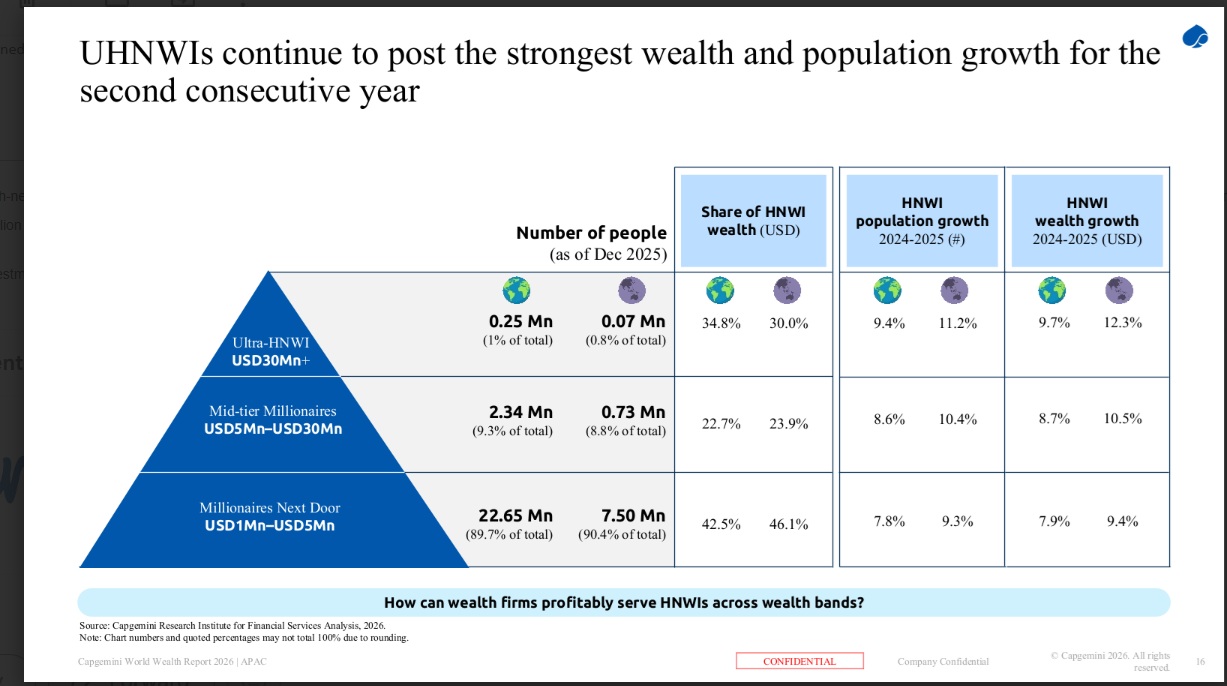
Across wealth bands, ultra-high-net-worth individuals (UHNWI) captured the largest share of the gains, buoyed by exposure to a greater range of public and select high-performing private asset classes. In 2025, the UHNWI global population stood at roughly 250,000 — a 9.4% increase year-over-year — retaining its status as the fastest-growing wealth segment for the second consecutive year. Global UHNWI wealth grew 9.7% year-over-year, outpacing the broader HNWI segment. Wealth remains heavily concentrated — the top 1% of HNWIs account for 34.8% of HNWI wealth.
Global stock market performance drives strong growth in HNWI wealth
Equity markets, fueled by AI-related rallies, were the primary engine of HNWI wealth growth across five of six major regions in 2025:
Tech-driven growth impacts HNWI portfolio allocations
Equity allocations increased to 25% of HNWI portfolios as of January 2026, marking a three-percentage-point increase from last year. The growth was primarily fueled by strong corporate earnings and significant gains in the technology sector. Fixed income holdings also expanded to 20%, up two percentage points, as bond markets delivered their strongest returns since 2020. Meanwhile, alternative investments[2] declined to 12% reflecting the relative outperformance of public equities. Despite this shift, investor appetite for alternatives remains strong, with two in three HNWIs (68%) indicating an intention to increase their exposure to private equity.
"In our 30 years of tracking global wealth, 2025 represents an exceptional moment for the size of the world’s population of high-net worth individuals and the assets they control. HNWIs now have access to more asset classes across markets, along with greater options in terms of advisors and expertise. For the industry, this is a clear inflection point: between 2022 and 2025, an estimated USD 1.5 trillion in new assets flowed to competitors of traditional firms,” said Kartik Ramakrishnan, CEO of Capgemini's Financial Services Strategic Business Unit and Group Executive Board Member. "Clients, including younger HNWIs benefiting from wealth transfers, are seeking more: greater product access, deeper personalization, and advice that truly reflects their lifestyle. Firms that can deliver this at scale, powered by AI-enabled insights and capabilities, will define the next era of wealth management."
Augmented intelligence can deliver a personalized experience to clients at scale
While the HNWI population has expanded, competition for their wealth-management business has intensified. Exclusive client relationships have halved in the past six years: in 2019, 39% of HNWIs worked with a single firm; in 2025, that figure shrunk to just 19%. A significant driver of HNWIs expanding their wealth management network is product access — 88% of HNWIs say they work with multiple firms specifically to gain better access to alternative investments. WealthTechs, single-family offices, and robo-advisory platforms are increasingly capturing market share from incumbents, attracting clients who feel underserved on product breadth, advice quality, or both.
According to the report, only 17% of HNWIs describe their advisory experience as seamless and personalized, with 42% having to restate their goals and preferences multiple times to the same firm. Addressing these challenges will require wealth management firms to embed augmented intelligence — where technology sharpens, not replaces, the human advice clients receive — to bridge a growing gap between the experiences HNWIs expect and what traditional operating models can deliver.
The challenges run deeper than technology. Nearly all firms (97%) still segment clients primarily by assets under management, failing to capture the nuances of behavioral signals that define how HNWIs actually engage. The traditional operating model is again the core problem here: over half (60%) of wealth management executives acknowledge their firms lack a unified client view, resulting in fragmented processes and duplicated effort.
While expanding products and services boost loyalty, realizing measurable value requires proper coordination and management across the customer journey. With 41% of advisors’ time consumed by operational tasks, three quarters (76%) want AI-enabled systems to automate routine work and 61% want access to an integrated ecosystem of specialists to respond effectively across financial and non-financial needs. When firms get customer experience right, 53% of HNWIs recommend their firm to others, and 47% consolidate their assets, directly influencing wallet share.
Report Methodology
The Capgemini World Wealth Report 2026 draws data from three primary sources: the 2026 Global HNWI Survey, the 2026 Global Wealth Management Executive Survey, and the 2026 Global Relationship Manager Survey. These research sources polled 6,510 high-net-worth individuals across 27 markets, 144 senior wealth management executives across 24 markets, and 1,317 relationship managers across 24 markets. Respondents were asked about investment preferences and priorities, client experience expectations, advisory relationships, and the adoption of AI and digital tools in wealth management. Participants represent major markets across North America, Europe, Asia-Pacific, Latin America, the Middle East, and Africa.
