For Indian investors, gold remains a resilient anchor for portfolio stability.

FinTech BizNews Service
Mumbai, March 18, 2026: Despite strong macroeconomic credentials, Indian financial markets have delivered softer returns amid currency weakness, subdued capital flows, rising global uncertainty. In this environment, gold has emerged as a notable outperformer. Its ability to provide effective diversification, act as buffer during periods of systemic stress, and a currency hedge, reinforces its strategic role in portfolios, argues Kavita Chacko, Research Head, India, World Gold Council, in her India gold market update.
For Indian investors, gold remains a resilient anchor for portfolio stability.
Escalating geopolitical tensions, changing relationships across asset classes and currency volatility are likely to keep financial conditions uncertain, reinforcing the importance of resilient portfolios. Gold is well positioned to anchor Indian portfolios during periods of market stress.
India’s macroeconomic credentials remain strong, with the country continuing to post one of the highest growth rates among major economies – above 7% for three consecutive years1 – despite persistent global headwinds. Growth has been upheld by resilient domestic demand, public investment and policy initiatives.
However, these favourable macro fundamentals have not translated into financial market performance. The INR has weakened, capital inflows have been subdued, and asset returns have been relatively muted. Gains in Indian equities have moderated amid elevated valuations, while monetary easing2 has compressed yields on debt instruments, making them less attractive for new investors. Against this backdrop, gold stands out as a notable outperformer.
Returns of key assets in 2025 and y-t-d in INR*
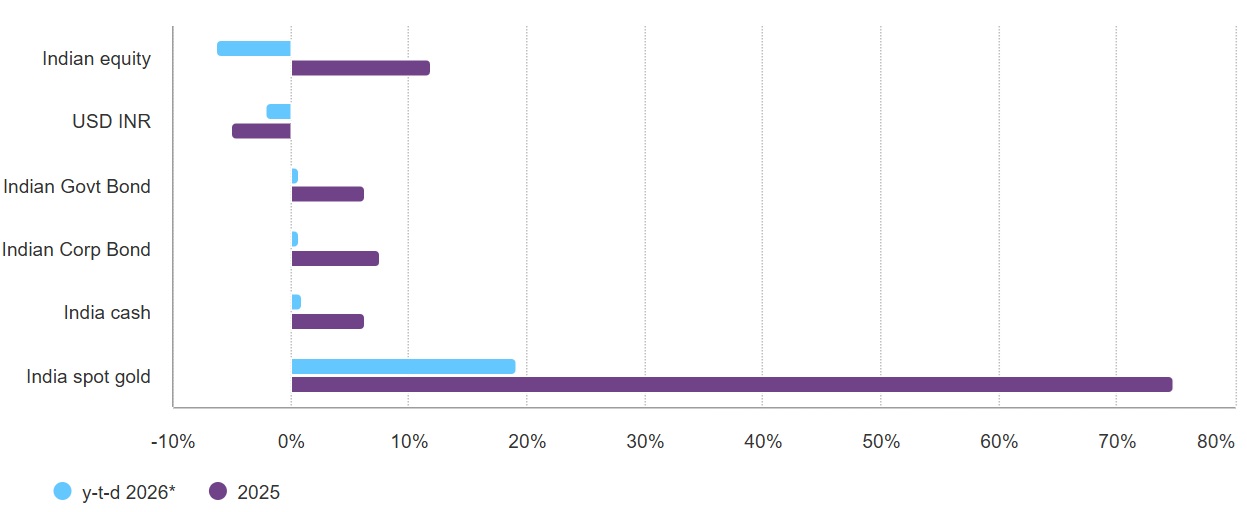
*As of 6 March 2026, in INR. Indices used: MCX Gold Spot Index, CRISIL Corporate Bond Index, Nifty TRI Total Return Index, ICE BoFA Govt Bond Index, India Govt 3M T-bill Index.
While the broad-based strength of economic activity suggests growth momentum is likely to persist, risks to the outlook stem largely from external uncertainties – spillover from geopolitical tensions, volatility in the global financial markets, and uncertain global economic prospects, all of which have intensified since the beginning of 2026. The implications of the ongoing West Asian conflict are particularly significant for India,3 from energy supplies to trade and capital flows. Prolonged disruption could exert pressure on inflation, the INR, and sectoral performance.
Gold has emerged as one of the strongest performing assets in recent years, outperforming equities, bonds and currencies as investors have sought protection against geopolitical tensions, policy uncertainty and inflation risks. Price momentum has further reinforced investor demand. Importantly, many of the drivers behind this rally remain firmly in place in 2026.
In this environment, building strong buffers and constructing resilient portfolios becomes increasingly important for wealth preservation. The case for gold in Indian portfolios extends beyond recent performance. Market cycles, correlation dynamics, currency movements, and periods of systemic stress all reinforce gold’s role as a portfolio stabiliser.
The relationship between equities and gold often reflects shifts in market sentiment. The equity-gold ratio (Nifty–gold ratio) captures the relative performance of the two assets over time. Periods of strong equity market performance have been associated with elevated ratios, while episodes of financial stress and equity drawdowns have coincided with declines, as gold outperforms. The ratio has recently fallen to around 1.5-1.6, well below its long-term average of 3, reflecting gold’s strong relative performance amid heightened macroeconomic and financial market uncertainty. Such phases typically signal a shift in investor preference towards safer assets and underscore gold’s role as a stabilising allocation within portfolios. And while we believe such a level is consistent with the current uncertain environment, there is also a potential for reversal.
Gold has historically shown strong resilience during episodes of systemic risk, often delivering positive returns while limiting portfolio losses. With few exceptions, its performance during such periods has helped reduce overall portfolio drawdowns.
Stocks, bonds and gold during various crises*
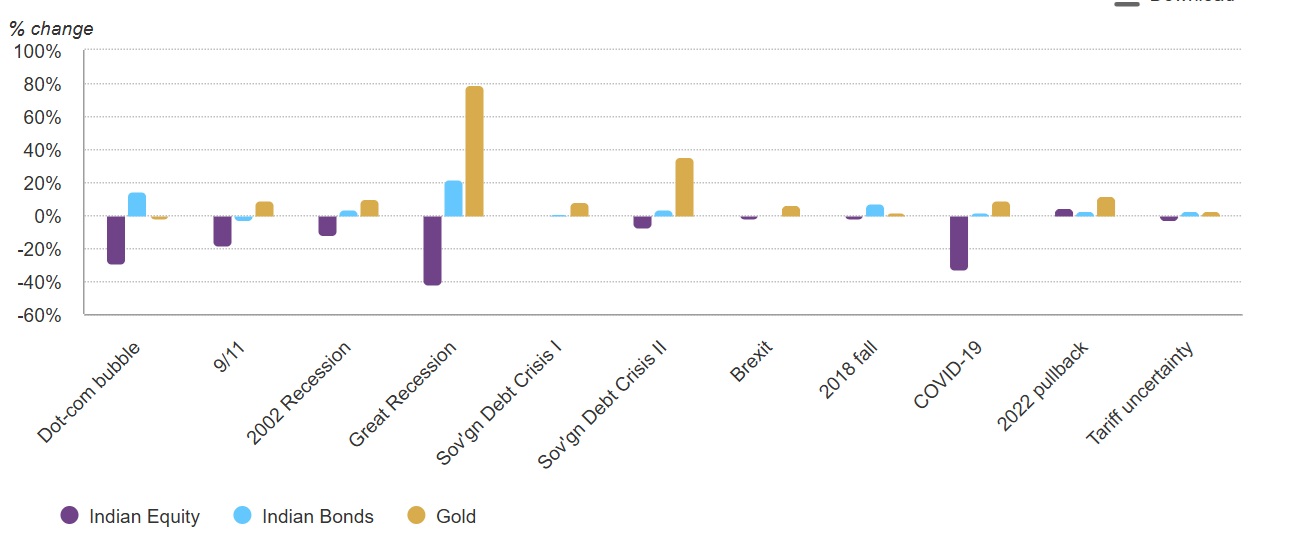
*As of 31 December 2025. Return computations in INR for ‘Indian Equity’: Sensex Index; ‘ Indian Bonds’: ICE BoFA Govt Bond Index; ‘gold’: LBMA Gold Price PM. Dates used: Black Monday: 9/1987 - 11/1987; LTCM: 8/1998; Dot-com: 3/2000 - 3/2001; September 11: 9/2001; 2002 recession: 3/2002 - 7/2002; Great Recession: 10/2007 - 2/2009; Sovereign debt crisis I: 1/2010 - 6/2010; Sovereign debt crisis II: 2/2011-10/2011; Brexit: 23/6/2016 - 27/6/2016; 2018 pullback: 10/2018 - 12/2018; 2020 pullback: 31/1/2020 - 31/3/2020; 2022 pullback: 1/2022 – 12/2022, tariff uncertainty: 18/2/2025-8/4/2025.
Diversification benefits of traditional asset classes have come into question in recent years. The relationship between equities and bonds – key components of most portfolios – has shifted, with the two increasingly moving in tandem. Historically, Indian government bonds tended to exhibit a negative correlation with equities, helping balance portfolio risks. However, over the past few years, the equity-bond relationship has turned increasingly positive. In contrast, gold has continued to predominantly display a negative correlation with equities across most periods, reinforcing its role as an effective diversifier during episodes of market stress.
Currency hedge
Movements in domestic gold prices reflect global gold market dynamics, import duty and exchange rate movements. With gold priced internationally in USD, the value of the Indian rupee can significantly influence its domestic price. Periods of INR depreciation tend to amplify gold price rises. Over longer horizons, the depreciation of the rupee has therefore contributed meaningfully to gold’s return profile. This becomes increasingly relevant during periods of stress, when capital flows and exchange rates tend to be volatile. During such times, gold provides additional protection against uncertainty as well as from currency risk within portfolios.
Strategic asset – gold in portfolios
Gold plays an important role as a strategic allocation within diversified portfolios. Beyond its resilience during periods of uncertainty, gold has delivered long-term returns across economic cycles. Our analysis shows that gold complements equities and broad-based portfolios by providing a unique combination of returns and diversification. These characteristics help improve portfolio resilience by enhancing risk-adjusted returns, reducing volatility and limiting drawdowns.
Our portfolio analysis further highlights gold’s positive contribution. Over a 19-year period4, an average INR portfolio would have delivered higher risk-adjusted returns and lower drawdowns with gold allocations in the range of 7.5% to 15%, underscoring its value as a core portfolio component.
Conclusion
An environment characterised by elevated geopolitical tensions, shifting market correlations, and persistent currency risks underscores the importance of building resilient portfolios. Gold’s performance across market cycles, its diversification attributes and its ability to provide protection during periods of financial stress reinforce its strategic, long-term relevance within portfolios. For Indian investors in particular, gold offers an additional layer of resilience by amplifying returns during periods of rupee depreciation.
