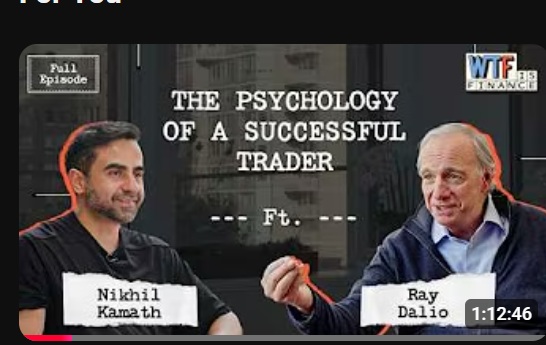
Nikhil Kamath’s latest podcast conversation on ‘WTF is Finance’, where he is in discussion with global investor Ray Dalio on the New World Order, India’s Emergence and many interesting points
FinTech BizNews Service
Mumbai, 23 December 2025: In the latest episode of 'WTF is Finance?', investor and entrepreneur Nikhil Kamath sits down with hedge fund legend and Bridgewater Associates founder Ray Dalio. The wide-ranging conversation bridges the gap between abstract macro-economic cycles and the visceral reality of wealth creation, offering a roadmap for the next generation of Indian aspirants.
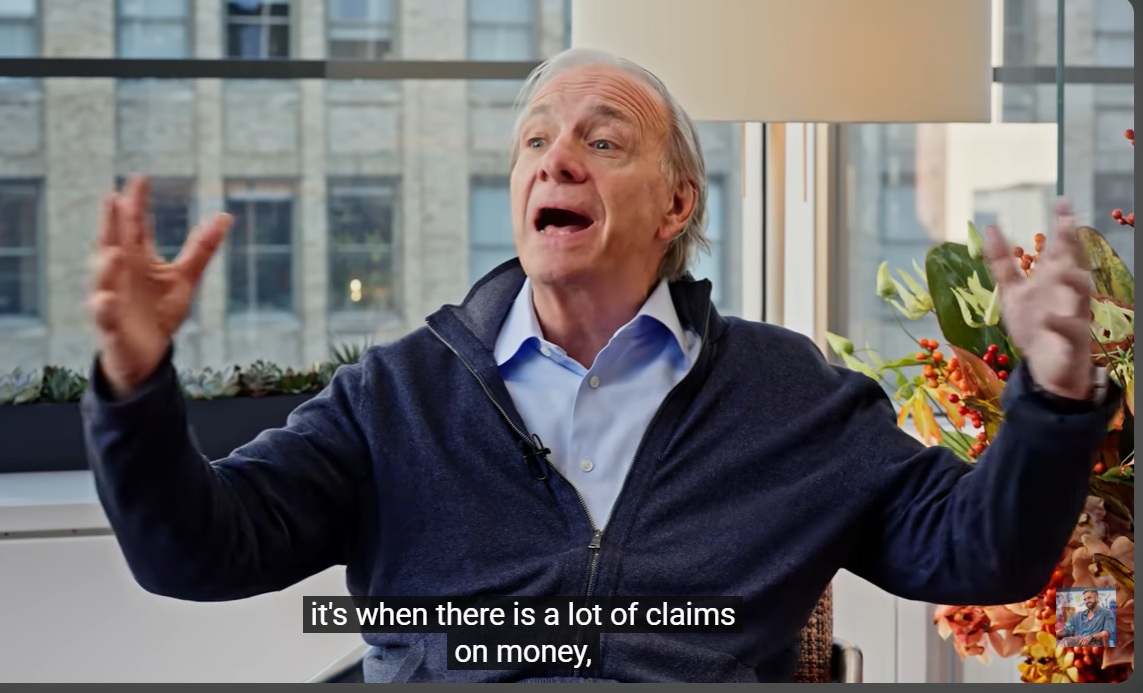
Through the conversation, Ray Dalio explains how money actually works, why asset bubbles form, and how investors should build portfolios that survive cycles, debt, and political change.
The conversation serves as a high-stakes roadmap for anyone seeking to master the psychological grit and mechanical "principles" required to dominate the next decade of global wealth creation. Key themes include:
1. Does the stock market have emotion?: Nikhil Kamath probes the psychological friction of trading by questioning if the market has a "personality," asking: “Do you think the stock market has emotion? Does it treat you a certain way?” Ray Dalio strips away the mysticism, defining the market as a cold machine that merely reflects the collective neuroses of its participants. “I think it's unemotional. We are emotional. And we certainly have emotions.” Dalio explains. To bridge the gap, he advocates for "algorithmizing" intuition: “Every time I'd make a decision, I would then think, why am I making that decision? And then I write down the criteria and see how it would have worked in the past.”
2. Learning by Playing the Game: Ray champions "visceral learning" over textbook theory, arguing that the only way to truly understand market mechanics is to feel the weight of a decision. He encourages aspirants to immerse themselves in the environment of professionals to accelerate their growth: "First, play the game if you have an opportunity to play the game... Find a game that you love and ideally one that makes money... that's a good path."
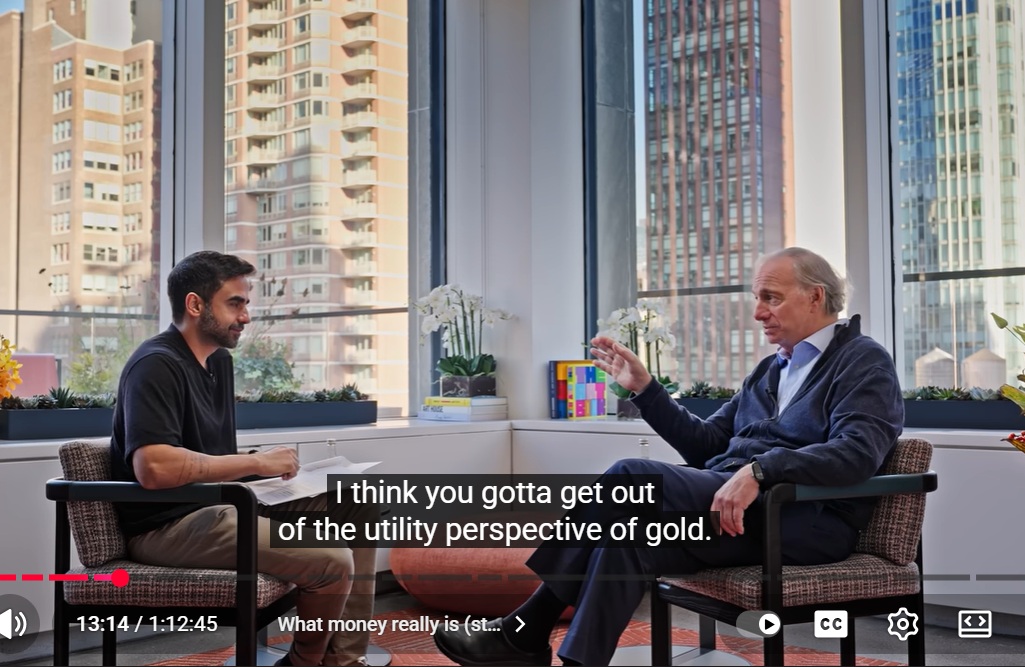
3. What is money, really?: Nikhil questions the foundation of modern currency, framing gold and crypto as essential hedges against a dollar-centric world: “I try and make it a habit to keep between 8 to 10% of whatever I have in gold. It’s done very well of late.” Ray Dalio views the shift toward gold and digital assets as a historical inevitability, labeling them both as “anti-dollar plays.” He warns that money lacks inherent utility, "if you're carrying around cash, there's not much utility", and cautions that everything that's money could be a risk: "If they could replicate gold, like they've been replicating diamonds, then that becomes a risk."
4. 4% Safe Money, GDP Myths, and Bonds: Nikhil challenges traditional definitions of "risk-free" assets, asking why treasury bonds remain anchored at 4% despite soaring national debt. Dalio deconstructs these metrics, dismissing GDP as a flawed benchmark: “GDP is a terrible measure to compare debt with. Think of it as like it's the country's revenue.” He explains that yields are driven by collective psychology and institutional habit: “Essentially at the 4% is that it won't be monetized and depreciated relative to gold.”
5. Bitcoin, Blockchain, and Crypto: As the conversation turns to crypto, Nikhil reflects on Bitcoin’s performance: “A Bitcoin is able to buy a lot more gold [than five years ago]. It has beaten gold significantly.” Ray Dalio places Bitcoin firmly within a macroeconomic framework, grouping it with gold as an “anti-dollar play.” He emphasizes continuity in wealth building, asserting that despite new narratives, “Equity valuation will always matter” and the basics of wealth creation will not change.
6. Should Real Estate Be Taxed?: Nikhil probes the potential for fiscal reform in India, questioning if property is currently undertaxed. Ray views real estate through a lens of extreme practicality: “Because the individual owner of real estate can't take it with them, it is a very practical asset to tax for the government.” He suggests aggressive property taxation could serve as a tool for social reform: “I think a lot of the benefits of corruption and the bad money... is in real estate, that might be a good way to bring it into the tax system.”
7. Strategic Advice for the Next Generation: Nikhil pushes for actionable advice for the 25-year-old aspirant looking to bridge the gap between economic frameworks and actual wealth. Dalio explains that success is a blend of passion and social immersion: "Find a game that you love and ideally one that makes money and then be around people who are pros at playing the game so you can chat about it."
8. Ray Dalio’s 5-Force Framework for the Global Future: Dalio shares his "5-Force Framework" to help investors navigate the current "perfect storm" of converging historical cycles:
9. The Archetype of a Successful Trader: Dalio identifies the winning archetype as a hybrid of a curious investigator and a disciplined engineer: "I think you have to be curious to understand mechanics... you have to learn the things that make the market go up or down." He warns that beginners often get "hooked" without real knowledge, asserting: "If you're just gambling and you don't understand the cause, you won't have an edge."
10. How Meditation and Karma Fuel Investment Success: Dalio identifies meditation as the single "biggest source of success" in his life, providing the equanimity to survive volatile markets: "It brings back a creativity, it brings back a flow." On karma, he takes a pragmatic view, framing it as a "law of nature" that creates high-trust environments: "By people mutually helping each other... [it] can make a life difference to them."
11. The New World Order and the Rise of India: Dalio argues the era of multilateral governance is over, replaced by raw "power struggles." He notes that India’s primary strength lies in its neutrality: "The winners of the wars lose... the losers of the wars get wiped out... and the neutral countries prosper from the wars." He views the technology war as the ultimate battlefield: "Whoever wins the technology war will win almost everything."
12. India’s Ascendance: The Next Economic Powerhouse: Dalio identifies India as a clear global outlier, ranking it as the country with the strongest projected growth rate for the next decade: "I think India over the next 10 years has all the ingredients to really be the strongest growth rate... India is at a wonderful arc in terms of its circumstances." He draws a direct parallel to modern-day India and the "opening up" era of 1980s China under Deng Xiaoping.
13. Ray Dalio’s Advice for the Young Indian Investor: When asked how to deploy a mere $100, Dalio pivots from financial assets to human capital: "First thing I would do is ask myself what do I need most to be most successful... as a young person invest in their own success to be able to learn. That's the best investment I can make."
14. Debt, Leverage & Financial Engineering: Dalio views leverage as a strategic tool, though he cautions that the global system is over-extended: "To me there's too much debt and we're producing it too much." He highlights that the U.S. wealth-to-money ratio is currently at an unstable level: "The wealth to money ratio right now... is about 8.5 to 1," a figure reminiscent of market peaks in 1929 and 2000.
Catch the full episode of 'WTF is Finance' featuring Ray Dalio on YouTube here: WTF Is Wealth? Ray Dalio Breaks It Down w/ Nikhil Kamath | WTF is Finance Ep 2
About the People by WTF podcast:
People by WTF is a compelling series where Nikhil Kamath engages in candid, thought-provoking conversations with trailblazers from diverse industries across the globe. From business and technology to sports, entertainment, and policy, each episode offers rare insights into the minds of those redefining success. Through deep dives into pivotal moments, hard-earned lessons, and bold perspectives, People by WTF challenges conventional thinking and inspires audiences to push boundaries. This podcast is your gateway to transformative ideas, whether you're a business leader, entrepreneur, or someone eager to refine your skill set. Past guests include Indian Prime Minister Narendra Modi, Bill Gates, Nandan Nilekani, Ranbir Kapoor, and Kumar Mangalam Birla.
