Equirus Wealth Report Based on Five-Year Study: 75–90% of women investors now hold through market corrections rather than exiting in panic

FinTech BizNews Service
Mumbai, March 5, 2026: Equirus Wealth, one of India's fastest-growing wealth management firms managing over Rs35,000 crore in assets among the country's top 10 non-bank wealth managers, has released a landmark report titled “Expanding Horizons: Changing Wealth Management Behaviours of Indian Women - Qualitative Analysis of Investor Evolution Across Age and Affluence.”
Beyond the Stereotype: A Multi-Dimensional Evolution
The report, draws on insights from interactions with approx. 55,000 women investors and more
than 100 relationship managers over a five-year period. It examines how investors across Mass
Affluent, HNI and UHNI| Family Office segments are evolving their approach to portfolio
construction, risk perception, advisor relationships and legacy planning.
It covers three age cohorts: Young (25–35), Mid-Career (36–50), and Senior (51+).
The study reveals women investors are increasingly moving away from episodic product purchases
such as fixed deposits, gold and property towards diversified, allocation-driven portfolios anchored
around long-term financial goals.
According to the report ,Artificial Intelligence may dominate global investment conversations, but
Indian women investors are adopting it cautiously — using it primarily as research and learning tool
rather than for autonomous investment decisions.
The findings also point to a structural shift in behaviour — from product-led investing to disciplined,
allocation-driven portfolio frameworks. What it reveals is not incremental progress—it is a structural
reinvention of how women engage with capital, mapping shifts in portfolio construction, risk
perception, macro awareness, advisor relationships, and legacy planning.
Commenting on the findings, Ankur Punj MD- Business Head, Equirus Wealth said: “Indian women
investors are becoming more informed, confident and strategic in shaping their financial futures.
Over the past five years we have seen a clear shift from buying individual financial products to
building structured portfolios anchored around asset allocation and long-term goals. Technology,
including AI, is beginning to play a role in the learning and research process — but disciplined
frameworks and human judgement continue to guide investment decisions.”
Key Findings from the Five-Year Study:
The Allocation Revolution:
Fixed Deposits have seen their share in portfolios drop from 45% to 20% over five years, while Equity
Mutual Funds have surged from 10% to 32%. Alternatives (PMS/AIF) have grown from a negligible
3% to 7%.
Five years ago, the dominant pattern among Indian women investors was familiar: fixed deposits,
gold, and property—the classic ‘safety-first’ portfolio. Today, the same cohort has migrated toward
allocation-led, goal-mapped portfolios that include equity mutual funds, structured debt products,
AIFs, PMS, and in some cases, global equities and private markets.
75–90% Hold through market corrections—‘wait and review’ dominates
55% Add capital selectively in market dips—conviction-led
↑ 80% Macro influence rated high (4–5/5) today vs.1–2/5 five years ago
75–100% Reference advisor but nowdemand explanation—not just trust
AI Is Emerging as a Learning Layer — Not a Decision Maker
While AI tools are entering the investment ecosystem, adoption among women investors remains
measured.
The study finds that 35–50% of women investors either do not use AI tools or use them selectively,
primarily for learning, monitoring and research insights. Importantly, final portfolio decisions
continue to rely on human judgement and advisor guidance rather than automated
recommendations.
This suggests that AI is emerging as an information and analytics layer within the investment process
rather than a substitute for human decision-making.
The Bucket Thinking Revolution:
The Bucket Thinking Revolution: Investors are increasingly adopting “bucket thinking” — organising
portfolios around life goals such as safety, growth, liquidity and legacy rather than individual
products — shifting the focus from “Which product should I buy?” to “What role should this asset
play in my portfolio?”, with portfolio discipline increasingly guided by allocation frameworks and
rules rather than market reactions
Stronger Behavioural Discipline During Market Cycles
Women investors are showing increasing maturity during market cycles.
Today, 75–90% of investors hold or review their investments during market corrections rather than
exiting in panic. At the same time, around 55% selectively add capital during market dips, reflecting
growing conviction and a longer-term approach to investing.
The Death of Product Push
The study finds a definitive shift toward "allocation-led" thinking. Investors are now segmenting
portfolios into "buckets" for safety, growth, goals, and legacy, rather than simply collecting financial
products.
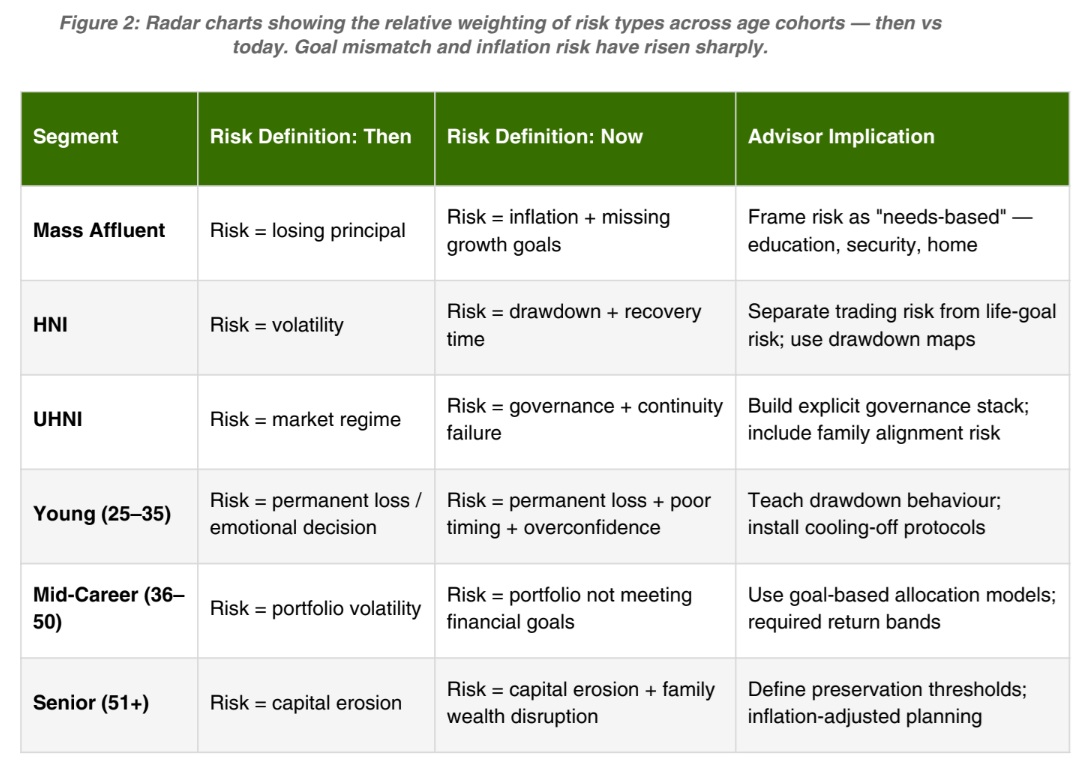
Risk Is Being Reimagined—Not Just Reduced
Women investors are also developing a more nuanced understanding of investment risk.
Five years ago, risk was largely interpreted as loss of principal. Today it increasingly includes inflation
erosion, failure to meet financial goals, portfolio drawdowns and recovery time, as well as
governance risks within family wealth structures.
This shift reflects growing financial awareness and investment sophistication across investor
segments.
Evolution of the Advisor Relationship
The study highlights a transformation in the advisor-client relationship.
Women investors increasingly evaluate advisors based on transparency, proactive strategy, financial
education and governance support, rather than simply product access. As a result, the advisor
relationship is evolving from product distribution toward strategic partnership in portfolio
construction and wealth governance.
Legacy Is No Longer an Afterthought
Intergenerational wealth transfer is emerging as a key priority with 75–90% of respondents actively
discussing legacy planning to ensure next-gen beneficiaries have the right behavioural guardrails.
Inheritance is increasingly viewed not just as a transfer of capital but as a transfer of financial
discipline and investment frameworks, ensuring that future generations are equipped to manage
wealth responsibly. Succession and intergenerational wealth transfer have moved to the forefront,
particularly among HNI and UHNI women investors who are taking active roles in family governance
and estate planning.
In conclusion What the Industry Must Do Now.
The report identifies three non-negotiable imperatives for wealth managers serving this evolving
cohort:
Build a portfolio “operating system”, not a product pitch. Start with a clear portfolio map
that defines the role of each asset bucket, expected drawdown ranges and a disciplined
review cadence
Shift the conversation from return maximisation to goal protection. Many women
investors increasingly define risk as goal failure, inflation erosion or poor decisions during
market stress
Translate macro events into clear portfolio actions. Investors are looking for simple
guidance — what has changed, what has not, and whether the right response is to
rebalance, hold or add
Bring stronger governance frameworks into wealth management. Particularly for HNI and
UHNI families, this includes clearer decision rights, Investment Policy Statements (IPS),
committee processes and reporting that separates signal from market noise
Build investor confidence through education and structure. Regular reviews, transparent
communication and small investment milestones help investors participate more actively in
portfolio decisions
Use digital and AI tools as an explainability layer. Technology is welcomed when it
improves understanding and monitoring, but investors continue to rely on human
judgement for final decisions
