Why Embedded SCF Will Redefine MSME Lending

FinTech BizNews Service
Mumbai, 18 May 2026: The Digital Fifth & FinessArt have come out with a special research report on the theme of Embedded Supply Chain Finance.
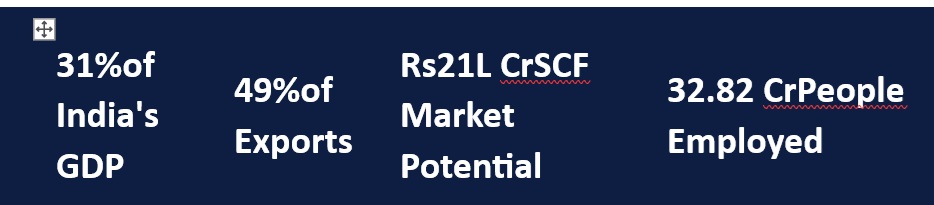
India's MSMEs contribute over 31% of the country's GDP, account for nearly 49% of exports, and support millions of businesses across manufacturing, trade, and distribution. Yet one challenge continues to persist: liquidity remains uneven, delayed, and structurally fragmented. Many MSMEs continue to face long receivable cycles, inventory lockups, fragmented approvals, and dependence on informal funding arrangements. The issue is no longer simply about whether credit exists. Increasingly, it is about whether liquidity can move with enough speed and precision to support real business activity.
| |||||||||||
From Standalone Lending to Embedded Liquidity Traditional lending models were designed around periodic assessments, static documentation, and enterprise-level financial evaluation. Even Supply Chain Finance, despite aligning credit more closely with trade activity, largely evolved around invoice stage financing and separate operating platforms. But supply chains today operate very differently. Commercial ecosystems have become deeply interconnected, digitally enabled, and significantly more transaction intensive. ERP systems, GST infrastructure, e-invoicing frameworks, distributor management platforms, payment rails, and operational workflows now generate continuous streams of real-time business data across procurement, manufacturing, inventory, distribution, and collections. Embedded Supply Chain Finance represents this transition. Rather than positioning credit as a separate financial journey, E-SCF integrates liquidity directly into the operational systems where trade activities happen. Purchase orders, invoice approvals, inventory movement, fulfilment activity, payment behaviour, and sales velocity become financing triggers — replacing traditional credit assessment models built around standalone loan applications, collateral strength, financial statements, and historical credit profiles.
| |||||||||||
Why the Market Opportunity Is Expanding Rapidly India's Supply Chain Finance market remains relatively underpenetrated compared to the overall size of MSME working-capital demand. However, that equation is changing quickly. The report estimates that the SCF market could scale to nearly ₹21 lakh crore over the next six years, supported by increasing formalisation, API-led infrastructure, transaction-level underwriting, and embedded finance adoption across enterprise ecosystems. This projected expansion is not simply the result of rising credit demand — it reflects a broader structural shift in how MSME financing is being delivered. | |||||||||||
| |||||||||||
Historically, formal SCF models remained concentrated around large anchors and Tier-1 suppliers. Deep-tier suppliers, distributors, dealers, and retailers often remained outside these frameworks due to fragmented data visibility, operational onboarding friction, and limited underwriting confidence. Embedded models change this dynamic by creating continuous operational visibility across all supply-chain participants. As integration depth improves, entirely new layers of MSME participants become financeable within formal systems.
Transaction Data Is Becoming the New Underwriting Layer One of the most significant shifts underway is the evolution of underwriting itself. Traditional MSME lending has historically depended on collateral strength, audited financials, and retrospective financial analysis. Embedded finance introduces a more dynamic framework where operational behaviour becomes a live indicator of credit quality. ERP activity, GST records, e-invoice data, procurement cycles, settlement patterns, inventory turnover, and sales velocity collectively create continuous visibility into how businesses actually operate. This allows lenders to move beyond static assessment models toward transaction-intelligent underwriting. | |||||||||||
| |||||||||||
|
The implications extend beyond underwriting efficiency alone. As risk visibility improves, embedded models also create the potential for lower operational costs, faster decisioning, scalable onboarding, and broader inclusion of thin-file MSMEs that previously struggled to access formal working capital.
Why Integration Depth Will Define Market Leaders
As Embedded SCF adoption accelerates, competitive advantage will increasingly depend on integration depth rather than the number of financing products launched. Shallow integrations may improve processing efficiency, but they rarely transform liquidity flows meaningfully.
The real structural advantage emerges when financing, payments, reconciliation, inventory systems, underwriting engines, and operational workflows operate as a connected ecosystem. In these environments, credit becomes embedded into day-to-day business execution rather than layered externally on top of it. This creates compounding benefits across the ecosystem:
| |
| |
| |
|
Over time, the market is likely to reward ecosystems that combine interoperability, operational visibility, and transaction intelligence at scale.
The Emergence of a New Financial Rail
India's digital public infrastructure has already transformed how identity, payments, and data move across the economy. GST systems, e-invoicing, Account Aggregators, API banking, and real-time payment rails have collectively created the foundations for a more connected financial ecosystem.
Embedded Supply Chain Finance is increasingly emerging as the next layer of this transformation. What digital payments achieved for transaction velocity, embedded finance now has the potential to achieve for working capital — making liquidity faster, more contextual, and more deeply aligned with real economic activity.
The future of MSME finance is unlikely to be defined by standalone portals, manual approvals, or disconnected lending journeys. It will increasingly be defined by ecosystems where trade flows, operational systems, and financial infrastructure work together seamlessly. And as that transition accelerates, Embedded Supply Chain Finance may well become one of the most important financial infrastructure shifts shaping India's next phase of economic growth.