India’s EMS Moment: From Assembly Lines to Global Value Chains
FinTech BizNews Service
Mumbai, July 31, 2026: Kotak Mutual Fund’s weekly blog focuses on Electronic Manufacturing Services (EMS).
The invisible engine behind every device
Pick up any smartphone, smartwatch, or smart TV today. While the brand is visible, the real story lies beneath the intricate ecosystem of suppliers, assemblers, and engineers that bring the product to life. This is the world of Electronic Manufacturing Services (EMS) a global industry quietly powering modern technology.
A decade ago, the story of Indian electronics was largely a story of consumption. India bought the world’s phones, laptops, televisions, routers, wearables and appliances — but much of the value was captured elsewhere. Today, that story is changing. Factory floors in Tamil Nadu, Karnataka, Uttar Pradesh, Telangana and Andhra Pradesh are becoming part of a much larger global reordering: the search for a second, third and fourth manufacturing node beyond China.
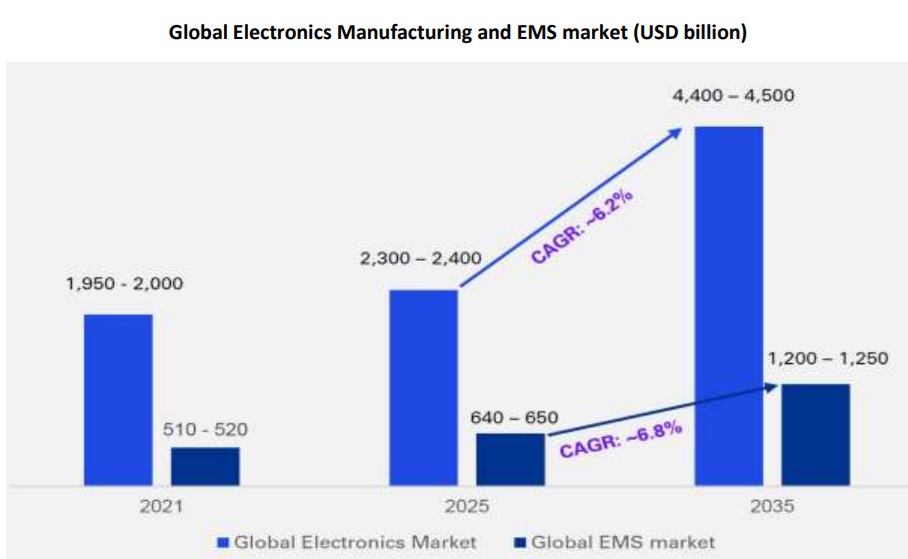
This is where India’s Electronic Manufacturing Services, or EMS, industry enters the frame. EMS companies are the invisible force behind the devices we use every day. They assemble circuit boards, integrate systems, test Products, manage supply chains and, at the more advanced end, help design and engineer products for original equipment manufacturers (OEM). Globally, this is not a niche industry. Global EMS market is estimated at about USD640–650 billion in 2025, with a path to over USD1 trillion by the early 2030s, implying roughly 6.5–7% CAGR.
The Next Chapter in Global Electronics Manufacturing
For three decades, electronics manufacturing followed a simple logic: concentrate production where scale, supplier density and cost efficiency were strongest. China emerged as the hub of the global electronics manufacturing ecosystem, accounting for an estimated 25–30% of worldwide electronics production in the early 2020s.
That model is now being modified, not abandoned. Geopolitical tensions, semiconductor export controls, pandemic-era disruptions and the need for resilient supply chains have made global OEMs rethink overdependence on one geography. EMS companies are no longer just contract manufacturers; they are increasingly strategic partners helping OEMs build geographically diversified production networks.
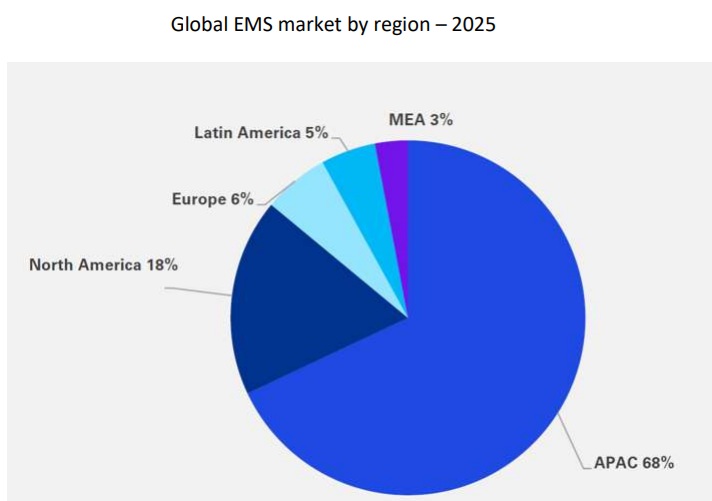
Asia remains the centre of gravity. Asia-Pacific accounts for 68% of the global EMS market, ahead of North America at 18%, Europe at 6%, Latin America at 5% and Middle East and Africa at 3%. But within Asia, the China+1 shift has created space for countries such as India, Vietnam, Malaysia and Thailand, each competing for a different slice of the electronics value chain.
India’s differentiator is the combination of domestic demand, policy support, talent depth and geopolitical relevance. India's share of global electronics exports increased from 0.6% in 2021 to 1.1% in 2024. During the same period, India's electronics exports grew at a CAGR of 28.7%, significantly outpacing China (0.2%), Vietnam (2.9%), Malaysia (5.7%), Mexico (7.5%) and Thailand (8.4%).
India has moved from promise to production India has long been seen as having immense potential in electronics manufacturing, owing to its vast population, low labor costs, and rising domestic demand making it an appealing destination for global firms that are diversifying away from China. India’s EMS market expanded from USD10–12 billion in FY20 to USD40–45 billion in FY25, driven by domestic demand, exports and outsourcing, while total electronics production crossed USD130 billion. India’s EMS market is expected to cross about USD150 billion by FY30, implying growth of more than 25% CAGR. Electronics manufacturing has created 25 lakh jobs over the last 10 years and attracted more than USD4 billion of FDI since FY2020–21.
The most visible symbol of this shift is the mobile phone. India is now the world’s second-largest mobile phone manufacturer, mobile phone production rising from Rs18,000 crore in 2014– 15 to Rs6.27 lakh crore in 2025–26. Mobile phone exports rose 165 times, from Rs1,566 crore in 2014–15 to Rs2.6 lakh crore in 2024–25 Growth drives for Indian EMS Market 1. Rising electronic content 2. Government incentive and regulatory push 3. Make in India 4. China +1 strategy 5. Exports the next frontiers 6. Expanding design and R&D capabilities.
From Incentives to Innovation:
The Next Phase of India’s Electronics Manufacturing India’s EMS rise did not happen by accident. The Production Linked Incentive (PLI)scheme phased manufacturing programmes, electronics clusters, semiconductor incentives and component schemes gave manufacturers a reason to invest. PLI scheme for large-scale electronics manufacturing provided 4–6% of incremental production value over five years, helping bridge India’s cost gap with China and Vietnam despite ecosystem weaknesses. The policy architecture has become broader over time. A series of interventions, including the Electronics Manufacturing Clusters scheme, EMC 2.0, large-scale electronics PLI, SPECS, semiconductor and display manufacturing programmes, IT hardware PLI 2.0 and the Electronics Component Manufacturing Scheme, with a combined outlay of about USD19.5 billion.
More recent government data shows PLI is now moving from announcement to disbursement. As of 31 December 2025, PLI schemes across 14 sectors had attracted more than Rs2.16 lakh crore in cumulative investments, generated over Rs20.41 lakh crore of production/sales, supported exports of more than Rs8.3 lakh crore, and created more than 14.39 lakh direct and indirect jobs. Within electronics and IT hardware, around Rs15,554 crore of incentives had been disbursed, and 59 companies reported about Rs2,45,375 crore of incremental production in the financial year up to December 2025.
Yet the next phase cannot rely only on incentives. Incentives can create capacity, but they cannot by themselves create competitiveness; the next phase of policy must reward value addition, certification depth and design integration rather than incremental revenue alone.
Semiconductor: The Next Star of India’s Electronics Manufacturing
Semiconductors are the backbone of modern electronics, powering smartphones, computers, automobiles, telecom, defence systems, and artificial intelligence. As economies become more digital and automated, chips have become critical for economic resilience and strategic security. The global chip shortage during the Covid-19 pandemic highlighted their importance, disrupting production across industries. Going forward, demand is expected to grow rapidly, driven by digitalisation, cloud computing, connected devices, and AI. The rise of artificial intelligence and machine learning is accelerating the need for high-performance, energy-efficient processors, making semiconductors one of the most important growth drivers of the global electronics industry and a significant opportunity for India.
The Missing Piece in India’s Electronics Story: Components The biggest challenge is not whether India can assemble more electronics. It can. The harder question is: how much of the value stays in India? India’s dependence on imported components across semiconductors, displays, PCBs, passives, camera modules and lithium-ion cells. Its component dependency table estimates import dependence at around 95% for semiconductors and Integrated Circuit (ICs), 85–90% for OLED/LCD displays, 85–90% for Printed Circuit Boards (PCBs), 80–85% for passive components, 85–90% for camera modules and sensors, and over 95% for lithium-ion cells.
This matters because imported components raise working capital needs, extend lead times and expose manufacturers to currency, freight and duty volatility. long import lead times of 4–8 weeks from China/Taiwan require higher inventory buffers, while imported component content of 60–90% of bill of materials in many segments limits domestic value addition and margin retention. If India wants to graduate from assembly hub to electronics powerhouse, components are the battlefield.
Cheap Labour Is an Advantage. Precision Is the Differentiator. India has an obvious labour-cost advantage. Average manufacturing wages at USD200–250 per month in India versus USD1,000–1,200 in China, USD600–650 in Mexico and USD250–300 in Vietnam. India’s labour productivity is only “moderate,” its automation maturity is “low-moderate,” and EMS technician maturity remains low-to-moderate despite strong engineering depth. That distinction is crucial.
Electronics manufacturing is not garment stitching. In high-reliability products — automotive electronics, aerospace systems, medical devices, industrial controls — quality, yields, traceability and certifications matter as much as cost. Certification is another moat. Standards such as IATF 16949 for automotive, AS9100D/NADCAP for aerospace and defence, ISO 13485 for medical devices and IPC Class III for high-reliability electronics can require three to seven years of sustained investment per facility before meaningful customer qualification. It also notes India had 7,777 IATF-certified sites, less than 8% of the global base, compared with China’s estimated 62,000+ sites, or over 55%. In EMS, qualification time is not a delay. It is a competitive advantage.
India’s EMS at strategic crossroads:
Assembly, integration, or global leadership India’s EMS future through three scenarios. In the first, India remains an assembly hub, reaching USD100–120 billion EMS market size by 2035 but continuing to depend heavily on imported components. In the second, India becomes an integrated manufacturing node, reaching USD140–200 billion by developing stronger component manufacturing, semiconductor packaging/testing and supplier ecosystems. In the third, India becomes a global electronics hub, reaching USD200–250 billion by building capabilities across semiconductors, components, advanced manufacturing and product engineering.
The difference between these futures is not simply money,it is coordination. Building a strong component ecosystem, developing world-class electronics clusters, creating shared design infrastructure, modernising shopfloor curricula, strengthening engineering capabilities within EMS firms, and fostering early design localisation partnerships with global OEMs will be critical to achieving this vision.
That is the heart of India’s EMS moment. The country has already proved it can scale assembly. It has proved it can attract global OEMs. It has proved electronics can become a serious export engine. The next task is harder: to convert scale into stickiness, policy-led momentum into self-sustaining competitiveness, and assembly into value-added manufacturing. Source: KPMG Report -India’s manufacturing electronic services (EMS) opportunity July 2026
Conclusion:
India’s EMS story is entering its decisive chapter
India’s electronics manufacturing journey is no longer a “future opportunity” slide in an investor presentation. It is visible in export data, factory investments, mobile phone shipments, PLI disbursements and supplier conversations. The industry has moved from question mark to contender. But the next leap will require patience. EMS leadership is built through clusters, components, process discipline, certification depth, design relationships and supply-chain intelligence. These capabilities do not arrive in one PLI cycle. They compound over years. The good news is that India has the ingredients: a large domestic market, global OEM interest, policy support, engineering talent and geopolitical tailwinds. The open question is whether it can build the missing middle — the component suppliers, specialised technicians, testing labs, design capabilities and logistics reliability that turn a low-cost assembly base into a high-value manufacturing ecosystem. If it can, India’s EMS industry will not merely assemble the world’s electronics. It will help design, build and power the next generation of global technology supply chains.
Saumil Mehta, Senior Vice President, Equity Research Analyst, adds - as the global electronics supply chain undergoes a structural realignment, Electronics Manufacturing Services (EMS) providers are emerging as critical beneficiaries. Rising geopolitical diversification, increasing outsourcing by global brands, and government-led incentives such as India's PLI schemes are accelerating manufacturing shifts beyond China. EMS companies are evolving from simple assemblers to integrated manufacturing partners, offering design, sourcing, and supply-chain management capabilities. As product complexity rises across smartphones, wearables, automotive electronics, and industrial equipment, EMS players are poised to capture a growing share of global manufacturing value creation.
