Muted Quarter Expected For Large IT Companies
Pricing pressure, AI-led deflation and the inability of incumbents to sustain growth beyond mid-single digits limit upside potential.
FinTech BizNews Service
Mumbai, 03 October, 2026: The latest Kotak Institutional Equities' special research report focuses on IT Services:
2QFY27 preview—status quo
Demand conditions have neither improved nor deteriorated since the June 2026 quarter. Expect another muted quarter for large companies, with HCLT being the notable exception. TechM will lead growth among hybrids, while mid-tier companies will report strong growth led by PSYS, Coforge and MPHL. Expect stable margins, though the underlying stress is becoming increasingly visible in operating metrics. We expect a guidance cut from Infosys and an unchanged midpoint for HCLT's growth outlook. AI deflation is now becoming visible in the base business. Challengers continue to offset this through share gains and stronger execution, while incumbents are largely defending existing revenues. Our preferred picks remain TechM, Coforge, Sagility and Indegene.
Expect a muted quarter for large companies; better for mid-tier
We expect muted growth for tier 1 IT companies in a seasonally strong quarter. AI deflation and, to a lesser extent, weaker macro will contribute to weak growth. Among tier 1 IT companies, HCLT will lead with organic qoq growth of 2% (2.4% yoy), while Infosys (1.1% qoq organic, 0.2% yoy) and TCS (0.5% qoq organic, 2.8% yoy) will lag. Among hybrids, TechM will likely report strong growth at 1.6% qoq and 6.6% yoy, while LTM will lag at 1.0% qoq and a decelerating 5% yoy. Mid-tiers will outperform once again with an accelerating growth rate for PSYS (+7% qoq, led by mega-deal ramp), Coforge (+4.5% qoq) and MPHL (3.5%). ERD companies will report lackluster growth, while Sagility leads among BPO peers.
Margins—steady for now, pressure points building
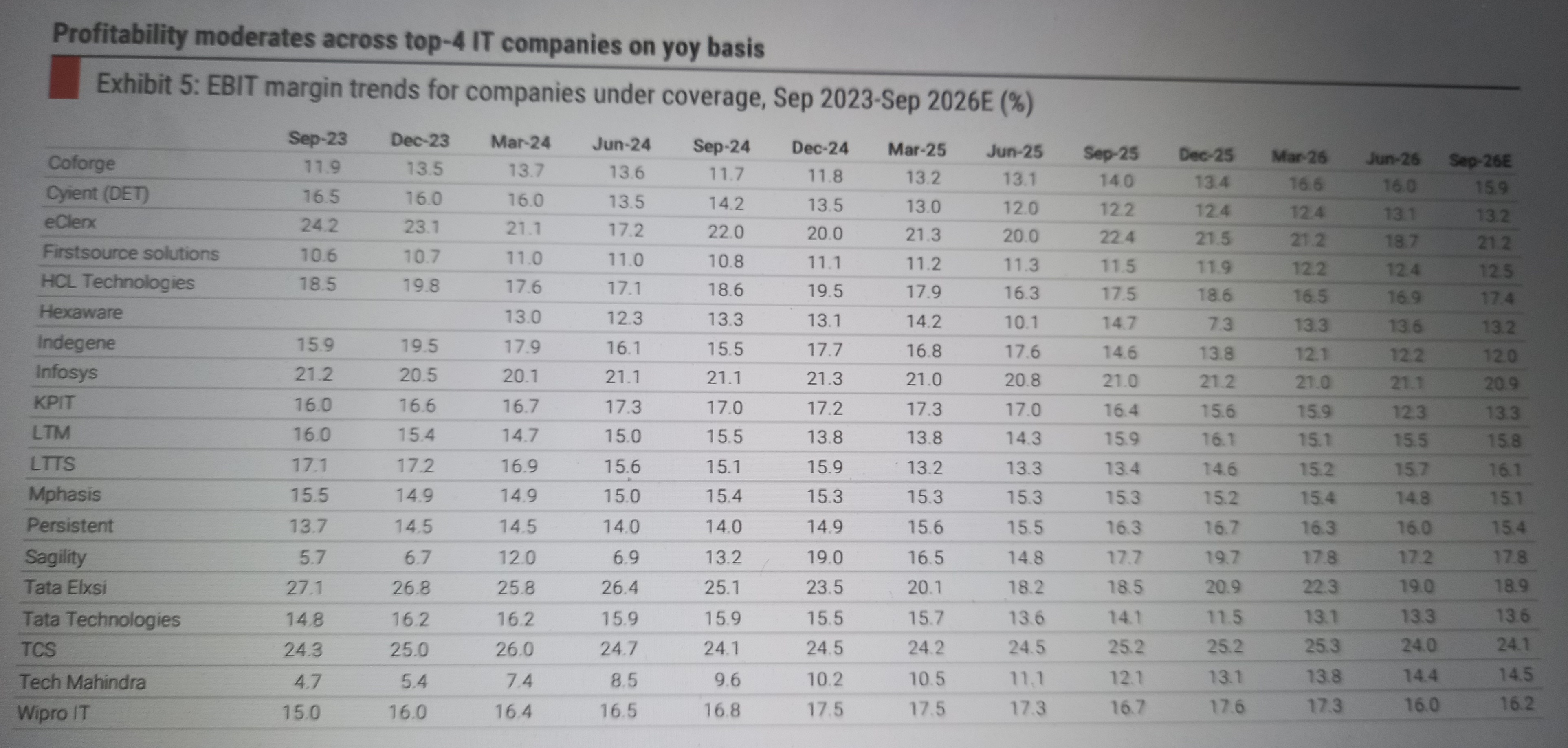
Margins depend on wage revision cycles, which have been inconsistent across companies. For all large companies, we expect a marginal decline to stable margins on yoy comparison. Margins have held steady due to rupee depreciation, which has offset pricing pressure. We expect stable to improving margins for mid-tier companies. For the quarter, the rupee has depreciated by 0.8% qoq and 8.4% yoy. The translation of rupee depreciation into net profit may not be immediate for many companies due to cash-flow hedging—TechM, LTM, Coforge and Hexaware are likely to report meaningful forex losses.
Guidance cut for Infosys, unchanged at mid-point for HCLT, weak for Wipro
We expect Infosys to cut guidance to 1.5-2.5% growth, down from 1.5-3%; this includes 170 bps contribution from acquisitions. Weak macro and AI deflation will play its part. We expect HCLT’s organic growth guidance to move to 2-3% from 1-4% earlier. After the consolidation of the HPE telco business and Jaspersoft acquisition, we expect HCLT’s overall revenue growth guidance at 3-4%. Expect (-)2% to 0% revenue growth guidance from Wipro.
Valuations: Downside protected, upside capped by growth
We, in our recent downgrade note, argued that the sector has largely moved beyond the terminal-value debate. AI is increasingly viewed as changing the economics of services rather than eliminating the need for services altogether. This places a floor for valuations. However, pricing pressure, AI-led deflation and the inability of incumbents to sustain growth beyond mid-single digits limit upside potential. Challengers are better positioned than incumbents. We continue to prefer companies demonstrating consistent share gains, superior execution and stronger deal conversion. TechM, Coforge, Indegene and Sagility are our key picks. PSYS’ valuations are coming down to more palatable levels. �
Furloughs could be similar or higher than usual
The December quarter is typically characterized by furloughs. While it is too early to comment with certainty, clients continue to face elevated cost pressures amid a weak macro environment and hardware-driven inflation. In such an environment, furloughs remain a useful lever for cost optimization. We expect furloughs to be similar to, or potentially higher than, usual levels this year.
Pricing pressure and high competitive intensity are the biggest sector risks
Competitive intensity remains elevated. Vendor-consolidation opportunities are plentiful, but competition is fierce and pricing is aggressive. AI-led revenue opportunities continue to grow, but remain insufficient to fully offset deflation in the existing book.
The industry benefited for much of the past decade from execution gaps among large vendors. TCS was absent from several mega-deals, Cognizant went through a prolonged recovery, Tech Mahindra suffered a self-inflicted decline and Wipro faced persistent execution challenges. Stronger players were able to gain share without facing equally capable competition.
That backdrop has changed. Execution levels across most large vendors have improved, and the competitive gap has narrowed. At the same time, the deal market has not expanded enough to support everyone's growth ambitions. The IT services pie is still growing, but the AI-adjusted pricing pool available to vendors is shrinking. Clients are embedding productivity concessions into renewals and capturing a larger share of AI-driven savings.
Deal wins increasingly protect relevance rather than guarantee growth. Earlier winners gained because competitors were weak. FY2027E is shaping up differently, with most competitors operationally stable and global peers growing faster. Pricing pressure remains the key risk. Currency has delayed the impact on margins, but another round of aggressive bidding and old-book repricing could make the pressure increasingly visible.
Repricing of book in focus and often misunderstood
The Street often assumes repricing is a one-time event across the entire book. The reality is more nuanced. Much of the T&M book has already been repricing over the past year, as code assistants and agents improved developer productivity. Repricing is continuous rather than episodic. The challenge is that enterprise adoption lags frontier-model capabilities, meaning contracts are often being repriced to yesterday's productivity assumptions while model capabilities continue to improve.
Fixed-price work has different dynamics. AMS faces the highest repricing pressure because renewals are more frequent and clients can quickly capture AI-led savings. IMS is different. The business was already heavily automated in the previous cycle, with pricing tied more to tickets, devices and consumption than headcount. As a result, incremental GenAI-driven deflation is lower and repricing is more gradual.
The point to note is that repricing is dynamic. To take CTSH’s view out of context and assume that the bulk of the book is repriced is incorrect. So is the opposite assumption, that every tool and model improvement permanently erodes the opportunity. The point to note is as follows: (1) the repricing of book is dynamic and still in early stages and (2) the offset will accrue as AI for business and new use cases pick up. Our current assumption is of 50% reinvestment with new business use cases eventually offsetting the deflation.
FX losses to create divergence in net profit growth
Reported earnings will diverge sharply from operating performance due to hedge positions. Companies such as Tech Mahindra, Coforge, Hexaware, LTM and others are likely to report meaningful forex losses once again. Mphasis recognizes hedge impacts in revenues, creating a different accounting outcome versus peers. Investors will need to look beyond net profit growth to assess underlying operating trends.
Deal momentum is uneven
Deal activity remains healthy at the sector level, but outcomes vary materially by company. HCLT, Persistent, Coforge and TCS should report strong deal TCV. Infosys, LTM and Wipro will likely report muted deal TCVs. Large-deal conversion into revenues remains a differentiating factor between leaders and laggards.
Key factors to watch for
4 | Enterprise AI adoption. Companies’ investments in AI initiatives are still in early stages. A few companies have implemented AI across the organization. The focus of the majority of enterprises remains on cost optimization and realizing productivity savings in the near term to partly fund these investments. New revenue use cases are not yet significant for companies. In the past few months, there has been a significant increase in the adoption of open-source and open-weight models. While open LLMs can provide an incremental opportunity for services providers, they could also risk steeper deflation as the adoption rises. We expect gross deflation of ~7% and net deflation of 3.5% for companies. |
4 | Large deals. Enterprises are likely to factor in significant productivity improvements as part of larger programs, extrapolating the current pace of improvement in model capabilities. In a few cases, the productivity is also upfronted. Renewals would come with significant pricing pressures. |
4 | Capital allocation. M&A intensity has increased across several companies. Companies would need to adopt the inorganic route to accelerate transformation and bridge white spaces. However, any revision to the pay-out ratios is unlikely to be viewed constructively. |
4 | AI services revenues. The definition of AI services is not consistent across companies. AI services contribute to 4.7-8.8% of revenues across tier-1 IT companies. Growth rates would be an indicator of participation in new value pools by companies. |
ERD—challenging backdrop in auto
Auto-related engineering spending remains weak. Competitive pressures from Chinese OEMs, weak demand and ongoing cost rationalization continue to weigh on R&D budgets. KPIT is likely to report a weak quarter, while Cyient (DET) is likely to report modest organic growth. TTL, TELX and LTTS would report 1.2-2% qoq growth. TTL services growth would be stronger at 3.4% c/c qoq. While auto demand remains weak with poor near-term visibility of investments in new platform development programs, other verticals should remain steady. Aerospace has remained stable for the past several quarters and has grown well across companies. The upcycle is also underway in plant engineering as part of sustainability initiatives across energy and industrial industries, which would drive growth for LTTS.
BPO services—steady trends; Sagility likely to outperform peers on growth
Indian BPO companies are likely to report a decent quarter. ECLX and FSOL are likely to report moderate, sub-1% growth qoq. Sagility would report organic growth of 1.8% c/c qoq, led by healthy demand across large clients and resilient performance in mid-market accounts. On a yoy basis, organic growth should moderate across companies, while Sagility is likely to lead, sustaining double-digit growth. We expect the company to raise revenue growth guidance to 13%+ for FY2027E and adj. EBITDA margin to 24.5-25%. FSOL is likely to revise revenue growth to 10-11.5% (including 200 bps inorganic contribution) from 10-13% for FY2027E.
Demand patterns remain largely stable across companies, with healthcare payers continuing to outsource spends to mitigate MLR pressures. Commentaries by large nationwide health insurers suggest increased competition in the upcoming annual enrollment period (AEP) to enroll new quality members. In the current year, Medicare Advantage programs are likely to add members on a net basis compared to a decline in the last year.
Discussion on individual companies
4 | TCS. We forecast modest 0.5% revenue growth, driven by the international business. We do not factor in any revenue contribution from the new BSNL contract. We forecast a 100 bps yoy margin decline yoy and stable qoq margins. The yoy decline reflects wage revisions, the impact of acquisitions, and ongoing pricing pressure. EBIT margins typically expand in the quarter following annual wage hikes, supporting sequential stability. We expect TCV of US$10-11 bn, growth of ~5% yoy, thanks to the Porsche mega-deal. We expect investor focus on: (1) TCS's ability to defend margins amid pricing pressure and incremental investment requirements, (2) the extent of productivity concessions being demanded in contract renewals, (3) the proportion of the portfolio that has been repriced for AI, (4) profitability of recently signed mega-deals, (5) the impact of GCC ramp-ups both as a competitive threat and a growth opportunity, (6) progress on planned data center investments and (7) the revenue contribution from the BSNL contract. |
4 | Infosys. We forecast organic c/c revenue growth of 1.1%. About 50 bps of growth is due to the reversal of a headwind seen in the previous quarter. Underlying organic growth remains modest, reflecting AI-led deflation and a weak demand environment. The Optimum Healthcare acquisition will contribute ~50 bps through a full-quarter consolidation. We expect stable margins. There are several moving parts, with a ~50 bps headwind from the swing in provision for post-sales client support offset by the absence of the ~50 bps revenue reversal headwind seen in the previous quarter. Benefits from rupee depreciation are likely to be offset by weaker revenue growth. We expect a large deal TCV of US$3 bn, stable on yoy comparison. We expect Infosys to cut FY2027E revenue growth guidance to 1.5-2.5%. The revised guidance implies -0.7-0.6% CQGR in 3QFY27-4QFY27E. In addition to the usual seasonal weakness in 4Q, Infosys also has to contend with the ramp-down of a large automotive client. We expect investor focus on (1) the reason for revenue growth underperformance in FY2027E, (2) retention/ renewal of mega-deals won in the last few years, (3) the split of growth impact between macro weakness and AI-led deflation, (4) the pace of conversion of GenAI programs from pilots to scaled deployments and whether these represent net-new revenue or deflation of existing work and (5) levers to defend margins amid elevated pricing pressure. |
4 | HCL Tech. We forecast organic c/c revenue growth of 2% qoq, led by the ramp-up of Guardian Life deal and seasonal strength. The acquisition of HPE's Telco Solutions business and Jaspersoft will contribute 110 bps to revenues. We expect stable EBIT margin despite rupee depreciation. Benefits from rupee depreciation will be offset by margin dilution from acquisitions. Expect a strong deal TCV of US$3.75 bn, driven by EUR1 bn mega deal and a large deal from Guardian Life. We expect HCLT to increase revenue growth guidance to 3-4% from 1-4% earlier. The revised guidance includes 100 bps from the Jaspersoft and HPE Telco Solutions business acquisitions. Organic c/c revenue growth guidance will be 2-3%, or 2.5% at the midpoint, broadly unchanged from the earlier guidance. The hurdle rate to achieve the lower end and upper end of guidance stands at 2.5-3.8% during 3QFY27-4QFY27E. We expect HCLT to retain 17.5-18.5% EBIT margin guidance band though margins could be toward the lower end. We expect investor focus on (1) margins in newly signed large deals, (2) AI-led deflation in the existing book and growth from AI-native services, (3) pricing pressure in the core business and its impact on margins, (4) factors driving consistent success in mega-deal wins, (5) drivers of growth acceleration, (6) progress on AI data center investments and customer commitments, (7) revenue contribution and profitability of the Guardian Life deal and (8) discretionary spending trends in telecom, manufacturing and ER&D. |
4 | Wipro. We forecast a revenue decline of 1% qoq. Our estimates include ~80 bps contribution from the AlphaNet acquisition and full quarter consolidation of the Mindsprint acquisition. On an organic basis, we expect a revenue decline of 1.8% due to weak macro, pricing pressure and share loss. We expect yoy decline in margins due to weak growth and upfront costs in lower-margin deals. Margins should be stable qoq. We expect revenue guidance of -2 to 0% growth. Continued weakness in the external environment and AI deflation will feed into weak guidance. The December quarter is also seasonally weak. We expect investor focus on (1) AI strategy and the measures taken to offset AI deflation on the overall business (2) pricing pressure in renewal deals, (3) timelines for catch-up of growth with peers, (4) GCC growth strategy and (5) integration plans and synergies from recent acquisitions. |
4 | TechM. We forecast 1.6% qoq growth driven by (1) the contribution from the Orange deal and (2) the ramp-up of strong deal wins of the earlier quarter. This will be partly offset by a decline in Pininfarina revenues after a large program was delivered in 1Q. We expect steady EBIT margins, as the benefit of rupee depreciation and efficiencies is offset by an 80 bps headwind from wage revision. We expect a forex loss of US$25 mn for the quarter. We forecast net new deal wins around US$0.9 bn, lower than the preceding three quarters but a healthy 10% growth on yoy comparison. We expect investor focus on (1) the path chosen by the company—does it expand margins further or reinvest to accelerate revenue growth; (2) longer-term growth direction of the telecom vertical after a revival in FY2027E, courtesy two large deal ramp-ups; (3) mindshare in AI seems lower than peers; measures taken to fix the narrative; and (4) magnitude of pricing pressure in renewal deals and productivity ask of clients. |