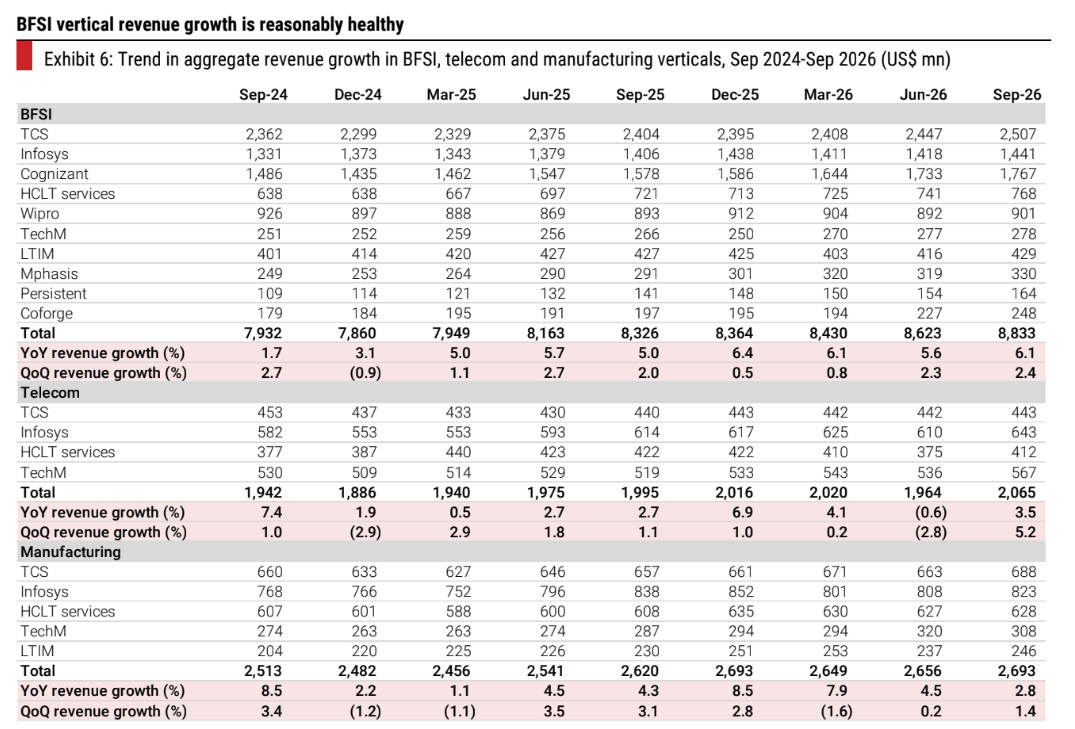
BFSI leads other verticals on yoy growth at 6.1%
FinTech BizNews Service
Mumbai, 15 November, 2026: The latest Kotak Institutional Equities report on IT Services provide important info on AI revenue trends of the relevant companies:
2QFY27 review—from relevance to sustainable growth
2QFY27 results were middling, barring a few exceptions. Demand remains subdued, although deal activity has improved and selective hiring has resumed. Despite middling results, stocks have done well as the sector discussion has shifted from the relevance of the model to revenue stabilization and now to sustainable growth, helped by Accenture’s medium-term outlook. Valuations have adjusted accordingly; further upside for incumbents requires growth delivery. We prefer challengers and hybrids that can grow through share gains.
Middling results; some improvement in deal activity
Results for Tier 1 IT companies were middling, with yoy organic revenue growth rate down to low-single-digit levels. Mid-tier companies performed relatively better, although headline numbers missed in some cases. TechM was the real standout in the quarter. There were a few bright spots in the quarter: (1) financial services demand was strong; (2) hiring picked up in a few cases, a natural outcome of high utilization rates or a lack of bench; and (3) deal wins were strong across companies with the exception of TCS and Wipro.
Margins held on well for now
Despite elevated competitive activity, margins held on reasonably well across most companies and even surprised us positively despite (1) new contracts dominated by price-sensitive cost take-out services and (2) the need for investments in AI capabilities. Margins are an important source for valuation sustainability for the sector and will be tested in the next 2-3 quarters.
AI deflation is getting acknowledged
Companies are becoming more realistic about AI-led deflation and the need to create new revenue pools to offset it. CTSH indicated that more than 50% of its fixed-price portfolio has already gone through an AI-led deflation cycle, while TCS, HCLT and Infosys are reporting growing AI revenues. Companies acknowledge deflation with the discussion to whether new work can offset it. We remain cautious: Improving model capabilities can increase deflation even as new use cases expand the addressable market.
Valuations reflect a less adverse growth outcome
The rally partly reflects a reversal of the anti-AI trade, but there has been a more fundamental change. Concerns around the terminal value of IT services have eased as FDE-led organization set up by frontier model labs reinforce the need for services in enterprise AI adoption. The focus subsequently moved to whether revenues can stabilize and, more recently, to the level of sustainable growth. Accenture’s medium-term outlook provides some comfort on core growth despite AI deflation. Valuations have moved to reflect the reduced downside risk. Further upside will require stronger growth.
Prefer challengers where earnings growth can drive returns
We retain our preference for challengers and hybrids over incumbents. Large-caps have benefited as concerns around terminal value have receded, but returns from here are increasingly dependent on earnings growth rather than another change in multiples. Challengers have more avenues to grow through wallet-share gains, new clients and expansion into new markets.
Services firms are better off with further progress in AI capabilities in the current direction
The AI-trade in the last several months has pitted AI beneficiaries against services (and software) firms. We do not agree with the implicit zero-sum assumption. We believe that prospects for services firms get better with higher progress in AI capabilities in the current direction. A slowdown in data center construction and funding environment for AI labs can slowdown the progress in AI capabilities. We acknowledge that this can lower the pace of progress in automating software engineering tasks, driving down the pace of AI-led deflation in services and help services firms hold on to base business longer.
We do not believe this is the best-case scenario for services. A slowdown in the improvement in AI capabilities will reduce the proliferation of new use cases, reducing new demand opportunities. Progress in capabilities in the last few months has been higher in non-software engineering areas such as math, biology, robotics and physics. Efforts are also on to increase capabilities in professional workflows such as in finance, legal, healthcare and engineering. Such progress can result in new AI adoption use cases requiring implementation and managed services effort from services firms. Unobstructed progress in AI capabilities will increase deflation in base business but as new use cases expand, they will eventually offset and can even exceed deflation impact, in our view.
On the contrary, services firms will have higher downside if AI labs aggressively invest to further improve AI capabilities in tasks done by services firms, rather than focusing on other areas. This is not the case currently.
AI revenue is growing at a breakneck pace; difficult to assess if it can drive overall growth acceleration
AI revenue trends for TCS, HCLT, Infosys and LTM are growing at a very strong pace on a meaningfully large base. AI revenue grew in the 10.7-29.5% range qoq, while it grew in the 40-101.8% range yoy. Growth accelerated in 2QFY27 despite an increasing base for TCS and HCLT, while we do not have the trend for Infosys and LTM due to limited disclosures. Accelerating revenue growth is a positive and coincides with increasing scaled AI adoption among enterprises.
However, accelerating AI revenue growth on an increasing base has not increased overall revenue growth outlook for these companies. Additionally, the non-AI revenue is declining more, with 3% and 0.5% yoy decline for TCS and HCLT. Revenue growth comparison points to a few interesting elements as well. Last three-quarter AI revenue CQGR is the highest for Infosys, whereas it will underperform the rest on overall revenue growth in FY2027. On a yoy basis, HCLT’s and TCS’ AI revenues are growing at a much higher pace than LTM, despite LTM growing faster on overall revenue basis. While TCS’ AI revenue is growing the fastest yoy (not including Infosys in the comparison due to a lack of data), its non-AI revenue is also declining the fastest.
Further re-rating requires evidence of growth acceleration
IT stocks have done well since the start of the result season in 2QFY27, partly due to higher comfort on current levels of growth sustaining and partly as a consequence of souring of the AI-trade and the perception that services firms will be beneficiaries as a result. Re-rating from current levels will be a function of revenue growth acceleration which can be a function of three factors:
4 | Slowdown in pace of AI-deflation on net basis. Commentary on AI-deflation in the base business was steady in the quarter, providing greater comfort to investors despite accelerated release of AI models in the past six months. Models have gotten more capable at software engineering tasks and agentic work but that has not led to greater deflation, according to management commentary. Investors are starting to anticipate the peak of deflation. AI scale-up is providing new opportunities in legacy modernization, cybersecurity, etc., and also through the adoption of new business use cases. Our base case does not expect a slowdown in net deflation in FY2028 but can be a possibility in FY2029. |
4 | Improvement in macro environment. The end of the Iran war, greater certainty on tariffs, etc. can drive a better macro environment. This can lead to better discretionary spending and faster decision-making on large deals. Sector-specific headwinds, such as in automotive and healthcare payers and hi-tech, may not fully abate, though since there are other causal factors. |
4 | Higher allocation of tech budgets to services. Incremental tech budgets are seeing greater allocation toward the hardware layer, cloud hyperscalers and AI labs compared to services. A greater allocation to services will help increase growth rates. Possible scenarios include greater adoption of low-cost AI models and in-house AI deployments, slowdown in inflation of hardware, enterprises prioritizing legacy modernization, custom application development and cyber security vulnerability remediation driving demand for services. |
4 | Better execution and lower client-specific headwinds. These are company-specific factors. We do not expect Tier 1 to benefit much. Among hybrids, better execution has already driven re-rating for TechM. LTM, Hexaware and Mphasis are candidates. |
Mid-tier continues to outperform Tier 1 by a significant margin; outperformance is not uniform
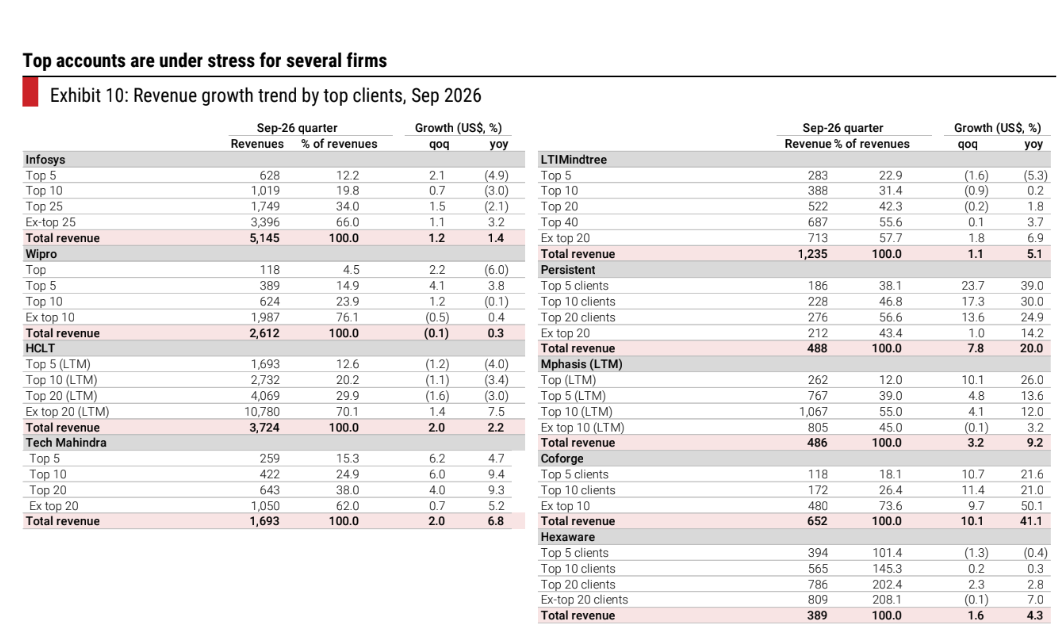
Persistent, followed by Coforge, lead mid-tier on revenue growth (organic basis) and are driving outperformance versus the Tier 1 pack. The market continues to be ripe for mid-tier, but it demands strong execution on all fronts. Growth yoy has decelerated to low-mid single digits for Hexaware and LTM. Growth is accelerating for Mphasis, though sustainability of growth acceleration is a debate point.
Mixed outcome on deal wins
Deal wins were strong for Infosys, TechM, Coforge and HCLT and middling for TCS, Wipro and LTM. Select firms such as Wipro, Hexaware and Persistent indicated slippage of closures of some deals to the future quarters. Select firms such as LTM and Mphasis also indicated an increase in short-cycle deals, which can potentially compensate for lower-than-expected TCV. 2HFY27 performance will be key for validation of such comments. AI led deals are increasing but remain smaller in size. Mega deals that provide new revenue for the industry (as opposed to deals involving a share shift between vendors) remain short in supply. Infosys won such a mega deal in the quarter.
BFSI contributing to consistent growth; retail, healthcare still under pressure
BFSI leads other verticals on yoy growth at 6.1%. Revenue grew 2.5% qoq. Hi-tech and telecom had strong sequential growth, driven by mega deal ramp-up in Persistent and TechM, respectively, and also had contribution from acquisitions from CTSH and HCLT, respectively. Revenue growth remains muted in retail and healthcare verticals. Manufacturing is steady, though the yoy revenue growth has decelerated. The demand environment has not changed significantly. Except for BFSI, other verticals are under some form of stress impacting discretionary spending.
Setup for 3Q: Expect Persistent, Coforge and Mphasis to lead growth among mid-tier
3Q is a seasonally weak quarter across most companies. HCLT will lead sequential growth due to seasonality in the products business. We expect a revenue decline on sequential basis for Infosys, Wipro and Hexaware and modest growth for TCS, LTM and TechM. Growth among mid-tier will be led by Persistent and Coforge followed by Mphasis on the back of a ramp-up of deal wins.
We expect investors in the run-up to 3QFY27 to focus on (1) the level of furloughs—IT firms expect normalized levels of furloughs, (2) any change in discretionary spending environment and (3) the outlook on deals/revenue that slipped to 3QFY27.
Rupee depreciation and cost optimization have aided margins so far but will be tested in the near term
Margins are under pressure from higher competitive intensity in large deals, AI-related investments and acquisitions (both amortization and margin-dilutive M&A). Rupee depreciation, G&A cost optimization, workforce restructuring and tactical measures such as wage hike delays and cuts to variable pay have helped keep margins intact.
EBIT margin in 2QFY27 largely increased across most companies on a sequential basis. The stress is visible yoy, though for select companies. We expect EBIT margins to decline in FY2027E for TCS (120 bps), Wipro (80 bps), Persistent (60 bps), Infosys (30 bps) and Mphasis (20 bps). Hexaware should deliver 13.1% EBIT margin in CY2026, at the lower end of the initial 13-14% guidance. TechM and Coforge are the outliers with EBIT margin expansion of 240 bps and 190 bps, respectively, in FY2027E.
Other key highlights
4 | Headcount. Hiring picked up modestly with net hiring of 17,118 on a sequential basis across aggregate of the top six offshore pure plays (TCS, Infosys, Wipro, HCLT, CTSH and TechM). |
4 | Attrition rates. Attrition rates remained benign despite companies taking on harsher measures such as wage hike delays, cut in variable pay, restructuring and tighter bench policies, indicating demand-supply mismatch. |
4 | Utilization rates. Utilization rates remained steady or increased across companies. Utilization rates are at high or peak levels across several companies but have room to improve for select companies as Wipro, Mphasis and Coforge. |
4 | Subcontractor usage. Leverage of subcontractor usage to reduce costs appear to have peaked. Subcontractor costs as a percentage of revenues was steady across most companies on sequential basis and increased yoy. |
