Experian Report: 69% of respondents agree that their current technology stack is inadequate to counter a rapidly evolving fraud threat

FinTech BizNews Service
Mumbai, 14 April 2026: Experian, the global leader in data and technology, today unveiled new findings from its latest fraud research report conducted by Forrester Consulting. The study, which surveyed nearly 1,000 senior fraud leaders across nine countries, including India, highlights a widening gap between the sophistication of fraud attacks and the capabilities of current business defences.
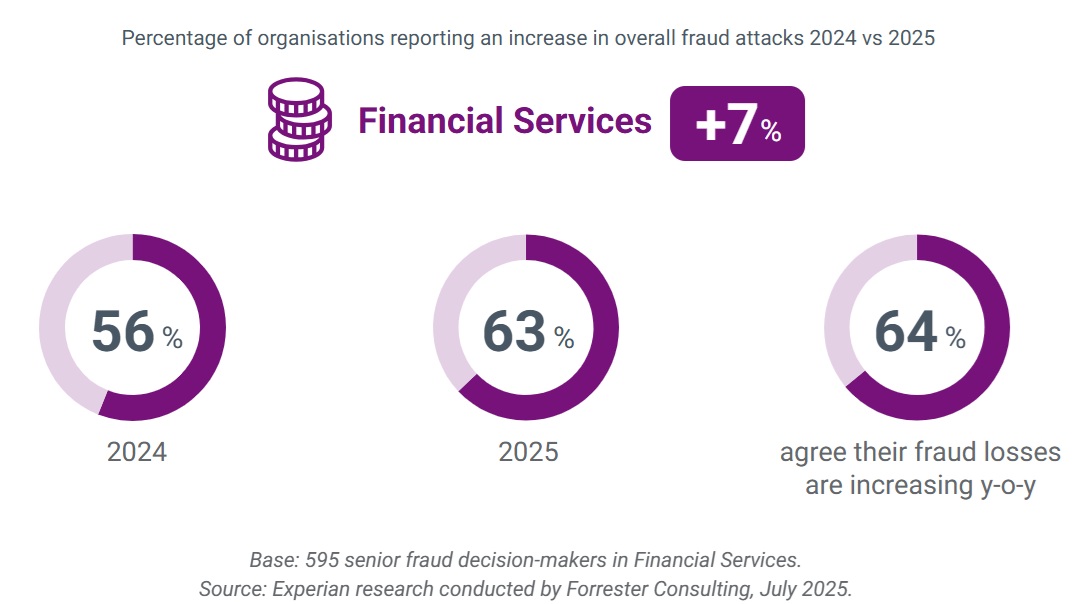
Sector‑specific insights show a surge in social engineering and identity theft across Financial Services and Telcos, while friendly fraud and refund abuse continue to rise in eCommerce.
Fraud is accelerating faster than business defences can catch up
Fraud has become faster, cheaper and more scalable, driven by organised transnational networks and GenAI‑powered attack tools. Identity verification is now the most targeted security perimeter.
The report reveals that 69% of Indian organisations believe their fraud prevention technology needs significant improvement, yet many remain stuck in long “build vs. buy” debates, delaying critical upgrades.
Encouragingly, 83% express interest in adopting passive fraud checks such as behavioural and device intelligence to reduce customer friction, while 64% are planning a unified approach that combines fraud prevention with credit risk assessment.
Machine learning emerges as a critical defence layer
Machine learning (ML) is increasingly central to modern fraud prevention. 54% of ML users have seen measurable improvements in detection accuracy since implementing ML. Meanwhile, 65% of senior fraud decision‑makers say ML helps them better prioritise cases for manual review, increasing analyst productivity.
Real‑time detection is highlighted by 55% of respondents as the biggest advantage of ML, alongside the ability to retrain models with new data to keep pace with evolving fraud tactics. Half of all respondents agree that ML can detect fraud that rules‑only systems typically miss, reinforcing ML’s role as a foundational fraud‑prevention capability.
Collaboration is the future of fraud prevention
While ML adoption is rising, 76% of Indian businesses acknowledge the need of stronger in‑house expertise to build or manage ML systems. At the same time, 74% intend to integrate ML‑based solutions into their fraud prevention workflows.
The report underscores the importance of shared fraud intelligence, 63% say proven ROI from peer networks would accelerate adoption. Experian enables this collaboration through secure, centrally managed fraud‑intelligence hubs with API‑based data exchange.
How is GenAI impacting fraud?
Businesses are increasingly concerned about AI‑generated fraud, with 65% believing that GenAI is the most significant fraud threat ever seen. Additionally, 69% say their existing KYC and identity‑verification checks are not equipped to detect GenAI‑generated documents, while 74% report a noticeable rise in GenAI‑driven fraud attempts. Many also feel that the industry has only seen the “tip of the iceberg,” with 60% believing the threat is far greater than what is visible today. Furthermore, 57% of respondents struggle to determine whether GenAI was involved in a fraud attack, making it difficult to accurately quantify its true impact.
Manish Jain, Country Managing Director of Experian India, said, “Globally, fraud has entered a new era, driven by economic volatility, highly organised fraud networks, and rapid advances in Generative AI.

These forces are reshaping the risk landscape faster than traditional systems can adapt. For fast‑growing markets like India, where digital adoption is accelerating across financial services, eCommerce and payments, the implications are even more significant. As fraudsters evolve, Indian businesses must modernise with equal speed, adopting machine learning, device intelligence and shared fraud networks to stay ahead. Safeguarding trust will be critical to ensuring that India’s digital momentum continues without disruption.
Experian is partnering closely with organisations across India to strengthen their resilience. By combining advanced fraud intelligence through consortiums, device insights, behavioural analytics and machine learning, we are helping businesses protect their customers, reduce risk and reinforce the trust that underpins India’s digital economy.”
“Fraud was never a static challenge, it’s constantly evolving,” says Shail Deep, COO, Experian EMEA & APAC.
“Generative AI is giving criminals unprecedented speed and sophistication. Businesses must modernise their fraud strategies now. Today, 71% of businesses are investing more in fraud technology than in human analysts, a clear signal that manual reviews and rules-based systems can no longer keep up. Device intelligence, behavioural analytics, and machine learning are becoming essential. Collaboration and innovation are no longer optional; they are the foundation of resilience in 2026 and beyond.” she added.
Explore the full findings and sector-specific insights in our comprehensive report here. https://experianacademy.com/forrester-fraud-research-report-2026/?utm_source=prin&utm_medium=media&utm_campaign=EMAP-FY26-PAN-Forrester-Fraud-Report&utm_content=Post
