National Entrepreneurship Day highlights the growing role of entrepreneurship in India’s journey towards Viksit Bharat @ 2047.
FinTech BizNews Service
Mumbai, 09 November, 2026: Observed on 9 November, National Entrepreneurship Day highlights the growing role of entrepreneurship in India’s journey towards Viksit Bharat @ 2047.
With over 2.62 lakh DPIIT-recognised startups, India has emerged as the world’s third-largest startup ecosystem, creating employment and expanding opportunities for its youth. Government initiatives such as Startup India, Fund of Funds for Startups, CGSS, SISFS, Atal Innovation Mission and PMEGP support innovation, access to finance, mentorship and enterprise creation. With nearly half of recognised startups originating from Tier-II and Tier-III cities, alongside expanding rural entrepreneurship, India’s ‘Amrit Peedhi’ is increasingly transforming ideas into enterprises, strengthening livelihoods and contributing to inclusive economic growth. |
National Entrepreneurship Day: Empowering Youth for Viksit Bharat
India has made significant strides in building a supportive environment for aspiring entrepreneurs. This progress holds particular significance for a nation where nearly 65% of the population is under 35. Recognising the potential of this demographic dividend, the Government has undertaken a range of initiatives to empower young Indians across fields including entrepreneurship.
DID YOU KNOW? The Ministry of Skill Development and Entrepreneurship was established on 9 November 2014. The day is observed as National Entrepreneurship Day, reflecting the importance of entrepreneurship in India’s development journey. |
Over the past decade, youth have increasingly moved beyond the role of beneficiaries to become active contributors to national development. Today, the ‘Amrit Peedhi’ is emerging as a driving force behind the vision of Viksit Bharat @ 2047. Entrepreneurship is central to this transformation, enabling young Indians to turn ideas into enterprises, generate employment and contribute to economic growth.
Recognising the importance of entrepreneurship in India’s development journey, the Ministry of Skill Development and Entrepreneurship was established on 9 November 2014. The day is observed as National Entrepreneurship Day.
Indicators of Growth in India’s Entrepreneurship Ecosystem
DID YOU KNOW? The Government has recognized over 55,200 startups during FY 2025-26- the highest number of startups recognized in a single year since 2016! |
The shift from job seekers to job creators reflects India’s growing entrepreneurial spirit.
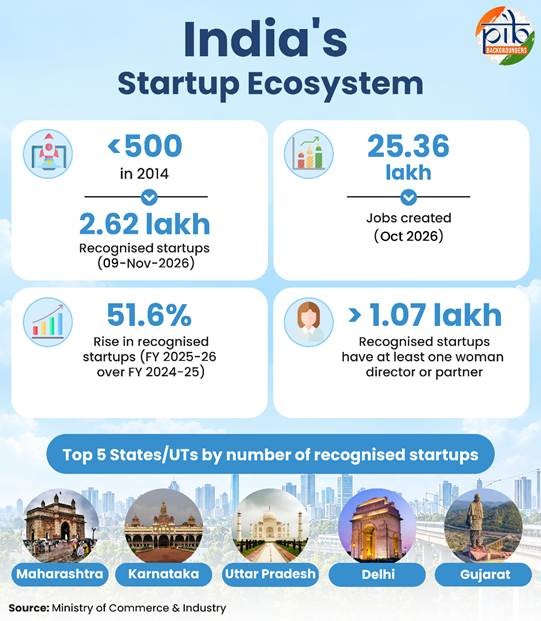
India has the 3rd largest startup ecosystem in the world. The number has grown significantly, from fewer than 500 in 2014 to more than 2.62 lakh DPIIT-recognized startups as of November 2026. Indian startups are increasingly launching IPOs, creating jobs, and attracting global attention.
Notably, startups are present across all States and Union Territories. Maharashtra, Karnataka, Uttar Pradesh, Delhi and Gujarat have emerged as leading regions in terms of the number of recognized startups and direct employment generation as on 31st March 2026.
Startups have been able to create more than 25 lakh jobs (up to October 2026). The number of startups recognized increased by 51.6% year-on-year in FY 2025-26 compared to FY 2024-25, while direct jobs created rose by 36.1% during the same period.
Besides, more than 1.07 lakh recognized startups have at least one woman director or partner, accounting for 48% of total recognized startups (As of March 2026).
Schemes Strengthening India’s Entrepreneurship Ecosystem
Through the Government’s policy support and innovation-focused initiatives, easier access to finance, and digital platforms, entrepreneurship continues to expand across India.
The Startup India Initiative
The Startup India initiative was launched in 2016. This initiative has evolved from a policy-focused framework into a comprehensive, multi-dimensional platform that supports startups at every stage, from ideation to scaling operations. To fast-track innovation-led entrepreneurship, several flagship schemes and digital platforms support funding, mentorship, and the scaling of startups, through the Startup India initiative.
Atal Innovation Mission (AIM)
Launched in 2016 by NITI Aayog, the AIM is the Government’s flagship initiative to foster a culture of innovation and entrepreneurship across schools, universities, research institutions, startups, and industry. AIM provides an integrated framework for developing innovation programmes, fostering partnerships, and strengthening India’s startup ecosystem. AIM 2.0, approved in November 2024, has an outlay of Rs2,750 crore up to March 2028. It expands this foundation through wider participation, stronger startup support and deeper regional collaboration.
Pradhan Mantri Mudra Yojana (PMMY)
Introduced in 2015, PMMY helps micro and small enterprises obtain loans of up to Rs20 lakh without collateral for income-generating activities in the non-corporate, non-farm sector. The Scheme offers loans under four categories based on borrowers’ funding needs and the stage of their business growth.
Loan Category | Loan Amount |
Shishu | Up to Rs50,000 |
Kishor | Above Rs50,000 and up to Rs5 lakh |
Tarun | Above Rs5 lakh and up to Rs10 lakh |
Tarun Plus | Above Rs10 lakh and up to Rs20 lakh |
The loans meet term-financing and working capital requirements for manufacturing, trading and service businesses, as well as agriculture-allied activities such as poultry, dairy and beekeeping.
As on 30 October 2026, PMMY had sanctioned 2.44 crore+ loans amounting to over Rs3.3 lakh crore during FY 2026-27.
MeitY Startup Hub (MSH)
Established in 2016, the MeitY Startup Hub (MSH), under the Ministry of Electronics and Information Technology (MeitY), promotes technology-led innovation and strengthens India’s startup ecosystem. It serves as a central platform connecting incubation centres, Centres of Excellence in emerging technologies, and other MeitY-supported initiatives to drive innovation and technology-led economic growth. As of 9 November 2026, MSH supports a growing ecosystem of over 6,149 startups, 518 incubators, and over 329 labs across India.
Technology Incubation and Development of Entrepreneurs (TIDE) 2.0 Scheme
The TIDE 2.0 Scheme (2019) promotes technology-driven entrepreneurship by strengthening incubators that support Information and Communication Technology (ICT) startups leveraging emerging technologies such as IoT, Artificial Intelligence (AI), blockchain, and robotics. The scheme provides holistic support across healthcare, education, agriculture, financial inclusion (including digital payments), infrastructure and transportation, and environment and clean technology. It operates through 51 incubators located in leading academic institutions and national research organisations across the country.
GENESIS (Gen-Next Support for Innovative Startups)
The GENESIS (Gen-next Support for Innovative Startups) initiative aims to scale up around 1,600 technology startups, particularly in Tier-II and Tier-III cities across India. Launched in 2022, it provides funding and support to promote deep-tech innovation and strengthen emerging startup ecosystems. The initiative has a budgetary outlay of Rs490 crore for a period of five years. It seeks to strengthen India’s technology startup ecosystem through collaboration among startups, government institutions, academia and corporates.
In August 2026, GENESIS Entrepreneur-in-Residence (EIR) Cohort 3 was launched. It is a national-level programme to support aspiring entrepreneurs, innovators, researchers, students and early-stage startup founders in transforming innovative ideas into technology-driven ventures. Notably, selected innovators can receive financial assistance of up to Rs10 lakh, along with incubation, mentorship and product-development support.
NIDHI (National Initiative for Developing and Harnessing Innovations)
Launched in 2016 by the Department of Science and Technology (DST), Ministry of Science and Technology, NIDHI is an umbrella programme that nurtures knowledge-based and technology-driven ideas and innovations into successful startups. It builds an innovation-led entrepreneurial ecosystem that promotes socio-economic development through wealth and employment generation. NIDHI has made significant contributions to India’s startup ecosystem. It has supported over 12,000 startups, over 200 Technology Business Incubators (TBIs), generating over 1,30,000 jobs. Further, it has contributed to the creation of over 1,150 intellectual property (IP) assets (11 October 2026).
ASPIRE (A Scheme for Promotion of Innovation, Rural Industries and Entrepreneurship)
ASPIRE promotes innovation and entrepreneurship in rural and underserved areas. It focuses on setting up Livelihood Business Incubators (LBIs) for micro-enterprise creation, skilling and re-skilling opportunities, and workforce supply to industrial clusters. As of October 2026, 109 LBIs have been approved and more than 1 lakh beneficiaries skilled.
Prime Minister’s Employment Generation Programme (PMEGP)
The Prime Minister’s Employment Generation Programme (PMEGP) promotes self-employment by supporting the establishment of new micro-enterprises in the non-farm sector. It provides beneficiaries with a margin money subsidy linked to bank loans to help meet the cost of setting up these enterprises.
The scheme is implemented by the Khadi and Village Industries Commission (KVIC) under the Ministry of MSME, ensuring wider outreach and effective last-mile delivery.
Project Cost Limits: The scheme supports projects with costs of up to Rs50 lakh in the manufacturing sector and Rs20 lakh in the service sector.
The scheme provides assistance under General and Special categories. The Special Category covers SC/ST/OBC communities, Minorities, Women, Ex-servicemen, Persons with Disabilities and Transgender applicants, as well as beneficiaries from the Northeastern Region, Hill and Border areas, and Aspirational Districts.
Beneficiary Category | Subsidy in Rural Areas | Subsidy in Urban Areas |
General Category | 25% of project cost | 15% of project cost |
Special Categories | 35% of project cost | 25% of project cost |
PM Street Vendor’s AtmaNirbhar Nidhi (PM SVANidhi)
Launched in June 2020, the Prime Minister Street Vendor’s AtmaNirbhar Nidhi (PM SVANidhi) is a micro-credit scheme for street vendors.
Loans and credit facilities: It supports vendors’ working capital needs through collateral-free loans that increase from Rs15,000 to Rs25,000 and then Rs50,000, backed by interest subsidies and credit guarantees. Those who repay the second loan can also qualify for a UPI-linked RuPay credit card with a Rs30,000 limit.
Digital participation: Vendors receive up to Rs1,600 in cashback for retail and wholesale digital transactions.
Welfare coverage: Under SVANidhi se Samriddhi, access to eight selected Central welfare schemes is facilitated for vendors and their families on the basis of socio-economic profiling.
As of 9 November 2026, the scheme had reached over 80.7 lakh beneficiaries, with more than Rs20,400 crore sanctioned.
Swavalambini Scheme
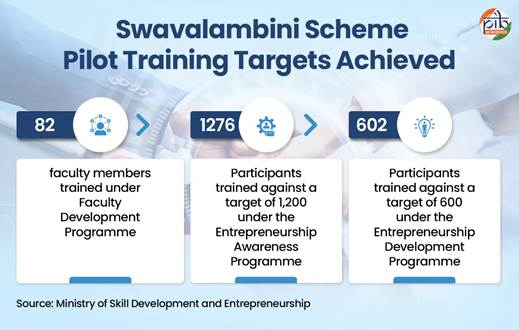
This scheme, launched in 2025, supports young women from business ideation to enterprise creation through entrepreneurship training, financial and market guidance, and legal support. Selected participants receive 21 weeks of mentorship and handholding to help develop sustainable enterprises. Notably, targets under the Swavalambini pilot have been achieved.
Entrepreneurship Beyond Metros: Tier II, Tier III and Rural India
India’s entrepreneurial ecosystem is expanding beyond traditional metropolitan hubs. 52% of recognised startups originate from non-metro cities, reflecting the growing geographical spread of innovation. Businesses are increasingly choosing Tier-II and Tier-III cities for their lower costs, skilled talent, stronger industrial clusters, and improving infrastructure. As innovation spreads across Bharat, emerging cities are powering the next wave of entrepreneurship and economic growth. Rural entrepreneurship is also gaining momentum through targeted livelihood and enterprise-development programmes.
Together, these initiatives are strengthening local enterprise creation, widening livelihood opportunities and enabling entrepreneurship to contribute to more geographically inclusive growth.
Powering India’s Journey Towards Viksit Bharat 2047
India’s startup ecosystem is transitioning from rapid expansion towards sustainable growth and deeper integration with the real economy. As the country progresses towards a projected $7.3 trillion economy by 2030 and the vision of Viksit Bharat 2047, startups will continue to play a significant role in driving innovation, generating employment and strengthening economic growth. Their expanding contribution reflects India’s growing entrepreneurial capacity and the potential of innovation-led enterprises to support long-term, inclusive development.
