Adi Vaani: Bringing India’s Tribal Languages into the Digital Age; Tribal literature is an integral part of India’s cultural heritage
FinTech BizNews Service
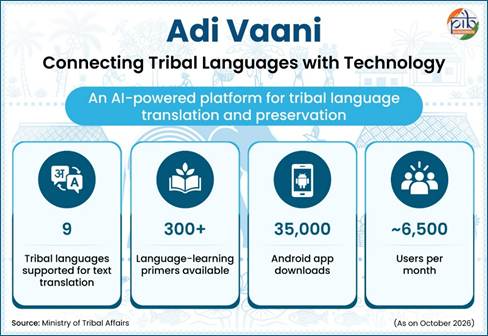
Mumbai, 15 November, 2026: Adi Vaani is an AI-powered platform of the Ministry of Tribal Affairs that makes tribal languages more accessible through translation and digital tools. As on 15 October 2026, it supports text translation in nine tribal languages and has recorded over 35,000 Android downloads. State Tribal Research Institutes have contributed approximately 13.9 lakh text sentences and around 300 hours of speech data to train its models. The Working Group on Tribal Languages, which first met on 15 October 2026, discussed positioning Adi Vaani as the National Tribal Language Repository. By reducing language barriers, it can support mother-tongue education, healthcare communication, access to public services and cultural preservation.
The Ministry of Tribal Affairs is observing Janjatiya Gaurav Pakhwada across the country from 1 to 15 November 2026, culminating in Janjatiya Gaurav Diwas on 15 November, the birth anniversary of Dharti Aaba Bhagwan Birsa Munda. On Janjatiya Gaurav Diwas, over 300 projects for tribal communities across States are being taken up, with 228 ready for inauguration and 74 for foundation stone laying. Two national digital initiatives, the Jan-HIT Portal and the National FRA Digital Platform, are also being launched. Tribal Research Institutes have planned more than 160 activities in 19 States/UTs.
Across India, tribal languages have carried folk tales, songs and valuable knowledge of forests, farming and medicine across generations. Yet many are low-resource languages, spoken by relatively small communities and passed down largely through oral traditions. With limited written records and very little digital text or speech data, these languages have remained largely unsupported by modern language technologies. Adi Vaani aims to bridge this gap by using artificial intelligence. It uses technology to document, translate and promote tribal languages, creating new opportunities for their preservation, learning and everyday use.
Adi Vaani: Connecting Language with Technology
Adi Vaani is an AI-powered translation and language platform built with tribal communities, for tribal communities. Launched by the Ministry of Tribal Affairs on 1 September 2025, it was developed by a national consortium led by IIT Delhi, along with BITS Pilani, IIIT Hyderabad, IIIT Nava Raipur and the Tribal Research Institutes (TRIs) of Jharkhand, Odisha, Madhya Pradesh, Chhattisgarh and Meghalaya. Over time, several other State Tribal Research Institutes (TRIs) also joined the initiative, further expanding its collaborative reach across the country.
Bridging the Digital Divide: Mission and Vision
Adi Vaani aims to bridge the digital divide for tribal communities through AI-powered translation. Its vision is a digitally inclusive India where no citizen is left behind due to language barriers. The initiative is guided by respect, collaboration, authenticity, innovation and empowerment through digital inclusion.
Expanding Language Coverage and Digital Reach
Starting with Santali, Bhili, Mundari and Gondi, Adi Vaani has expanded to offer text translation in nine tribal languages as on 15 October 2026. It also provides speech translation, Optical Character Recognition (OCR), video subtitling and access to more than 300 language primers. Primers are basic language learning resources designed to help new learners understand and practise tribal languages easily. The platform has recorded over 35,000 Android downloads and around 6,500 monthly users, indicating its growing digital reach.
Building AI with Tribal Communities
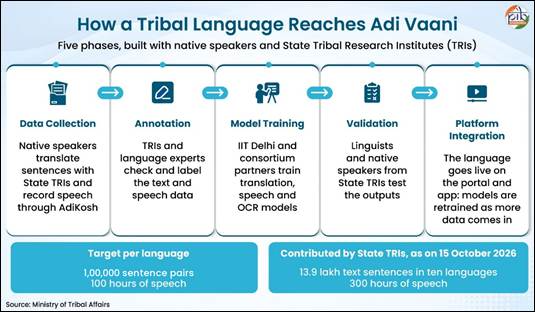
What makes Adi Vaani different is its community-based approach. Native speakers contribute words, sentences and voice recordings through TRIs and AdiKosh. These are checked by language experts before being used to train AI models. The project aims to collect around 1,00,000 sentence pairs and 100 hours of speech recordings per language. As on 15 October 2026, State TRIs had contributed approximately 13.9 lakh text sentences across ten languages and around 300 hours of speech data. This approach combines modern technology with community knowledge to support the preservation, learning and everyday use of tribal languages. Each language passes through five phases, from data collection to integration on the platform, and the models are retrained as the community contributes more data.
What Are TRIs and AdiKosh?
What Are TRIs and AdiKosh? |
Tribal Research Institutes (TRIs) are research bodies established at the State level under the Ministry of Tribal Affairs. They serve as centres of knowledge and research, functioning as think tanks for tribal development. TRIs preserve tribal cultural heritage, while providing research-based inputs to States for evidence-based planning and appropriate legislation. They build the capacity of tribal communities, as well as of individuals and institutions associated with tribal affairs. They also disseminate information and create awareness on tribal issues. AdiKosh is the word bank of Adi Vaani. It holds dictionary entries and spoken sentences, recorded by verified speakers and reviewed by the language team. Speech recorded through AdiKosh is validated by TRIs before it is used to train the models. |
The platform’s key features include:
Tribal Languages: Preserving Knowledge and Identity
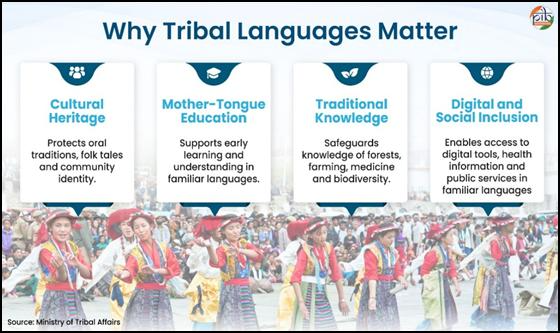
According to Census 2011, India has about 10.45 crore Scheduled Tribe people, accounting for about 8.6% of the country’s population. These communities have distinct languages and cultural traditions. Preserving these languages is important as they carry centuries of folklore, traditional knowledge and community identity. They also support early learning in the mother tongue and help pass knowledge of forests, farming, medicine and biodiversity to future generations. Making these languages digitally accessible can further reduce language barriers and improve access to education, healthcare information and public services.
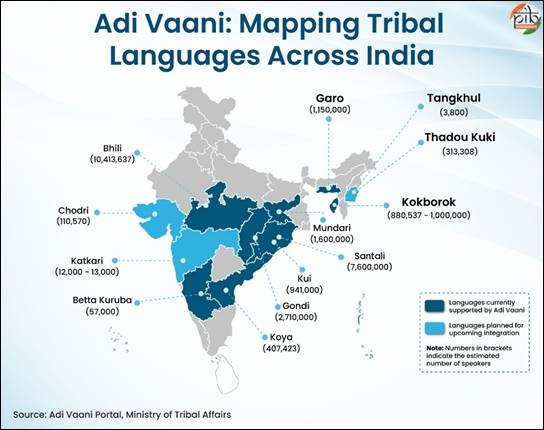
Tribal Languages Covered by Adi Vaani
Adi Vaani works with a total of 13 tribal languages across different regions of India. The table shows the State named on the portal for each language, with its corpus size and script. Some languages are spoken in several States beyond the State identified for the Adi Vaani project.
S. No. | Tribal Language | State (as on the Adi Vaani portal) | Corpus Size | Script Used in Adi Vaani |
1 | Bhili | Madhya Pradesh | 2,53,634 | Devanagari |
2 | Mundari | Jharkhand | 3,39,394 | Devanagari |
3 | Santali | Odisha | 2,19,063 | Ol-Chiki |
4 | Gondi | Chhattisgarh | 1,49,133 | Devanagari |
5 | Garo (A’chik) | Meghalaya | 1,33,747 | Latin |
6 | Kui | Odisha | 95,478 | Odia |
7 | Kokborok | Tripura | 63,556 | Latin |
8 | Betta Kuruba | Karnataka | 33,635 | Kannada |
9 | Katkari | Maharashtra | 59,160 | Devanagari |
10 | Koya | Andhra Pradesh | 45,940 | Telugu |
11 | Thadou Kuki | Manipur | - | Latin |
12 | Tangkhul | Manipur | - | Latin |
13 | Chodri | Gujarat | - | Gujarati |
Together, these languages represent India’s linguistic diversity and the voices of millions of speakers. Corpus sizes are as reported by State TRIs and grow as more community-validated data is contributed.
Adi Vaani’s Impact: Beyond Language Translation
The usefulness of Adi Vaani extends to education, healthcare awareness and public communication, where language can influence how information is understood and used.
Supporting Mother-Tongue Education
The National Education Policy 2020 recommends the use of the home language, mother tongue or local language as the medium of instruction wherever possible, at least until Grade 5 and preferably until Grade 8 and beyond.
Adi Vaani provides access to more than 300 language primers prepared by Tribal Research Institutes, along with 24 dictionaries and other learning resources.
The National Education Society for Tribal Students has also highlighted the potential use of these resources across more than 525 Eklavya Model Residential Schools, serving over 1.7 lakh students. Their integration into school learning could support mother-tongue-based multilingual education and encourage students to engage with their linguistic heritage.
Improving Healthcare Communication
Language accessibility can play an important role in public health programmes, particularly in explaining diseases, screening procedures and preventive measures.
Adi Vaani includes translated awareness resources on Sickle Cell Disease, a major health concern among several tribal communities.
The National Sickle Cell Anaemia Elimination Mission, launched on 1 July 2023, aims to eliminate the disease as a public health problem by 2047. By 16 July 2026, more than 7.24 crore screenings had been conducted in tribal-dominated areas. Adi Vaani can complement such health initiatives by supporting awareness and communication in local languages.
Economic Empowerment: Improving Access to Markets
Language barriers can limit access to market information, digital services and business opportunities. Adi Vaani aims to address this gap by making online information more accessible in tribal languages. Its translation tools can support tribal entrepreneurs in understanding market information and government support programmes.
India is also expanding market opportunities for tribal producers. As on 13 August 2026, 4,712 Van Dhan Vikas Kendras had been sanctioned in 28 States and UTs, covering 12.94 lakh beneficiaries. These centres support tribal livelihoods through processing, packaging, branding and marketing of products.
Digital market access is also growing. As on 18 March 2026, around 6,000 tribal products were available on the Tribes India e-commerce platform, and 1,339 products had been onboarded onto the Open Network for Digital Commerce (ONDC).
By reducing language barriers, Adi Vaani could complement these efforts and help tribal communities participate more easily in the digital economy.
Public Services: Making Government Information Accessible
Language barriers can make it difficult to understand government schemes, official documents and public services. Adi Vaani helps address this through AI-powered translation in tribal languages.
The Ministry also launched Jago, its official AI conversational assistant, on 24 August 2026, to make information on tribal welfare schemes, programmes and initiatives easier to find and understand. Together, these initiatives aim to make public information more accessible, particularly in remote tribal areas.
Cultural Preservation: Keeping Tribal Traditions Alive
Adi Vaani brings together technology and community knowledge to document tribal languages, folk songs, stories and oral traditions. Native speakers, elders and linguists contribute language data, which is reviewed by experts to ensure accuracy and reflect local usage.
The Ministry of Tribal Affairs also provides financial assistance to 29 TRIs to preserve, document and promote tribal heritage, including languages, oral traditions and indigenous knowledge systems. By involving communities directly, Adi Vaani helps build authentic digital resources and makes tribal cultural heritage more accessible to future generations.
Building a National Tribal Language Repository
The Ministry of Tribal Affairs is taking steps to expand Adi Vaani beyond translation into a broader national resource for tribal languages.
On 15 October 2026, the Ministry convened the first meeting of the Working Group on Tribal Languages, chaired by Smt. Ranjana Chopra, Secretary, Ministry of Tribal Affairs. The group includes representatives from the Central Institute of Indian Languages, IITs, universities, language organisations and experts working on endangered languages.
The meeting discussed positioning Adi Vaani as the National Tribal Language Repository, bringing together corpora, primers, dictionaries and community stories. The Ministry will circulate the agenda items and prepare a roadmap for the work ahead.
Proposals placed before the Working Group include:
Earlier, at the National Conclave on Tribal Languages and Museums in Mysuru on 24 August 2026, an upgraded version of Adi Vaani was introduced, along with an iOS application and the addition of five languages. The Ministry of Tribal Affairs also signed an MoU with the Central Institute of Indian Languages on language documentation and corpus development. The Government of Karnataka and the Karnataka State Tribal Research Institute released Class 1 primers in Jenukuruba at the Conclave.
These initiatives aim to bring existing linguistic research and community resources together within a common national framework.
Towards a More Inclusive Digital India
Adi Vaani has established an initial digital foundation for tribal languages through translation tools, educational resources and community-generated language data. As each language’s corpus grows, the models are retrained and translation accuracy improves.
As India advances towards Viksit Bharat 2047, the initiative connects the preservation of linguistic diversity with the wider goal of digital inclusion. Making tribal languages accessible through modern technologies can support both cultural continuity and participation in education and public services.
The next step is to ensure that these digital resources become useful tools in the everyday lives of the communities whose languages they represent.
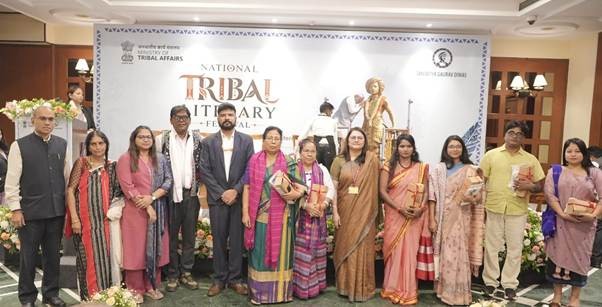
The two-day National Tribal Literary Festival, organised by the Ministry of Tribal Affairs at the India Habitat Centre, New Delhi, concluded on 13 November 2026 with discussions on preserving India’s rich tribal literary traditions and connecting indigenous knowledge and oral narratives with contemporary literary expression. Organised as part of the Janjatiya Gaurav Diwas celebrations, the festival brought together tribal writers, poets, researchers, linguists and scholars from across the country under the theme ‘From Oral Tradition to Contemporary Tribal Literature’.
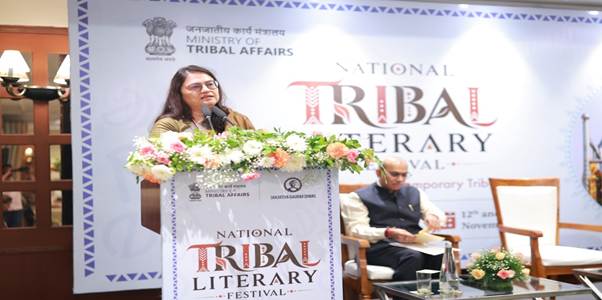
The concluding day featured thematic discussions on oral epics and heroic traditions, the contribution of indigenous knowledge to multilingual education, and readings by emerging tribal writers and poets. The sessions highlighted how stories, songs, epics and poetry continue to preserve the collective memory, cultural identity and lived experiences of tribal communities.
Oral Epics and Heroic Traditions
Moderated by Shri Prakash Jha, the first session featured Shri Bhagwandas Patel, Shri Upendra Anu and Shri Mayanglambam Sadanand Singh. The speakers explored the oral literary heritage of the Bhil and Gond communities, including Gond Ramayana and Bhil Mahabharata, as well as Manipur’s Wari Leeba storytelling tradition and the Khamba-Thoibi epic. The discussions highlighted the importance of documenting these traditions through audio-visual recordings and research, while recognising community storytellers and knowledge holders as custodians of tribal literary heritage.
Oral Traditions in Multilingual Education
The next session examined the role of indigenous languages and community knowledge in strengthening inclusive education. Moderated by Dr. K. Srinivasa Rao, former Secretary, Sahitya Akademi, the session featured Shri Anil Kumar Boro, Shri Sylvanus Lamare and Smt. Parvati Tirkey. The deliberations highlighted how oral narratives, traditional songs and community stories can enrich learning experiences and strengthen children’s connections with their mother tongues and cultural identities. The speakers emphasised incorporating indigenous knowledge and oral traditions into educational processes, particularly in early childhood education, and discussed the role of documentation, translation and technology in supporting tribal languages.
Emerging Writers and Poets Bring Contemporary Tribal Experiences to the Fore
The final two sessions provided a platform for tribal writers and poets to showcase their creative works and share contemporary narratives rooted in their linguistic and cultural identities. In the story-reading session, chaired by Shri Mahadev Toppo, Smt. Neeta Kusum Bilung, Shri Ramesh Karthik Nayak and Shri Vasanth Kumar V.P. presented their stories, highlighting the diversity of tribal literary expression and the evolving experiences of tribal communities.
The poetry-reading session, moderated by Smt. Jogamaya Chakma, brought together poets representing diverse linguistic and cultural traditions. Shri K. Vasamalli, Shri Kriri Mog Chowdhury, Shri Babu Sangda, Shri Hirjir Ingti Katharpi, Shri Gopi Krishna Soni, Smt. Marina Ekka, Smt. Sudha Chauhan and Smt. Anjali Belagal recited their original compositions. The readings reflected the richness of tribal poetry and its engagement with community life, cultural memory, identity and contemporary social realities.
Expanding Recognition and Reach of Tribal Literature
During the valedictory session, Smt. Ranjana Chopra, Secretary, Ministry of Tribal Affairs, emphasised the need to create sustainable platforms for promoting tribal literature, supporting authors writing in indigenous languages and connecting them with publishers and wider readerships. She highlighted Living Roots Originals, an initiative developed in collaboration with the Indian Performing Right Society (IPRS) to recognise and protect the creative rights of tribal musicians and performers. She also highlighted the Ministry’s initiative to facilitate a dedicated section for tribal literature at the National Book Trust’s forthcoming book fair at Pragati Maidan, providing tribal authors and publishers an opportunity to showcase their works and reach wider audiences.
Dr. K. Srinivasa Rao summarised the two-day festival, highlighting the representation of 27 languages, including 23 tribal languages. He emphasised that tribal literature is an integral part of India’s cultural heritage and underscored the need for its greater inclusion in university curricula, translation initiatives and mainstream publishing platforms to ensure wider recognition and dissemination.
In his concluding remarks, Shri Ganesh Nagarajan, Deputy Secretary, Ministry of Tribal Affairs, highlighted the significant expansion of the Ministry’s cultural, linguistic and livelihood initiatives over the past year. He expressed appreciation to the scholars, authors, poets, moderators and participants for their valuable contributions to the festival.
In line with the Prime Minister’s vision of inclusive development and guided by the spirit of ‘Ek Bharat Shreshtha Bharat’ and ‘Vikas bhi, Virasat bhi’, the National Tribal Literary Festival reaffirmed the Ministry of Tribal Affairs’ commitment to bringing indigenous literary voices into the national discourse and ensuring that India’s tribal literary heritage remains an integral part of the journey towards Viksit Bharat@2047.
.
