AI Could Detect Mule Accounts in Under a Minute, Says Maharashtra Cyber Cell ADG
FinTech BizNews Service
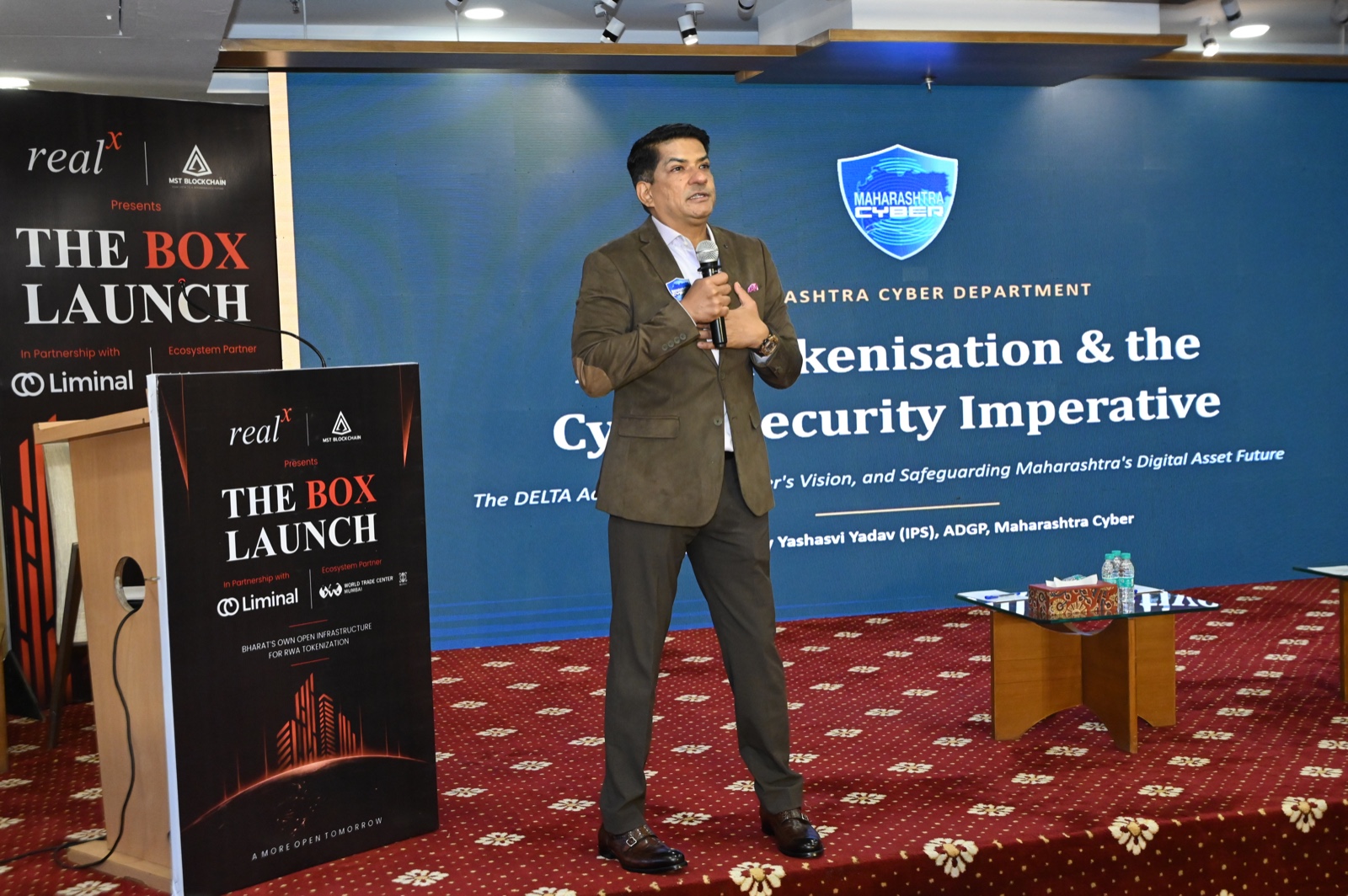
Mumbai, 12 September, 2026: Artificial intelligence could help financial institutions identify money mule activity in less than a minute, as suspicious transaction patterns are often markedly different from those of genuine account holders, said Yashasvi Yadav, ADG, Cyber Cell, Maharashtra Police on the sidelines of The RealX Box event on real estate tokenization. The launch marked the introduction of RealX REDbox and Whitebox, powered by MST Blockchain, bringing together the legal, marketplace and blockchain infrastructure required to build tokenised asset platforms on Indian rails.
Money mule accounts are typically used to receive and move funds linked to fraudulent or illicit activities. According to Yadav, the transaction behaviour associated with such accounts can provide clear signals for AI-driven systems to identify potential risks in near real time.
“Money mule activity can be identified and addressed very easily and seamlessly with the latest AI technologies because the pattern of a money mule is very distinct and very different from that of a bona fide account holder,” Yadav said.
He explained that a typical pattern involves a sizeable amount of money entering an account, remaining there for a short period and then being distributed across multiple platforms. In some instances, funds may eventually move into cryptocurrency wallets, making the transaction trail more complex.
“Typically, a sizable amount of money comes into an account, remains parked for a very short period, and is then distributed across multiple platforms, with some of it even reaching cryptocurrency wallets. For an AI engine trained to identify such patterns, detecting this activity can be a matter of less than a minute,” he said.
The ability to identify such patterns rapidly could potentially shift the approach to financial crime from a largely reactive model to one based on early detection and intervention. Yadav said the technology needed to address the problem already exists, and that deploying the right systems could substantially accelerate the response.
“The money mule problem in the country can therefore be addressed in a matter of hours if the right software and technologies are deployed,” he said.
Yadav also highlighted cybersecurity as a critical enabler for emerging digital financial models, including land tokenisation. As physical assets increasingly interact with digital platforms, he said, cybersecurity will need to protect not only financial value but also the identity and reputation of individuals using these systems.
“Land tokenisation can only be successful and effectively regulated when it is underpinned by robust cybersecurity, ensuring that the sacrosanct reputation of individuals and the valuables entrusted to the system remain protected,” Yadav said.
He further pointed to the state-of-the-art cybercrime centre inaugurated by the Maharashtra Government as an example of the advanced infrastructure required to address evolving forms of digital crime.
“The state-of-the-art cybercrime centre inaugurated by the Maharashtra Government is among the best in the world and represents the kind of advanced infrastructure and technological capability needed to tackle these emerging challenges,” he said.
The broader challenge, however, lies in translating technological capability into rapid action. As financial fraud becomes increasingly sophisticated and transactions move across banking, digital and crypto ecosystems, the ability to detect suspicious behaviour may ultimately be determined not just by the quality of AI, but by how quickly institutions can act on its signals.
