BRICS countries express shared commitment on food security, climate crisis and agricultural trade: Shri Shivraj Singh
FinTech BizNews Service
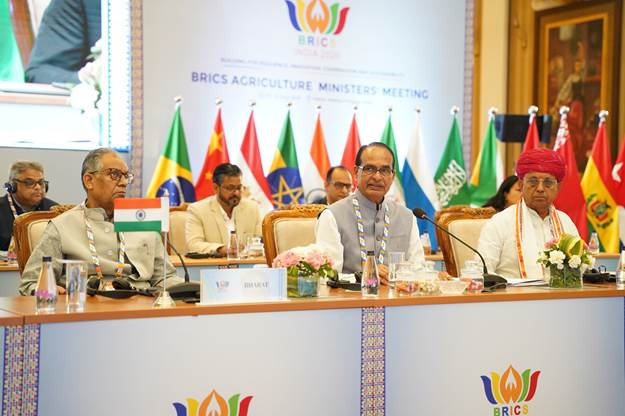
Mumbai, 12 June 2026: The BRICS Agriculture Ministers and officials-level meetings held in Indore concluded today with the adoption of a unanimous ‘Indore Declaration’ that includes several historic decisions giving new direction to food security, farmer welfare, climate-resilient farming, agricultural trade and digital agriculture. Union Minister for Agriculture and Farmers’ Welfare, and Rural Development, Shri Shivraj Singh Chouhan said in the press conference that amid global crises and uncertainties, this BRICS meeting has brought a powerful message of hope, confidence and collective responsibility for the entire world. This meeting has shown how countries can come together to address common challenges in agriculture and create solutions that benefit farmers everywhere.
The Format, Strength and Context of the Meeting
Union Minister Shri Shivraj Singh Chouhan, in the presence of his colleague ministers Shri Ramnath Thakur and Shri Bhagirath Chaudhary, and senior officials told the media that both the officials-level and ministerial-level meetings of the agriculture group were held successfully with great satisfaction and meaningful outcomes. He informed that nearly 60 foreign delegates from member and partner countries, along with a total of around 100 representatives, participated in the meeting, which clearly shows the deep connection and seriousness among BRICS countries on issues of agriculture and food security. The active participation of so many representatives highlights the importance that BRICS nations attach to these critical topics.
Union Minister Shri Shivraj Singh Chouhan said that BRICS countries represent nearly half of the world’s population, possess about 42 per cent of global agricultural land and contribute nearly 42 per cent to world foodgrain production. Therefore, their collective voice has emerged as an effective force on the global stage. This significant representation gives BRICS a strong position to influence international agricultural policies and cooperation.
He also expressed pride that under the leadership of Prime Minister Shri Narendra Modi, India is holding the BRICS Presidency this year and both the officials-level and ministerial-level meetings of the BRICS agriculture group were successfully concluded in Indore in this context. India’s leadership has helped shape meaningful discussions and outcomes during these meetings.
Four Main Priorities: Farmers, Food Security and Climate
Shri Shivraj Singh Chouhan said that the entire process involved deep discussions on four major priorities — food security and nutritious diets for the world and BRICS countries, promotion of agricultural trade and cooperation among BRICS nations, regenerative farming and climate-resilient sustainable agricultural practices in the face of climate change challenges, and strengthening innovation, technology and partnerships in food systems and the agriculture sector. He particularly highlighted that the meeting kept at its centre the questions of ensuring abundant foodgrains as well as nutritious food for all, and securing and improving the livelihoods of the farmers who feed the world. These priorities reflect a balanced and comprehensive approach to global agricultural challenges.
Shri Chouhan said that a separate session was organised with special focus on small and marginal farmers, also known as family farmers in many countries, where detailed discussions were held on their challenges, availability of inputs, credit flow, fair prices and market linkages. This focus on small farmers shows the commitment to inclusive growth in agriculture.
‘Indore Declaration’: Farmer-Centric Global Charter
Union Agriculture Minister Shri Shivraj Singh Chouhan informed that after extensive deliberations, the joint declaration prepared was adopted unanimously and, having been adopted in Indore, it will be known as the ‘Indore Declaration’. He said that the centre of this declaration is the farmer — the shared commitment to advance food security, nutrition, livelihoods, agricultural trade, innovation, investment, climate-resilient farming and sustainable agricultural development by keeping the farmer at the centre has been recorded in this declaration. This farmer-centric approach makes the declaration truly meaningful and practical.
Shri Chouhan strongly emphasised that this document is not merely a paper of agreement but a symbol of the collective will, shared responsibility and commitment of BRICS countries to build a more secure, prosperous and sustainable future through agriculture. The declaration reflects a strong resolve to work together for long-term benefits.
He also made it clear that member countries have decided to make collective and sustained efforts to translate all initiatives mentioned in the Indore Declaration into action on the ground so that its benefits actually reach farmers, rural communities and food systems in a real and impactful manner.
Four New Institutional Initiatives: Networks and Forums
1. Centres of Excellence on Agro-Ecology and Regenerative Agriculture
Shri Shivraj Singh Chouhan informed that the first major initiative is the establishment of the BRICS Network of Centres of Excellence on Agro-Ecology and Regenerative Agriculture. He said that this network will become a platform for joint research, experience sharing and capacity building on natural, organic and regenerative agricultural practices, through which member countries will learn from each other’s best practices and promote climate-resilient and sustainable agricultural systems. This initiative will help countries adopt better and more sustainable farming methods.
He reminded that under the leadership of Prime Minister Shri Narendra Modi, India has long emphasised natural farming, organic farming and balanced use of chemical fertilisers, has been warning about the dangers of excessive chemical use, and now BRICS countries have also recognised its importance and agreed to establish this network.
Union Agriculture Minister Shri Shivraj Singh Chouhan informed that in India, the Indian Institute of Farming Systems Research, Modipuram, has been given an important role as a Centre of Excellence on natural farming under this network, which will make significant contributions in joint research, knowledge sharing and training. This will strengthen India’s position in global agricultural cooperation.
2. BRICS Network on Digital Agriculture
The second major initiative is the establishment of the BRICS Network on Digital Agriculture, which will give new direction to cooperation in the fields of artificial intelligence, geospatial technology, digital public infrastructure and data-based agricultural solutions. Shri Chouhan said that this network will act as a strong bridge between modern technology and agricultural innovation, enabling developed technologies to be strengthened and taken directly to farmers. He informed that IIT Delhi in India will coordinate this network, while all member countries will participate and share their experiences, innovations and policy initiatives so that collective progress in the field of digital agriculture is ensured. This network will help modernise farming practices across BRICS nations.
3. Global Forum on Farmers’ Rights in Seed Systems
The third important announcement is related to the establishment of the Global Forum on Farmers’ Rights in Seed Systems, whose objective is to protect farmers’ seed rights, the diversity of indigenous seeds and traditional knowledge. Shri Shivraj Chouhan said that in countries like India, farming has been practised for hundreds and thousands of years and many traditional seeds, which are symbols of our biodiversity and cultural heritage, are today facing an existential crisis. New varieties and hybrid seeds are necessary, but along with them, the conservation of indigenous seeds is equally essential. This forum will play a key role in preserving these valuable resources.
He said that this forum will work to ensure that traditional seeds do not become extinct, their availability continues, their role is recognised in the context of climate change and food security, and farmers’ traditional knowledge is also preserved for future generations.
4. BRICS AgriN – Agro Input, Genetic Resources and Information Network
The fourth major initiative is the establishment of BRICS AgriN (Agro Inputs, Genetic Resources and Information Network), which will strengthen cooperation among member countries in the areas of agricultural inputs, seeds and genetic resources. Union Minister Shri Shivraj Singh informed that this network will promote information exchange, capacity building, technical cooperation and partnerships so that information about best varieties, genetic resources and inputs available in different countries can be shared and practical solutions can be developed. This will create better access for farmers across member countries.
He said that this will especially benefit those countries and farmers who previously had limited access to such resources and information, helping them improve their agricultural productivity.
Strengthening Existing Initiatives and Focus on Trade
Shri Shivraj Singh Chouhan informed that there was agreement to further strengthen the already established BRICS Agricultural Research Platform and develop it as a powerful ‘Knowledge to Action Hub’ so that research does not remain limited to laboratories but reaches farmers’ fields quickly and effectively.
He said that innovations should move beyond limited circles for wider dissemination and new technologies and solutions should reach more countries and farmers. This is the main objective of this hub and this is the real ‘Lab to Land’ model that will benefit millions of farmers.
He said that BRICS countries reiterated their commitment to a fair, equitable, inclusive and transparent multilateral trading system in the area of agricultural trade and cooperation, and through the special dialogue organised by India, discussions on initiatives like BRICS Grain Exchange were given new momentum. This will help improve agricultural trade among member countries.
Union Minister Shri Shivraj Singh Chouhan said that in one-to-one bilateral meetings between member countries, detailed discussions were held on easing agricultural trade, reducing customs and other barriers, research and technology exchange, and increasing commercial cooperation, which will give new direction to mutual trade in the coming times and create more opportunities for farmers and businesses.
Climate Change, El Niño, Carbon Credits and Food Loss
Shri Shivraj Singh Chouhan said that when the world is struggling with the dangers of climate change, encouraging regenerative farming, climate-resilient and sustainable agricultural practices is a shared responsibility, because the earth is not only for the present generation but also for future generations. This collective approach is essential for long-term sustainability.
In response to a question on the possible effects of El Niño, he said that its impact may affect India and many countries in the Asia-Pacific Region, but the country is making full preparations and discussions were also held on strategies to face these challenges through information exchange and cooperation among BRICS countries. This preparedness will help mitigate risks effectively.
On the issue of carbon credits, he said that an established system exists and those farmers who follow the prescribed processes and earn carbon credits receive benefits. Climate-resilient farming, carbon-sensitive policies and regenerative agriculture are practical paths in this direction that can bring additional income to farmers.
Referring to technical discussions on food loss, Shri Chouhan said that detailed discussions were held on how to reduce food loss from harvest to market and how to prevent foodgrains that become waste and increase carbon emissions. Reducing food loss is crucial for improving food security and environmental sustainability.
Fertiliser and Input Prices, Small Farmers and Technology
On the question of the impact on farmers due to rising fertiliser costs amid global crises, wars and increase in raw material prices, Union Agriculture Minister Shri Shivraj Singh Chouhan clearly stated that the Government of India has decided that farmers will continue to receive fertilisers at affordable rates. He said that urea bags will continue to be available at Rs. 266 and DAP bags at Rs. 1,350, the entire additional burden of increased costs is being borne by the Central Government, and in this situation of crisis, standing with farmers is the duty of the government. This support ensures that farmers are not burdened by rising costs.
He also said that unbalanced and excessive use of pesticides and chemical fertilisers creates serious dangers, therefore India is working in mission mode on natural farming, organic farming and balanced use of chemicals, is raising awareness through campaigns like ‘Khet Bachao’ and is promoting alternative solutions. This balanced approach is important for long-term soil health and farmer welfare.
On technology transfer and reaching modern technology to small farmers, he said that not every farmer can buy expensive machinery, therefore arrangements have been made across the country through Custom Hiring Centres and group-based models to make machinery available on rent, so that small farmers can also benefit from drones, modern tools and other equipment. This model makes advanced technology accessible to small and marginal farmers.
Youth, Women and Innovation: Direction For The Future
Shri Chouhan said that without increasing the participation of youth and women, long-term change in the agriculture sector is not possible, therefore special discussions were held on this in the meeting and it was clearly recorded in the joint declaration as well. Their involvement is key to the future of agriculture.
He informed that in India, youth are rapidly getting attracted towards the agriculture sector through agri-startups, agri-business, agri-preneurship and technology-based services, thousands of startups are active and examples of rapid success are also coming to the fore. This trend is encouraging for the sector.
Union Minister Shri Shivraj Singh said that youth are playing the most effective role in innovation and use of technology, therefore there is a need to give further momentum to this trend by sharing experiences and policy initiatives among BRICS countries so that the agriculture of the future becomes smarter, more sustainable and more profitable for everyone involved.
Indore: A New Platform For Global Agricultural Diplomacy
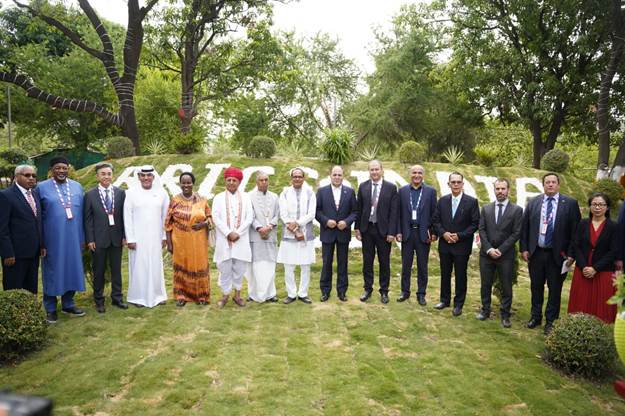
While specially appreciating the hosting of Indore, Union Minister Shri Shivraj Singh Chouhan said that in accordance with the tradition of Malwa, the warm hospitality and reception with which the delegates were welcomed left everyone overwhelmed and delighted. The visits to 56 Dukan, Rajwada and Mandu will remain etched in their memories for a long time. He informed that while advancing Prime Minister Shri Narendra Modi’s call of ‘Ek Ped Maa Ke Naam’, all member countries’ representatives planted trees in Meghdoot Garden and established the ‘BRICS Vatika’ (tree plantation site). Earlier, Global Park and Euro-Russian Park have also been established here. Shri Chouhan highlighted the contribution of the Madhya Pradesh Government, the Chief Minister and his team, as well as all departments of the Government of India including Agriculture, External Affairs, Animal Husbandry and Fisheries, Commerce, Food Processing, NITI Aayog and others, and said that this event is a living example of the success of the ‘Whole of Government Approach’ and ‘Team India’, which made the BRICS meeting in Indore unprecedented and historic.
