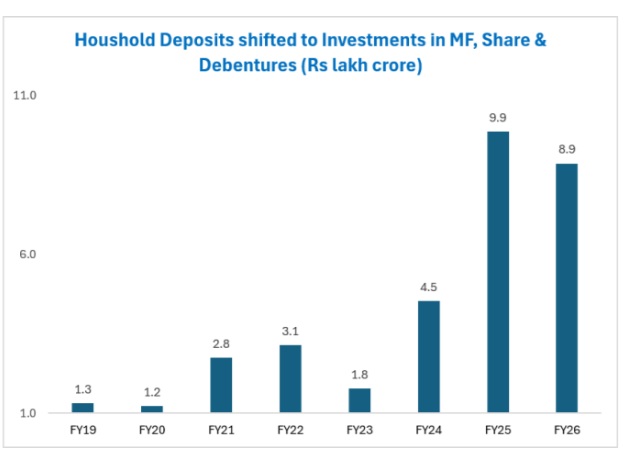
Since FY23, credit growth has consistently surpassed the deposits growth, which has resulted in gap widening to 5.3% in June 2026; Households (HH) remain the largest depositors, but their share is gradually declining as they diversify into mutual funds, equities, and other instruments.
FinTech BizNews Service
Mumbai, July 18, 2026: The State Bank of India’s Economic Research Department has come out with a research report on the credit-deposit growth dynamics in the current banking sector (India). The special report has been authored by Dr. Soumya Kanti Ghosh, Group Chief Economic Adviser, State Bank of India:
Banking system has experienced persistent and rapid expansion in bank credit with a growth of 18.6% for the fortnight ended 30 June’26..Concomitantly, the deposit growth has also improved to 13.3% closely aligning with long term trends in deposit growth, tracking the nominal GDP growth.. Since FY23, credit growth has consistently surpassed the deposits growth, which has resulted in gap widening to 5.3% in June 2026
❑ This phenomenon calls for an explanation by looking at credit and deposit dynamics more closely at granular and system balance sheet level post COVID
❑ Demand side story with Bank Deposits as a proxy reveals 3 major structural changes post COVID
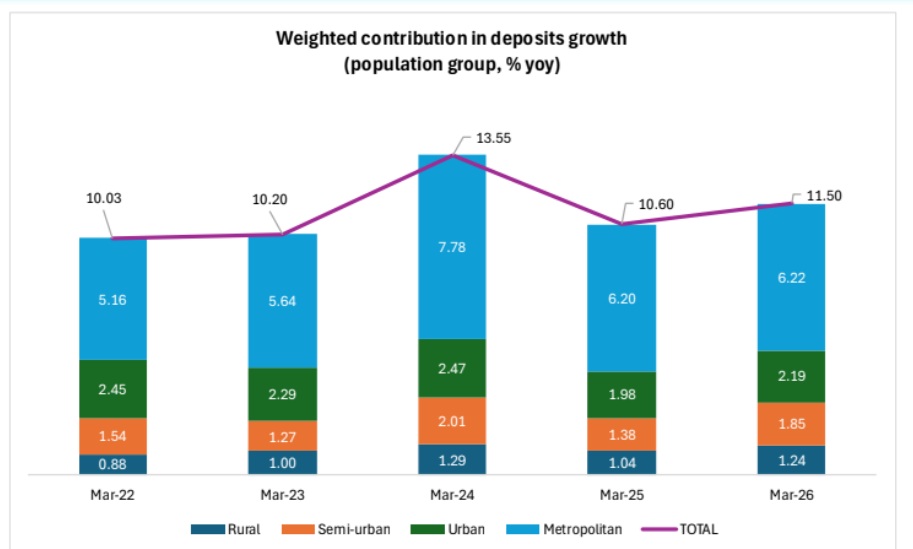
• The traditional deposit markets in large metropolitan regions have saturated and there is a shift in bank deposits towards semi-urban and rural with increasing women empowerment and women centric schemes
• Preference for term deposits has risen across broad institutional sources like nonfinancial and financial corporations away from households with a shift in household savings behavior. Census towns are emerging as the new sources of such institutional deposits. Banks are also mobilizing CASA from institutional sources.
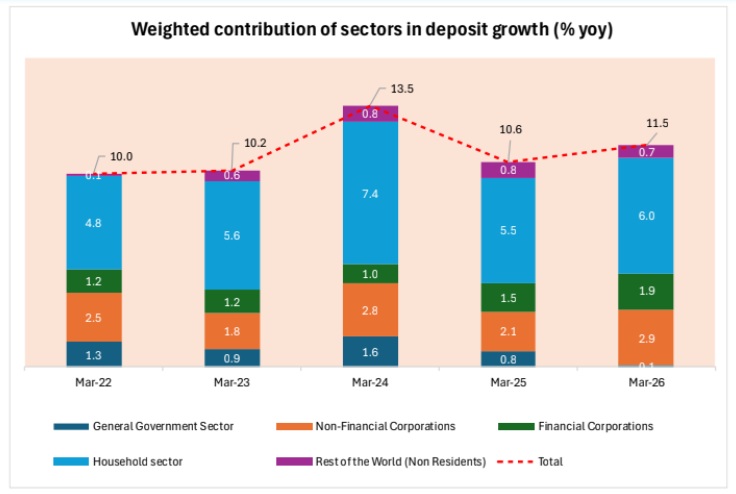
Households (HH) remain the largest depositors, but their share is gradually declining as they diversify into mutual funds, equities, and other instruments.. Share of deposits under Financial Institutions...has increased by 2.6 percentage points during FY22-26...
❑ Separately, the share of deposits under Non-Financial Corporations (Trusts, Societies, Clubs, Educational Institutions accounts etc are being increasingly sourced by Banks to strengthen the CASA base) has jumped by 1.5 percentage points during FY22-FY26
• Rise of term deposits has seen shift in contractual maturity with share of 1–3-year bucket rising as banks strive to balance asset and liability with shift to EBLR regime...FCNR (B) deposit mobilization could result in some shift towards the 5-year bucket as most of the flows are in that category till now
The growth in credit has been persistent since FY23
• In 2024, after RBI regulatory action, the share of personal loans has declined and credit supply has spilled over in industry, finance and other sectors driven by de-risking mechanism of ECLGS
• Post-2022, working capital loans such as cash credit, overdraft, demand loans, export credit have registered relatively faster growth vis-à-vis overall credit and term loans. This pattern is prominently seen in agriculture, industry, services.
This trend coincides with the period characterized by multiple supply side shocks such as COVID-19, Russia-Ukraine War, supply chain disruption and now West Asia conflict
• Share of long-term loans (Housing) have declined in retail loans. With shift to the new tax regime, people are now repaying their loans faster. NBFCs are also aggressively mobilizing housing loans...
❑ A S-VAR model reveal that such supply-side shocks are transmitted asymmetrically across banking aggregates, with bank credit growth responding more strongly than bank deposits growth. Such supply shock invariably creates liquidity gaps through wedge between deposit and credit growth and indicates one of the many dimensions of geopolitical risk to banking system in India, though the recent FCNR(B) deposit mobilization will result in a pickup in deposit growth
• Crude oil shocks are the dominant source of such variation in credit, while food inflation becomes increasingly important for deposits over longer horizons. Furthermore, the shocks of food inflation on deposit accumulates over time horizons rather than dissipating... This conclusion has both historical precedence with similar pattern observed in FY05..
Given the aforesaid analysis, if the geopolitical risk and external supply shocks persists, we expect that wedge between deposits growth and credit growth will persist, though deposit growth will pick up with the onset of FCNR(B) deposits and could shift the dynamics much
❑ This conclusion has both historical precedence with similar pattern observed in FY05
• During 2004-05, average oil price was $41.3 per barrel which was 42.3% higher than average price of $29 per barrel in previous year. The credit growth observed during the same year was 21.7% compared to 13.5% growth a year ago.
Deposit growth which was higher than credit growth in previous year at 17.5% declined to 14.1% completely flipping the credit deposit gap from negative to positive
❑ Indian banks are well-capitalised, with CRAR holding strong and low NPA, providing a significant cushion for credit expansion and absorption of any macro-driven stress.. Indian banks are currently in a goldilocks period... Credit growth is expected to remain strong, supported by consumption demand & capex momentum; Banks to prioritise balance sheet discipline
❑ The policy conclusions that emerge form this analysis are as follows:
• Liquidity management of banks requires different strategy when supply shocks are accounted
• Food inflation has significant impact on deposit mobilization, though impact of food inflation arising out of deficient rains has been contained
• Long term energy decoupling is critical for stable growth and sustained capital formation.. India is doing relatively well on this front
