PSBs earn a higher RoE than PVBs, as they hold less capital for every rupee of assets
FinTech BizNews Service
Mumbai, 14 November, 2026: CareEdge Ratings has released its latest report on Bank Profits, which provide useful sectoral analysis:
Net profit of scheduled commercial banks (SCBs) rose 20% y-o-y to Rs 1.16 lakh crore in Q2FY27, led by higher net interest income. Strong loan growth and a weak base a year ago also helped.
• Stake-sale and NSE IPO gains at large public sector banks (PSBs) added about Rs 10,000 crore to the profit in Q2FY27. Excluding one-time items in both years, profit grew about 16% y-o-y and was also lower than in Q1FY27.
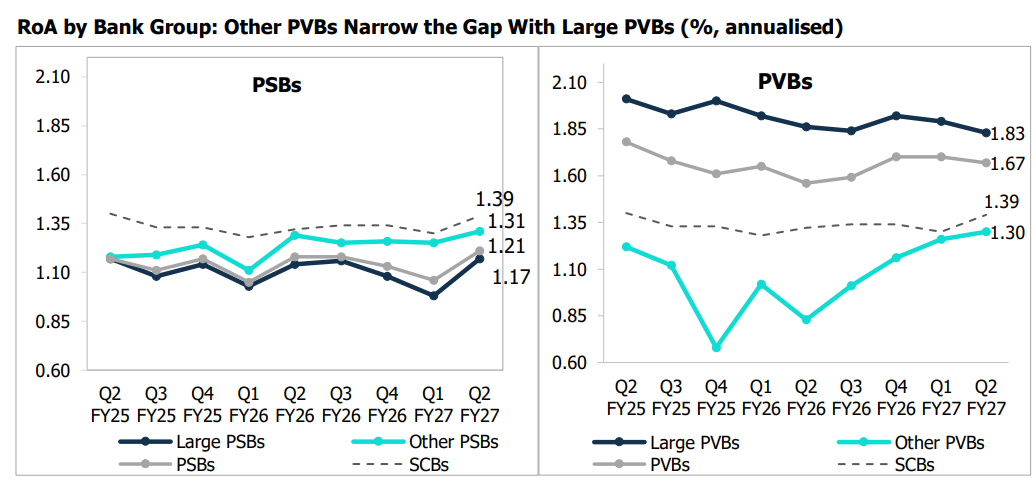
• Return on assets (RoA) rose 7 bps y-o-y to 1.39%, the highest since Q2FY25, mostly because of one-time gains. Excluding one-time items, it was broadly unchanged from a year ago.
• Median return on equity (RoE) rose 79 bps y-o-y to 13.6%. Other private banks gained the most, as lower provisions lifted their profit.
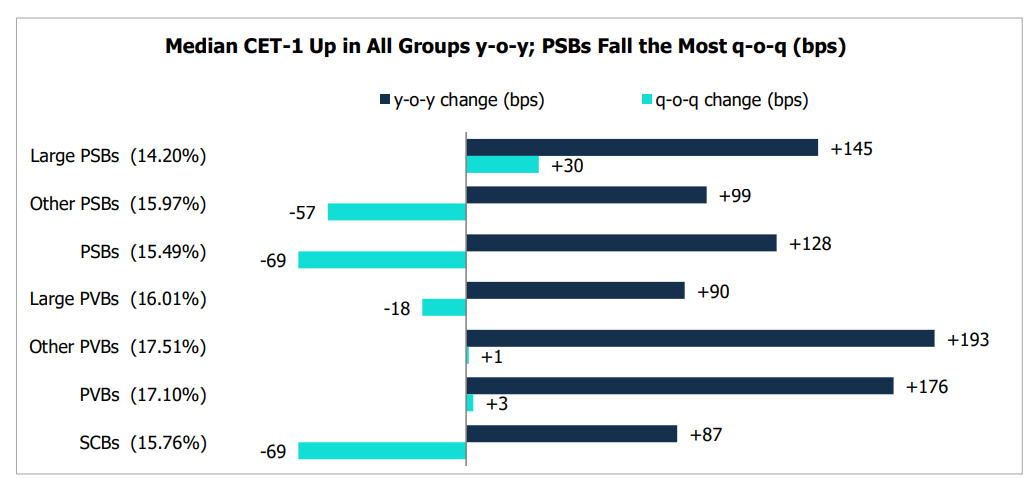
• Median Common Equity Tier 1 (CET-1) ratio rose 87 bps y-o-y to 15.8%, though it eased from Q1FY27 in the usual second-quarter dip. Every bank is well above the regulatory requirement.
• Profit growth is likely to moderate in H2FY27. One-time gains are likely to fade, treasury income may stay weak, and banks are likely to build provisions ahead of the move to expected credit loss (ECL) rules. “Core lending drove bank earnings this quarter. Operating profit grew 13-15% y-o-y in both bank groups, so provisions explain the gap in their profit growth. Other private banks are catching up as credit costs ease. Their return on assets now trails the large private banks by about 50 bps, half the gap a year ago. Large private banks expect margins to improve after Q3FY27 as they lend out the FCNR(B) deposits. Higher provisions ahead of the ECL rules may lower returns.” - Vineet Jain, Senior Director, CareEdge Ratings.
Bank Net Profit Rises 20% to Rs 1.16 Lakh Crore as Net Interest Income Grows 15.4%
SCBs’ net profit rose 20.0% y-o-y to Rs 1.16 lakh crore in Q2FY27, staying above Rs 1 lakh crore for the fourth consecutive quarter. The growth came mainly from higher net interest income (NII), as bank credit grew about 19%. In Q1FY27, by contrast, a 12.8% fall in provisions was a key driver of profit growth. Treasury income fell sharply as bond yields rose during the quarter. Part of the 20% growth also reflects a weak base, as profit had grown only 4.2% y-o-y in Q2FY26.
PSBs and private sector banks (PVBs) grew operating profit at a similar pace, and the gap in their net profit growth came from provisions. PSBs’ net profit rose 15.9% y-o-y. FCNR(B) inflows helped them replace costlier bulk deposits, but provisions rose as some banks began setting aside money ahead of ECL. PVBs’ net profit rose 25.1% y-o-y, as provisions fell sharply at other PVBs after stress in microfinance and unsecured loans eased. The PVB figure is also helped by a weak base, as their profit had fallen 4.0% y-o-y in Q2FY26.
One-Time Items Add About Rs 10,000 Crore; Net Profit Up 15.7% y-o-y Excluding Them
One-time items affected all three quarters compared in this report. In Q2FY27, large PSBs booked gains from a stake sale in an asset management subsidiary and from the NSE IPO. Q1FY27 carried a legal settlement charge at a large PSB, and Q2FY26 had stake-sale gains at two PSBs and a one-time provision at a large PVB. Excluding these items, net profit rose 15.7% y-o-y and fell 4.5% q-o-q, so the entire sequential rise in reported profit came from one-time items.
Banks’ Return on Assets Rises 7 bps y-o-y to 1.39%; Up 1 bp Excluding One-Time Items
SCBs’ RoA rose to 1.39% in Q2FY27, the highest since Q2FY25, though almost all of the y-o-y gain came from onetime items. NII and lower costs and provisions relative to assets supported RoA, while lower treasury income held it back. The fall in the cost ratio reflects faster asset growth, as operating expenses still rose 8.2% y-o-y. Banks mobilised about USD 133 billion under the RBI’s FCNR(B) swap window between June 8 and August 31, 2026, which enlarged balance sheets before the funds could be fully lent out.
The FCNR(B) inflows affected the two groups differently. PSBs used them to replace costlier bulk deposits, which lifted their NII as a share of assets. Large PVBs had not yet lent out much of these funds, which weighed on their margin, and their RoA slipped 4 bps y-o-y. Excluding one-time items, large PSBs’ RoA also fell, mainly because of lower treasury income. Other PVBs were the main gainers. Their RoA rose 47 bps y-o-y as credit costs eased, and the gap with large PVBs narrowed to about 50 bps from about 100 bps a year ago.
Sequentially, SCBs’ reported RoA rose 9 bps, but it fell 10 bps excluding one-time items. Higher provisions and operating expenses at some large PSBs, including one-time staff and technology costs, drove the decline.
Banks’ Median Return on Equity Rises 79 bps y-o-y to 13.6%; Other PVBs Gain the Most
SCBs’ median RoE rose 79 bps y-o-y to 13.56%, as profit grew faster than net worth. Excluding one-time items, the rise was smaller, at 38 bps y-o-y. More banks had RoE above 15%, and fewer had RoE below 10%. Other PVBs gained the most, with their median RoE up 240 bps y-o-y, though it still trails PSBs. Several of these banks raised fresh equity over the past year, and it may take time for this capital to earn returns. PSBs earn a higher RoE than PVBs, as they hold less capital for every rupee of assets. Large PVBs were the only group where the median fell, because of a decline at the largest bank in the group.
Median CET-1 Rises 87 bps y-o-y to 15.8%; Eases 69 bps q-o-q in Usual Q2 Dip
SCBs’ median CET-1 rose 87 bps y-o-y to 15.76%, as banks retained profits and a few raised fresh equity. Sequentially, it fell 69 bps, with 24 banks reporting a lower ratio. This is in line with the usual pattern, in which the ratio rises around the year-end and in Q1, and falls in Q2 and Q3 as loan growth uses up capital. A similar fall was seen in Q2FY26.
Higher bond yields also reduced gains held in banks’ available-for-sale (AFS) reserves this quarter, and FCNR(B) funds lent out added to risk-weighted assets. PSBs saw the largest q-o-q fall, led by other PSBs, while the median for large PSBs rose, helped by one-time gains. Over the year, the ratio rose most at other PVBs, several of which raised fresh equity, including a large strategic investment at one bank.
Median Capital Adequacy Ratio Rises 71 bps y-o-y to 17.9%, Well Above the 11.5% Requirement
SCBs’ median capital adequacy ratio (CAR) rose 71 bps y-o-y to 17.86%, less than CET-1, as Tier 2 capital continued to shrink. Older Tier 2 bonds lose part of their capital value each year as they near maturity, and new issuance has not kept pace with balance sheet growth. All banks in the sample remain well above the 11.5% requirement. Most large banks are unlikely to need fresh equity at current growth rates, and plans to raise capital are mainly at smaller banks.
Bank Profit Growth Likely to Moderate in H2FY27 Profit growth is likely to moderate in H2FY27. Treasury income is likely to stay weak, as the 10-year G-sec yield rose further to 7.39% by October 19, and the one-time gains of Q2FY27 are not expected to recur. Provisions may rise as more banks build buffers ahead of ECL from April 1, 2027. Most PSBs have guided for RoA of at least 1% for FY27, and large PVBs expect the pressure on margins from FCNR(B) deposits to continue in Q3FY27 before easing. CET-1 may come under some pressure as banks expect faster loan growth, though current buffers should allow most banks to absorb the ECL transition.
CareEdge Ratings’ View
According to Saurabh Bhalerao, Director, CareEdge Ratings, “Banks remain well capitalised. Median CET-1 is about 15.8%, nearly 90 bps higher than a year ago, and the dip from the June quarter is in line with the usual secondquarter pattern. The big event ahead is the switch to expected credit loss rules on April 1, 2027. The one-time impact will be adjusted against reserves and can be phased into capital ratios until March 31, 2031. Many banks are already setting money aside for this from current profits, which will lower reported returns in the coming quarters. With today’s buffers, we expect most banks to absorb the change without raising fresh equity, though smaller, fast-growing banks may continue to raise capital.”
