EXCHANGE RATE MANAGEMENT REMAINS A MAJOR CONCERN
FinTech BizNews Service
Mumbai, 12 September, 2026: The SBI Ecowrap from the State Bank of India’s Economic Research Department deals with the likelihood of rate hike and exchange rate management. The report has been authored by Dr. Soumya Kanti Ghosh, Group Chief Economic Adviser, State Bank of India.
Tempus fugit, or Time flies is a great saying since ages often accredited to Virgil. Seems, it just gets truer for financial markets going by the turn of events plaguing markets globally, with a panic like situation not far from the shores. Just one month back there were practically not much talks of rate hikes, and MOST (if not all) expected a “prolonged pause”. But the situation has changed drastically since then. Now we strongly advocate a 25-bps rate hike in the upcoming October policy (followed by another in December in quick succession), factoring the myriad evolving undershoots as detailed in this report. Out rate hike call is agnostic to August CPI inflation print that could comes around 4.8-4.9%. If oil prices remain at high levels, inflation print for October and November should move towards 6.5% or higher.
First, crude prices recently crossed the $100/bbl mark amid heightened geopolitical uncertainties and our results from the quantile regression indicates that at 60th quantile over the next 15-days the prices can reach $123 / bbl.
Second, CPI inflation is showing incipient signs of generalizations. The risk of further generalization is particularly pronounced in sectors where input prices are currently rising faster than output prices, suggesting that the pass through has not been enough on producer’s side, evident in Crude Petroleum & Natural Gas, beverages, pharmaceuticals, electronics etc. Going forward this could result in greater pass-through from producer prices to final prices especially in case of Crude Petroleum & Natural Gas as its imported share of 31.3%. This provides a case for a rate hike now, followed by another in December (Total 50 bps as a moat).
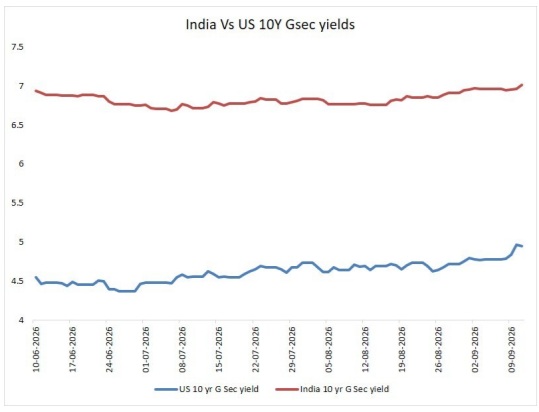
Further, globally, yields are inching past decadal highs surefootedly (we leave the pandemic disruptions for smoothening purposes) due to whirling synergy of multiple factors. A notable off-shoot is the vaulting US yields, 10Y within striking distance of 5% now (something unthinkable by majority of markets till a few days back ) while 30Y has pulled back towards 5.40%, after a short lived reprieve emanating from the Treasury Department’s tantrums to smoothen the longer end of the curve through elevated repurchases. Latest data shows tepid response to Treasury’s first expanded buyback putting a question mark on efficacy and efficiency of policy tools to counter market mayhem (read: recent US Treasury Bond buybacks). With US PPI up 0.4% in August (up 5.4% for the 12 months ended in August ‘26 while core PPI too is 4.6%), markets are reading between the lines of CPI (All Urban Consumers), which rose 0.4 percent, seasonally adjusted (SA), further having a bearing on Fed’s rate hike probability (~71% now) though the Fed may still toy with other measures for now.
An interesting, yet alarming analysis is that US increase has been dominated by the real-yield component, alongside a substantial rise in estimated term premium but other jurisdictions show more of local factors effects.
Back home, with benchmark Indian yields crossing 7% today (last seen on June 3 this year), we believe domestic liquidity can support the front end to some extent though not necessarily eliminating long-end pressure as an oil shock can work through several channels simultaneously. That essentially can checkmate the Mint Street strategy to keep volatility low and borrowing costs in check, signaling 10Y yields to travel some more miles (~10-15 bps), testing the May/March highs first but not limiting themselves there. We believe 10 year yields should move up towards 7.15% or even higher tracking multiple cues.
Against evolving scenario, this liquidity bulge looks more short-term in nature, tapering as we enter the festive season and should be absorbed optimally within the next 3/4 months rendering RBI to find it less plausible to implement structural measures such as CRR or MSS/OMO (the last resort ideally going by today’s numbers and response) operations. Also, going by the logic that RBI has concentrated more on OMOs targeting the short end of the curve, there is a fair likelihood of its tilting towards a possible rate hike should the brawl come to a fight. Also, we estimate the liquidity to steadily taper through the remaining part of FY27 and it ideally should stand at ~Rs 6 lakh cr by March27 (sans accelerated OMOs).
Clear, credible and consistent communication by the RBI is essential for anchoring inflation expectations, maintaining policy credibility and ensuring that temporary price pressures do not become entrenched in broader inflation dynamics. A shallow rate hike should serve many purposes at this juncture, most important building confidence in agility of the RBI. Also, it can go a long way in RBI leading the way in setting the course, and tone for others (read DMs) to follow!
