Presented amid heightened global uncertainties, the Budget rightly prioritises sustaining India’s growth momentum.
FinTech BizNews Service
Mumbai, 2 February 2026: Union Minister for Finance and Corporate Affairs, Smt. Nirmala Sitharaman tabled the Union Budget 2026-27 in the parliament on Sunday 1st February 2026. FM Sitharaman said that the Government led by Prime Minister Narendra Modi, has decisively and consistently chosen action over ambivalence, reform over rhetoric and people over populism.
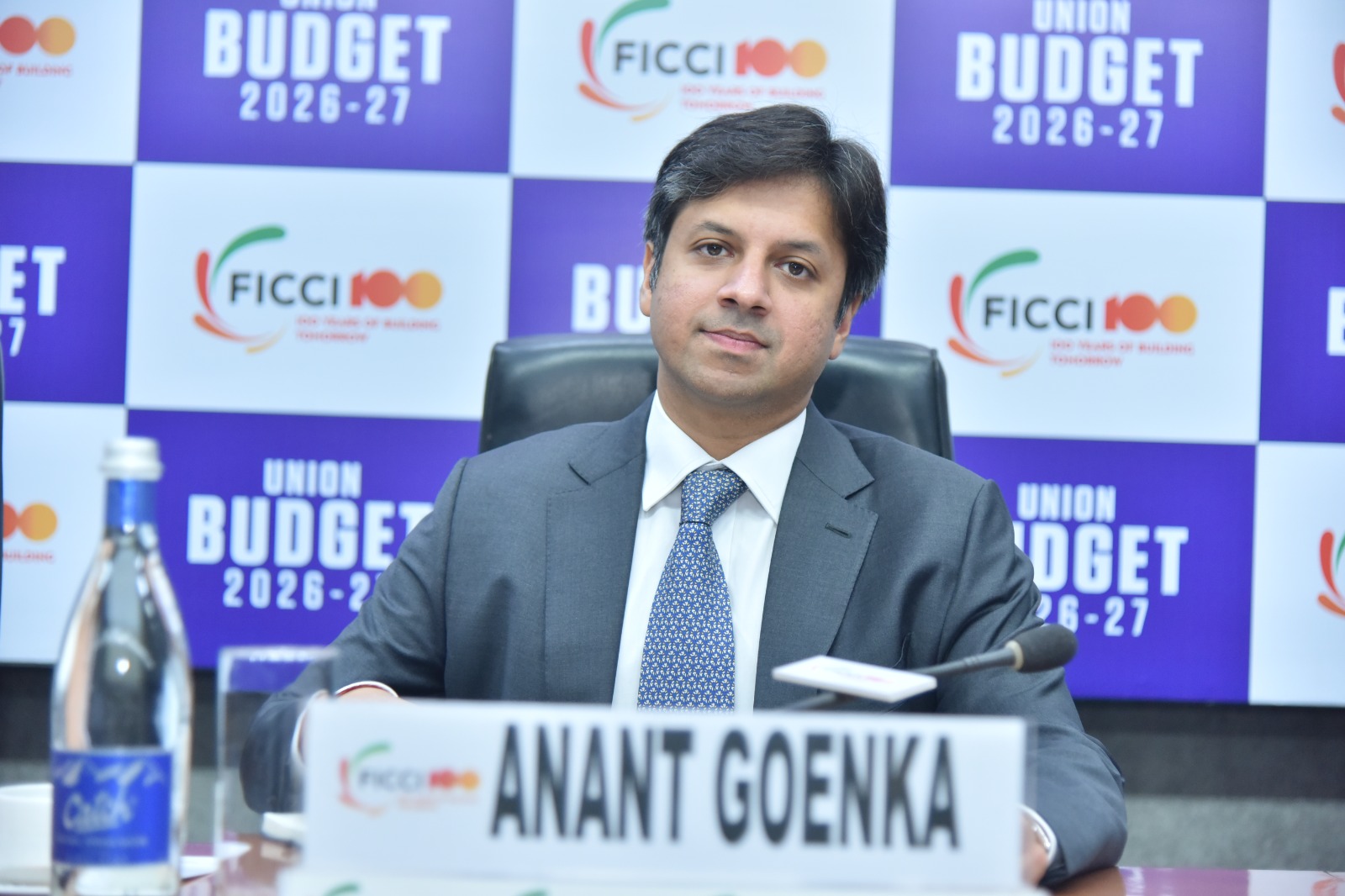
Commenting on the Union Budget 2026–27 announced earlier today, Mr Anant Goenka, President, FICCI said, “The Budget strikes a balanced and credible note, with a clear focus on growth, inclusivity and yuva-shakti. FICCI commends the Finance Minister for ensuring continuity and stability through sustained reforms, a strong public capex push, ease of doing business and a decisive emphasis on manufacturing, MSMEs, agriculture and services.”
He added, “Presented amid heightened global uncertainties, the Budget rightly prioritises sustaining India’s growth momentum. The proposals announced today reinforce confidence that the Government remains firmly committed to strengthening the core growth levers of the economy, aligned with the long-term vision of Viksit Bharat.”
FICCI has consistently emphasised the importance of Atmanirbharta for long-term economic resilience, and this Budget provides a clear thrust in that direction. The proposals to scale up manufacturing across seven strategic and frontier sectors, including bio-pharma, critical minerals, electronics and capital goods, will strengthen India’s manufacturing ecosystem, reduce import dependence and create large-scale employment opportunities for the youth.
Support for labour-intensive, export-oriented sectors such as textiles, marine and leather will help maintain export competitiveness despite a challenging global environment. The revival of 200 legacy industrial clusters, many of them in traditional sectors, will further enhance industrial productivity and regional competitiveness.
MSMEs stand to benefit significantly from improved access to finance. The Rs10,000 crore SME Growth Fund, enhanced allocation to the Self-Reliant India Fund, and strengthened liquidity support through the TReDS mechanism will provide much-needed financial depth to micro and small enterprises.
The impetus given to infrastructure, with public capital expenditure rising to Rs12.2 lakh crore, will support growth momentum, crowd in private investment, reduce logistics costs and generate employment. Investments in dedicated freight corridors, national inland waterways, ship-repair ecosystems and the Coastal Cargo Promotion Scheme signal a decisive push towards a more efficient, multimodal logistics framework.
The Budget also provides an important boost to the services sector, with focused interventions in healthcare, education, tourism, skilling and training - key to employment generation and inclusive growth.
The continued focus on agriculture and farmer incomes, particularly through targeted support for high-value crops in coastal and North-Eastern regions, is a welcome step. Dedicated programmes for coconut, cashew, cocoa, sandalwood, walnuts, almonds and pine nuts will help rejuvenate these sectors by improving productivity, enhancing exports and generating quality employment.
On the reform front, the Government’s commitment to sustaining the Reforms Express is encouraging. Structural measures proposed in the financial sector, including the High-Level Committee on Banking, restructuring of Power Finance Corporation and Rural Electrification Corporation, review of FEMA (Non-Debt Instruments) Rules, and initiatives to deepen corporate and municipal bond markets, will strengthen the financial system and support India’s growing capital needs.
FICCI also welcomes the measures announced to enhance ease of doing business and ease of compliance, including tax simplification, decriminalisation, tariff rationalisation and trade facilitation. The incentives and tax certainty measures aimed at attracting global capital are a strong positive and will further reinforce India’s position as a preferred destination for foreign investment.
