India’s deep-rooted affinity for gold remains intact, with consumption patterns gradually evolving towards the investing rather than the holding the physical gold.
FinTech BizNews Service
Mumbai, April 17, 2026: Kotak Securities has come out with a Special Report on Gold on the auspicious occasion of Akshaya Tritiya. The report has been authored by Kaynat Chainwala, AVP Commodity Research, Kotak Securities.
Introduction and price performance
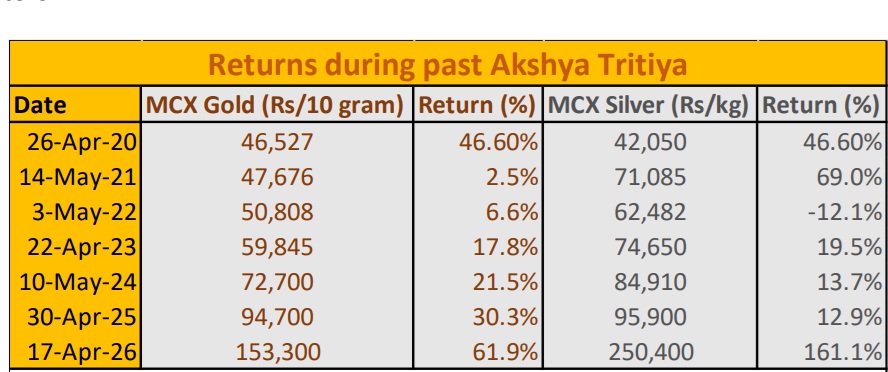
As India celebrates Akshaya Tritiya on 19th April 2026, retail investors are once again focusing on bullion as a preferred avenue for wealth creation. Regarded as one of the most auspicious occasions in the Hindu calendar, the festival symbolizes prosperity and good fortune, with gold purchases traditionally believed to bring enduring wealth. Recent price performance of gold further strengthens this sentiment. Over the past year, gold has delivered gains exceeding 60%, marking one of its strongest rallies in recent annual cycles. This has been supported by geopolitical uncertainties, sustained central bank buying, and resilient investment demand. Gold’s consistent track record during Akshaya Tritiya periods emphasizes its role as a reliable fundamental holding for long-term portfolio constancy. Silver, however, has outpaced gold significantly, surging about 160% over the same period. The rally has been driven by a combination of safe-haven demand and strong industrial consumption, particularly from renewable energy and electronics sectors. While silver offers higher return potential due to its greater sensitivity to economic cycles, it also comes with higher volatility, making gold and silver together a balanced approach for retail investors.
India gold demand trends: Investment strength offsets Jewellery demand weakness
According to the World Gold Council (WGC), elevated bullion prices are reshaping India’s gold demand dynamics, with consumers increasingly adopting staggered purchases and exchange-led buying. Jewellery demand remains relatively subdued, while investment demand, particularly coins, bars, and ETFs, continues to strengthen. This shift shows evolving consumer behavior, with investors increasingly favoring lighter, value-oriented purchases and younger participants adopting regulated investment avenues like gold ETFs. While Akshaya Tritiya continues to act as a key trigger for seasonal demand, overall volumes are likely to remain measured despite steady participation driven by cultural significance. In Q1 2026, investment demand particularly bars, coins, and ETFs remained robust, offsetting a sharp decline in jewellery consumption. Persistently high prices, which touched record levels above Rs1,80,000 per 10 grams, have significantly curtailed discretionary buying, with annual demand projected to moderate to 600–700 tons from the high of over 810 tons in 2024 and 710 ton in 2025. As per the WGC, consumer behaviour towards jewellery is evolving, with a shift toward lower caratage and lightweight designs to manage affordability. Additionally, gold recycling has surged, accounting for an estimated 40–70% of purchases through exchange transactions. On the supply side, domestic prices are trading at a premium to global benchmarks amid concerns of import disruptions linked to geopolitical tensions. Market feedback indicates that while earlier price rallies supported investment demand, recent volatility has led to cautious buying, with many consumers deferring fresh physical purchases.
Gold ETFs witness steady inflows amid rising retail participation
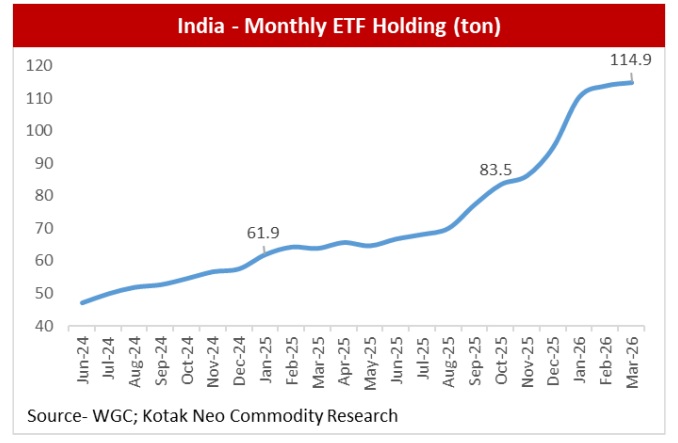
Gold ETFs in India continued to attract investor interest in March 2026, marking the eleventh consecutive month of net inflows, though at a moderated pace. Net inflows stood at US$176.6 million, adding 1.1 tonnes to holdings, with the slowdown largely due to profit-taking after strong earlier gains. Despite this, investor participation remains robust, with total folios rising to 12.1 million, indicating growing retail participation. Q1 2026 inflows stayed strong overall, supported by price momentum and portfolio diversification needs as the total holdings increased to 114.9 tonnes, while AUM reached record highs. Moreover, elevated prices and market volatility have led to a balanced trend of fresh inflows along with selective redemptions, showing a more mature and dynamic investor approach toward gold ETFs.
Akshaya Tritiya 2026: A balanced approach to gold and silver Investing
Gold demand is expected to remain firm in value terms, although jewellery volumes may stay moderate due to elevated prices. Investment-oriented products such as coins and small bars are likely to see strong traction, continuing the shift toward practical and liquidity-friendly formats. India’s deep-rooted affinity for gold remains intact, with consumption patterns gradually evolving towards the investing rather than the holding the physical gold. From a broader perspective, gold continues to be supported by persistent global uncertainties, including fiscal imbalances, geopolitical tensions, and ongoing diversification by central banks away from fiat assets. Short-term volatility, driven by shifting interest rate expectations and liquidity conditions, should be viewed as an opportunity for gradual accumulation rather than a deterrent. For retail investors, maintaining a gold allocation of 8–15% remains a prudent strategy for portfolio stability. Additionally, this year presents a compelling case to include silver as a tactical allocation. With its dual role as a precious and industrial metal, silver offers higher return potential over the medium term. A balanced allocation of 75–80% in gold and 20–25% in silver, can help enhance portfolio resilience while capturing diversified opportunities in the evolving precious metals market.
Outlook
Bullion markets continue to show a positive underlying trend, despite trading near elevated levels and experiencing intermittent volatility driven by shifting risk sentiments. Supportive factors include expectations of monetary easing, lower real yields, ongoing geopolitical uncertainties, and sustained central bank demand. However, potential easing of geopolitical tensions, a stronger US dollar, and demand moderation at higher prices may limit near-to-medium term upside. Gold remains well-supported as a hedge against macro and geopolitical risks, while silver may offer higher return potential with greater volatility due to its industrial linkage. On MCX, gold has rebounded about 30% from its March lows to trade above Rs1,50,000, with support near Rs1,40,000 and resistance at Rs1,60,000–Rs1,75,000. A breakout could extend gains towards Rs1,80,000 and Rs2,00,000, while downside risks persist below support levels towards Rs1,25,000 and Rs1,10,000.
