CareEdge Ratings’ latest analysis: Credit Card Average Monthly Spend Tops Rs 2 Trillion; Credit card Issuance Outpaces Utilisation
FinTech BizNews Service
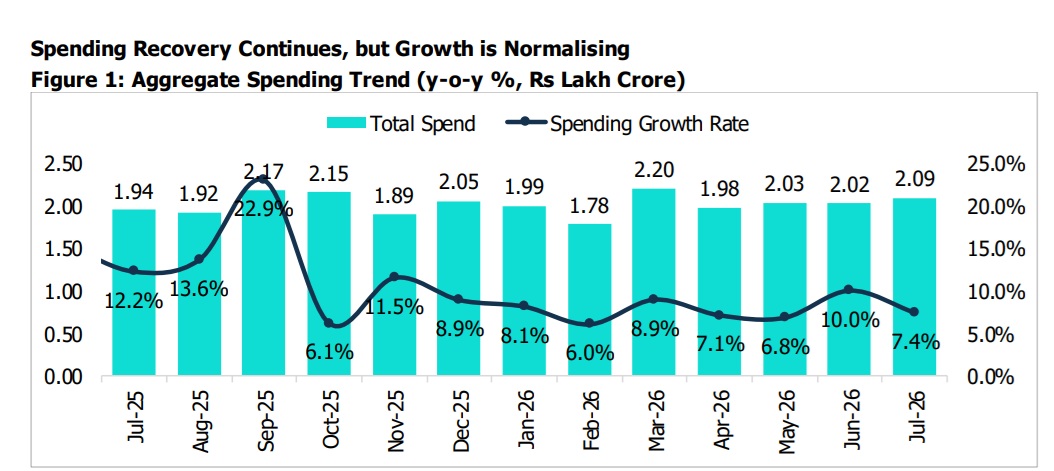
Mumbai, 28 August, 2026: CareEdge Ratings’ latest analysis highlights a key shift in the credit card ecosystem: issuance is accelerating faster than utilisation. While credit card spends recovered to Rs2.09 lakh crore in July 2026, the outstanding card base crossed 12.29 crore, its fastest growth pace in over a year.
Key insights:
• Credit card spending rose 7.4% y-o-y and 3.4% m-o-m, indicating resilient consumption demand despite normalising growth rates.
• Card issuance grew 10.1% y-o-y, outpacing spending growth and resulting in softer per-card utilisation.
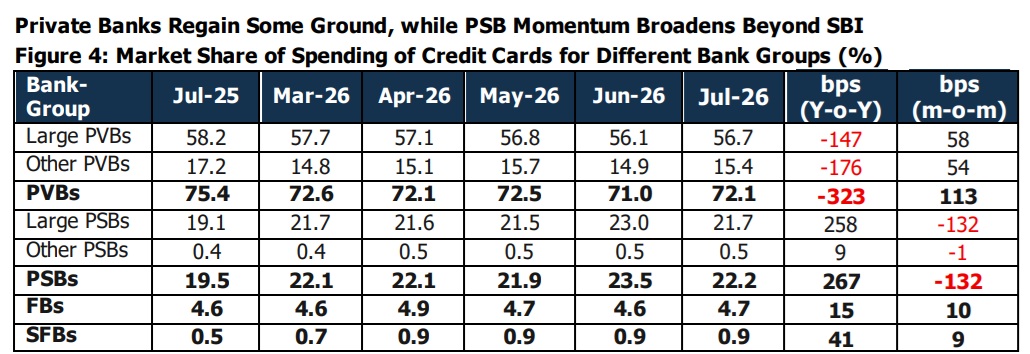
• The structural story remains favourable for PSBs, with growth momentum increasingly broad-based beyond SBI.
• Online channels continued to dominate, accounting for 63.5% of total credit card spends.
• The next growth phase will depend less on card issuance and more on customer activation, engagement, and wallet-share expansion.
Spending momentum remains intact, but utilisation is emerging as the key monitorable. Credit card spends recovered to Rs 2.09 lakh crore in July 2026, while the card base expanded at its fastest pace in over a year, crossing 12.3 crore.
• The resulting divergence between card growth at 10.1% y-o-y and spending growth at 7.4% y-o-y has led to softer per-card spends, indicating that penetration gains are outpacing usage.
• While private banks (PVBs) regained some market share during the month, the broader structural trend remains favourable for Public Sector Banks (PSBs), whose growth is increasingly extending beyond SBI.
• Looking ahead, CareEdge expects credit card spending in August 2026 to remain in the range of Rs 2.04-2.09 lakh crore. Additionally, with festive demand expected to strengthen from September and card penetration continuing to deepen, industry growth remains healthy.
• However, future performance will depend more on customer activation and spending engagement than on issuance alone.Credit card spending rebounded to Rs 2.09 lakh crore in July 2026, rising 7.4% y-o-y and 3.4% m-o-m, marking the highest monthly spend since March 2026 and exceeding the Rs 1.98-2.03 lakh crore range observed over the preceding three months. Cumulative spending for April-July FY27 increased 7.8% y-o-y to Rs.8.11 lakh crore, reflecting sustained momentum in consumer spending.
• While y-o-y growth moderated from 10.0% in June 2026, the slowdown primarily reflects an elevated base rather than weakening demand. The sequential recovery in spending suggests consumption activity remained healthy, even as growth rates normalised. Private and foreign banks drove the monthly recovery, with spending increasing 5.0% and 5.7% m-o-m, respectively. However, PSBs continued to outperform on a y-o-y basis, recording 22.3% growth compared with 11.1% for foreign banks (FBs) and 3.0% for PVBs, indicating that market share gains by PSU issuers remain structurally intact despite month-to-month volatility.
• The improvement in card spending was supported by a favourable consumption backdrop. Gross GST collections grew 15.4% y-o-y, the strongest pace in 14 months, while automobile retail registrations increased around 26% y-o-y, underscoring resilient consumer demand and continued economic activity.
• The July performance points to a normalisation in growth rather than a slowdown in demand. While PVBs led the sequential recovery, PSBs continue to gain traction structurally, supported by stronger growth rates and expanding customer adoption. When read alongside the consumption indicators, the data indicates a constructive outlook for credit card spending in the run-up to the festive season.
The outstanding credit card base rose to a record 12.29 crore cards in July 2026, registering 10.1% y -o-y growth, the fastest pace in the past 15 months. Net additions remained robust at 12.7 lakh cards, exceeding the 11.4 lakh added in June and extending the acceleration in card issuance to a fourth consecutive month. The sustained momentum indicates that issuers are focusing on customer acquisition and market penetration. • PVBs remained the primary drivers of industry expansion, with their card base growing 9.8% y -o-y to 8.69 crore, supported by strong digital onboarding capabilities and extensive retail distribution networks. While PSBs reported a relatively lower growth of 8.9% y-o-y, the composition of growth is becoming increasingly broadbased. Notably, PSBs excluding SBI recorded a stronger 15.5% y-o-y increase, significantly outpacing SBI's 7.1% growth, which could indicate some diversification of card issuance. • In contrast, FBs continued to rationalise their credit card portfolios, with the outstanding card base declining 6.5% y-o-y to 0.42 crore. The contraction reflects an ongoing strategic shift away from scale-driven card issuance toward higher-yield, affluent customer segments. The announced transfer of a select retail card portfolio to a domestic PVB further reinforces this trend of portfolio optimisation over market share expansion. • The July data highlights the divergence between penetration and utilisation trends. While card issuance is accelerating, growth is being driven by customer acquisition rather than spending intensity. The broadening participation of non-SBI PSBs represents a notable structural development, while FBs continue to prioritise profitability and customer quality over card volumes.
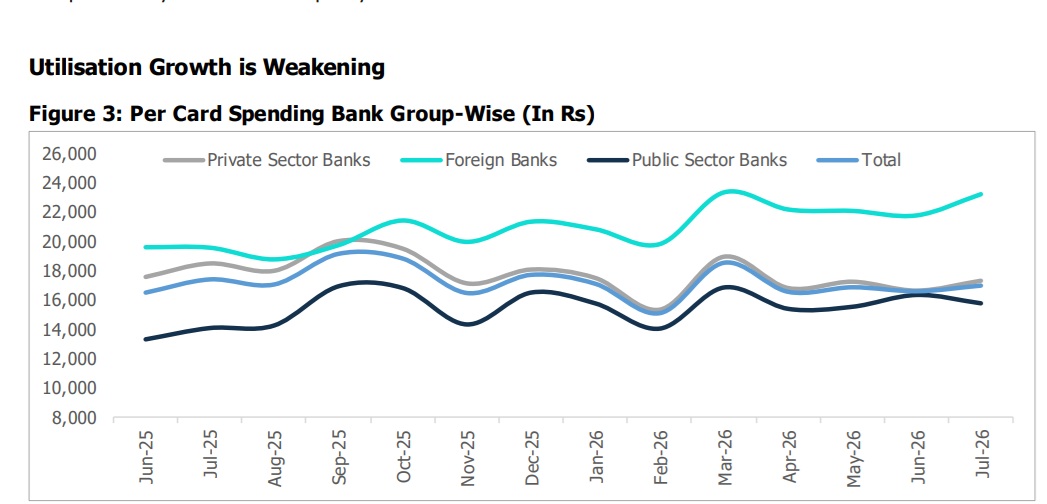
Per-card spending recovered sequentially to Rs 16,976 in July 2026, up 2.3% m-o-m, reflecting the improvement in aggregate card spends. However, it remained 2.4% lower on a y-o-y basis as the credit card base expanded faster (10.1%) than overall spending (7.4%). This divergence suggests industry growth is increasingly driven by customer acquisition, while the spending intensity of new cardholders has yet to converge with that of the existing customer base. • Across bank groups, spending intensity trends remained divergent. Per-card spending for PVBs stood at Rs 17,308, declining 6.4% y-o-y but improving 4.1% sequentially, indicating pressure from rapid card additions. In contrast, PSBs reported per-card spending of Rs 15,767, up 12.0% y-o-y despite a 3.5% m-o-m decline. Consequently, the spending intensity gap between PVBs and PSBs widened to Rs 1,541 in July from just Rs 295 in June, indicating that the apparent convergence seen in the previous month was largely driven by temporary factors rather than a structural shift in spending behaviour. • FBs continued to exhibit the highest spending intensity, with average spends of Rs 23,216 per card, up 18.7% y-o-y. The increase reflects an increasingly premium customer mix, as portfolio rationalisation and a shrinking card base have concentrated spending among higher-value cardholders. This highlights FBs' ongoing strategic emphasis on profitability and customer quality over scale. • Looking ahead, per-card spending is expected to strengthen as festive-season demand gathers pace. However, the sustainability of this recovery will depend on issuers' ability to activate recently acquired customers and translate a rapidly expanding card base into higher transaction volumes. While UPI continues to constrain card usage in lower-ticket transactions, the industry outlook remains favourable, with spending intensity likely to improve alongside festive consumption and greater engagement of new cardholders.
Read Full Report: https://lnkd.in/draf6CSS
