Potential restrictions on US data centre development could encourage hyperscalers to diversify investments, creating opportunities for India’s data centre industry, which is projected to expand to 7.5 GW by 2030.
FinTech BizNews Service
Mumbai, 09 November, 2026: The latest research note, authored by Mr. Apoorva Javadekar, Chief Economist, Shriram Group, offers an assessment of the US midterm election results and their implications for global markets and India.
The report examines the Democratic Party's victory in both chambers of Congress, the resulting sell-off in AI infrastructure stocks, the rotation of investments towards China and India, and the implications for oil prices, financial markets and India's economic outlook.
Key Takeaways
• Result: Democrats won both chambers of Congress in a midterm for the first time since 2006. Highlights include Kansas’s first Democratic Senate win in 94 years and Democratic wins for both governor and Senate in Texas, the most important state for AI infrastructure with 27% of planned US data center capacity.
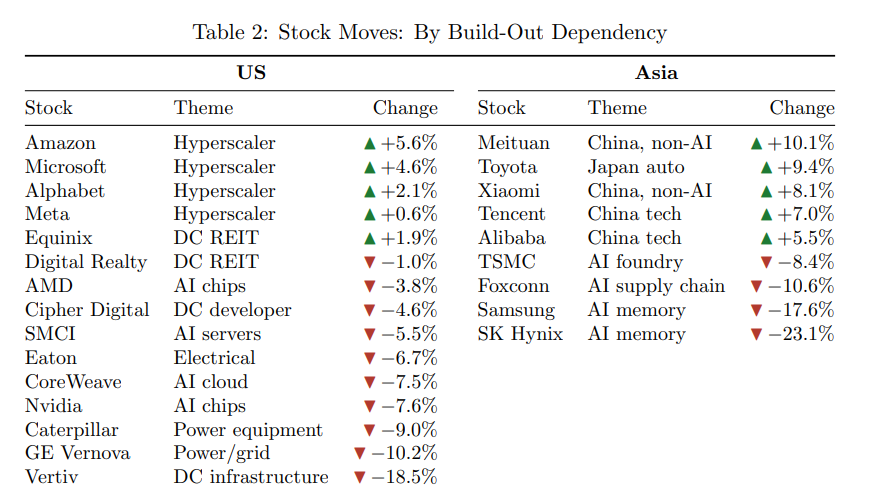
\• AI Rout: The Democratic sweep in Texas triggered fears of data center moratoriums and tighter regulation, driving a sharp repricing of AI infrastructure and build-out-dependent stocks. The Nasdaq 100 fell 3.6%, and the selloff spread beyond the US as SK Hynix and Samsung fell 23% and 18%, respectively.
• Rotation: AI Rout in the US, Taiwan, & Korea triggered a sharp rotation into China and India, with Hang Seng & NIFTY50 gaining 4.7% & 6.8%, respectively, post-elections, also aided by oil’s fall.
• A puzzle: If Kalshi gave Democrats a 94% chance of winning the House and 75% of a sweep on the eve of the vote, why did markets move so sharply after the result?
• Our resolution: Three things were not fully priced: the scale of the sweep; the Texas result (Polymarket gave Democrats only a 40% chance of the governorship on election eve), followed by Governor-elect Hinojosa’s call for a data center moratorium; and what a result this strong implies for the 2028 presidential race, which led markets to rework long-term projections.
• Still a blocking event: Democrats now control both chambers, which adds confirmation power (judges, Fed governors) to the House’s control of funding. But the filibuster and the presidential veto still bind, and trade policy runs on executive powers.
• Oil back to $99/b on Diplomacy Uncertainty: Brent fell about 10% on 4 November on bets that the sweep would hasten an end to the war, but was back near $99 by the 5 November close as the gaps in US–Iran talks became clear, supporting our earlier view that oil prices will be driven more by the White House than by Congress.
• India Is the Standout EM Winner So Far: Nifty is up 6.8%, the rupee closed at 93.81 on 6 November (93.78 at the time of writing), and the 2Y yield is down 17 bps as December RBI rate-hike odds fell. But the 10Y has given back more than a third of its peak rally as oil recovered to $99/b, reiterating our point that India’s gains depend on Iran de-escalation, which is in the White House’s hands.
Results
In a blue wave across the US, the Democratic Party took control of both chambers: the House (D: 252, +38; R: 162) and the Senate (D: 54, +7; R: 44) at the time of writing. Many results stand out: the flip in Kansas (the first Democratic Senate win there in 94 years),
Abdul El-Sayed’s victory in Michigan, Republicans’ loss in Iowa (a state Trump won by 13 points in 2024) and Ohio (Vice President Vance’s former seat) and Maine, where five-term Senator Susan Collins lost. Most notably, in Texas, Gina Hinojosa defeated Governor Greg Abbott to become governor-elect, with Democrats also winning the governorship in Georgia, two of the most important states for data center build-outs.
What changes with both chambers:
Our pre-election baseline assumed a Democratic House and a Republican Senate. We already predicted that losing the House would significantly alter Trump’s ability to secure continued war funding or implement details of OBBBA. On top of that, a Democratic win in the Senate pushes our baseline towards gridlock even more, but with some important nuances.
Filibuster and Veto Still Bind:
With 54 seats, Democrats remain short of the 60 votes needed to overcome a Senate filibuster on most legislation, so Republicans can still block most bills in the Senate. Bills that do clear both houses face a presidential veto, which Trump has shown his willingness to use, and Democrats are well short of the two-thirds majorities needed to override it. Democrats can still force votes to signal their agenda for the 2028 presidential election, even if those bills do not become law.
• Confirmations:
A Democratic Senate can block the administration’s preferred nominees, including Fed governors, from early 2027. This could matter for restoring the Fed’s independence through potential appointments of politically less-aligned board members. The core of our view is unchanged, however; Democrat-controlled chambers are likely to produce political and congressional gridlock, rather than a sharp policy reversal, with tariffs and war or peace talks largely run on Trump’s executive powers. While Democrats may push the narrative of tariff reversal, the short-term loss to the exchequer is a hard reality that will push Democrats to negotiate wider healthcare coverage, the core of their midterm campaign, in return for some cuts to defense spending.
Asset Prices Puzzle:
Going into the vote, prediction markets had all but settled the outcome: Kalshi priced a Democratic House at 94% and a Democratic sweep of both chambers at 75%, up from about 40% in June. Yet the result triggered sharp cross-asset moves.
Resolution: If the outcome was so widely expected, why did markets move so much, and why did the VIX, a gauge of market uncertainty, rise 21% to 25.6? We propose three explanations. First, a sweep of this scale, which markets had not anticipated, raises the Democratic Party’s chances in the 2028 presidential election, prompting the market to reassess long-term projections. Second, on the eve of elections, Polymarket still gave only 40% odds of a Democratic governorship in Texas, suggesting a Texas sweep was a true surprise. Third, Trump’s immediate comment that he is willing to work with Democrats triggered sharp moves in oil and a rally in bonds, along with Hinojosa’s call for immediate moratoriums in Texas on data center build-outs.
Asset Prices (Closing of 6th November):
• Oil: On bets that the sweep would improve the prospects for peace talks, Brent fell to a low of $93.6/b, recovered to about $99 by the 5 November close, and closed at $98.3 on 6 November, 6% below its 2 November level.
• Yields:
With oil prices falling sharply, the market reassessed short- and long-term inflation expectations; 2Y breakeven (gauge of expected inflation) fell from 2.54% to 2.18% (36 bps move), and 10Y breakevens fell by 6 bps. Lower inflation expectations translated into expectations of a more dovish Fed, with the OIS-implied probability of a December rate hike falling from around 75% pre-election to as low as 60%. However, recovery in oil and a strong US jobs report for October (+165K gains in payrolls) pushed back the probabilities to 80% on the morning of 9 Nov. Yields fell in both the US and India, with the front end falling more than the long end (US: 2Y −8.2 bps, 10Y −5.5 bps; India: 2Y −17.1 bps, 10Y −12.5 bps), steepening both curves.
• Gold: Expectations of fewer rate hikes pushed gold above $4000/oz, backed by strong ETF flows in the first week of November. Gold is trading at $4119/oz on the morning of 9 Nov, despite a stronger jobs report which has pushed up the December rate hike odds back to 80%. This suggests gold’s appeal has improved as a safe-haven asset against fiscal and AI risks, given the potential for budgetary gridlock in the US and an AI rout after the Midterms.
• AI: Meanwhile, threats of potential moratoriums on data center build-outs, triggered by a Democratic sweep in Texas, led the tech-heavy Nasdaq 100 to fall 3.6%, and the selloff spread beyond the US borders, with Korea’s KOSPI down 13.6% (triggering a circuit breaker) and Taiwan’s TAIEX down 11.6%. Within Asia, capital rotated towards Chinese and Indian stocks, which have less exposure to AI hardware; together with lower oil, this lifted India’s Nifty 6.8%.
AI Rout (aka Build-Out Rout)
A potential slowdown in data center construction drove a sharp selloff in US AI-linked stocks and a rotation out of Taiwan and South Korea into China and India. A closer look shows the selloff was more specific than the headline indices suggest.
Build-Out Vs. Broad AI/Tech Repricing:
Build-out-focused names (developers and suppliers to data centers such as GE Vernova, Caterpillar, Cipher) and chip or material providers to the data centers (like NVIDIA, SMCI, and AMD) fell a median 7.1% and 5.5%, respectively. Meanwhile, stocks not directly exposed to build-out risk, including five of the Magnificent Seven, gained a median 3.3%. This suggests the market priced a slowdown in US data-center construction while leaving its view of AI demand intact. AI memory and hardware-focused names kept selling (SK Hynix −23.1%, Samsung −17.6%, Foxconn −10.6%, TSMC −8.4%) in Asian markets, pointing to broad repricing of AI infrastructure names.
The Texas Trigger Spread Beyond Texas:
While the moratorium narrative emerging from Texas was the trigger, we find the market repriced build-out-exposed stocks more broadly. Build-out stocks with high Texas exposure fell a median 7.5%, against 7.8% for those with little or none. Cipher Digital, the most Texas-exposed name, with a 5.9 GW pipeline including a 1 GW Texas site, ended just 4.6% lower after much larger intraday losses, while generator and turbine makers supplying to data centers broadly with no Texas pipeline fell about twice as much. Markets used the Texas result as a signal about the regulatory outlook for US data-center construction as a whole. That points to the 2028 channel: a multi-year physical build-out is being repriced for the risk of a less supportive regime after 2028.
Oil: Diplomacy vs Congressional Funding
Our pre-election note argued that a Democratic Congress would not necessarily deliver durable oil relief. Even if Democrats curtail new war funding, oil depends on a lasting reopening of the Strait of Hormuz, which rests on diplomacy and peace talks rather than on Congressional budgets, at least in the short term. Oil was already falling before the vote: Brent dropped from about $112 to $104 on 2 November as signs of progress in US–Iran diplomacy took some of the war-risk premium out of prices. Brent then fell about 10% on 4 November as traders bet that the sweep would hasten an end to the war. It bottomed near $94 on the morning of 5 November (IST) and was back at about $99 by the 5 November close, retracing about half of its post-election fall. The rebound reflected three factors. The sweep produced no immediate diplomatic breakthrough, as some traders had expected, and Trump, who retains his commander-in-chief authority, was still reviewing military options.
Vice President Vance’s public break over the war was read as a political signal rather than a shift in military posture. And the physical market stayed tight, with Hormuz flows only just back to pre-war levels and inventories thin. We expect oil to remain sensitive to comments from the White House and Iranian officials.
Implications for India
India has been the standout EM winner, and the channel is almost entirely oil: • Oil and rates: India imports about 88% of its crude, and every $10/bbl adds roughly 0.3–0.4% of GDP to the net oil import bill. By the 6 November close, the 2Y yield had fallen 17.1 bps as bets on a larger December rate hike faded, more than the 10Y (−12.5 bps), so the curve has steepened. The 10Y had fallen about 20 bps by 5 November and has given back more than a third of that as oil retraced. The rupee gained 1.1% to close at 93.81 per US dollar on 6 November (93.78 at the time of writing), one of the strongest moves in EM FX.
• FII flows:
Foreign investors sold about $26.75 bn of Indian equities in 2026. A correction in AI-linked assets, which has hit Korea and Taiwan hardest, could redirect EM flows towards India. Since 2nd Nov, CDSL data shows that India received net equity inflows of $3.2 bn, which could support a strong rotation strategy in favor of India.
• Tariffs: India’s 10% US tariff and the additional Section 301 duty rest on executive powers that a Democratic Congress cannot unwind against a veto. We do not expect an immediate resolution of tariff risks despite the Democratic narrative against tariffs, as the loss to government revenues would be substantial (gross collection of $23 bn in Sept-26) and Democrats may prioritize the healthcare agenda.
• Data centers: Moratorium risk in Texas and Georgia gives hyperscalers a reason to diversify. India’s capacity is projected to rise about fivefold to 7.5 GW by 2030 (∼$36 bn of investment). India, with its tax holiday, relatively cheap power, engineering talent, and a government actively courting hyperscalers, is well placed to attract some of the investment that developers redirect away from the US.
