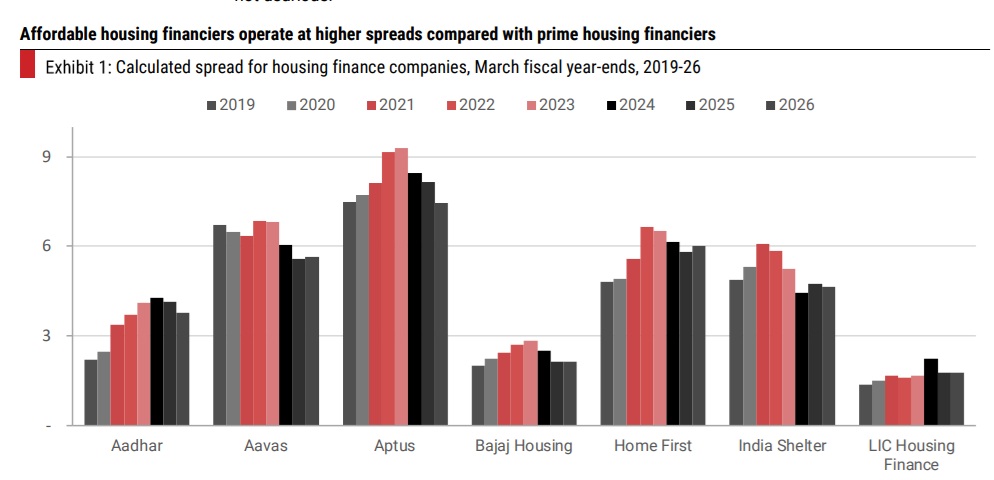
Affordable housing financiers operate at higher spreads compared with prime housing financiers
FinTech BizNews Service
Mumbai, 18 August, 2026: The latest Kotak Institutional Equities report focuses on Diversified Financials.
The RBI has released draft directions on determining interest rates on loans and advances for lenders. We have three readings that are relevant for NBFCs—(1) loans cannot be offered below a benchmark PLR (extant practice in prime home loans), (2) EBLR is not mandatory for HFCs/NBFCs (puts this speculation to rest) and (3) the benchmark on floating rate loans will be reset within three months; this will lead to faster rate transmission of bank loans to NBFCs. Floating rate loans to be linked to benchmark, pricing has to exceed benchmark
Many HFCs today follow internal PLR as a benchmark and offer loans below the benchmark. This benchmark may be set high (for instance, 12-15%) and all customers may receive different levels of discount to the benchmark (with effective home loans at 8-10%). Floating rate loans will now need to be above the benchmark, i.e., the benchmark will need to be set low (for example, 9%, broadly reflecting the cost of funds plus a spread) and no loan should be below the benchmark.
Large HFCs, which operate in the prime markets on low spreads (such as LICHF and Bajaj Housing under coverage) enjoy flexibility in pricing in the current ‘PLR minus’ regime. This is the key reason for the large difference in home loan rates of new and existing customers, i.e., new customers could be offered a much lower rate (during falling rates), while home loan rates for existing customers may be unchanged/higher. The new regime (MCLR+) will take away/reduce this flexibility and hence, negative for these HFCs. In a falling rate regime, HFCs may offer prime home loans linked to EBLR to stay competitive. There is, however, enough time to comply; the migration to the new structure should be completed by April 01, 2029. This will have a lower impact on affordable HFCs. Gross spreads in the affordable segment are structurally higher. All loans are offered at a substantial spread to the cost of funds. EBLR is not mandatory for NBFCs External benchmark is not a mandatory requirement for NBFC/HFCs. This eases concerns of migrating HFCs to EBLR. Faster rate transmission of bank loans to NBFCs The benchmark on a floating rate loan shall be reset at a frequency determined by the lender, not exceeding three months. NBFCs have large borrowings from banks linked to MCLR; most loans are repriced annually. These borrowings will be repriced within three months, implying faster transmission to NBFCs.
Key highlights of the RBI’s draft directions on loans and advances
The guidelines will be effective from April 2027. These are applicable for all regulated entities, including banks, NBFC and HFCs. The lender should have a comprehensive policy on interest rates on loans and advances, approved by its Board of Directors or a committee of the Board.
All loans (fixed or floating) must be priced as benchmark + risk-based spread and cannot be priced below the benchmark. Floating rate loans must have clearly disclosed benchmarks, reset dates and reset frequency, with benchmark resets generally required at least once every three months. Interest shall be computed based on a daily reducing balance.
The lender shall explicitly put a ceiling on the annual percentage rate (APR) inclusive of interest rates and all other charges/fees on microfinance loans and small-value loans while ensuring that these are not usurious.
