SBI Pre-MPC Research Report - Peace in a piecemeal manner
FinTech BizNews Service
Mumbai, 1 August, 2026: The State Bank of India’s Economic Research Department has come out with a Pre-MPC Research Report - Peace in a piecemeal manner: The special report has been authored by Dr. Soumya Kanti Ghosh, Group Chief Economic Adviser, State Bank of India:
Global Economy: NO LIGHT IN THE TUNNEL....
Growth Trajectory: Visibility Low Through a Near Opaque Landscape
❑ IMF projections remain cautious, downward sloped and full of the pitfalls of a vacuum should the fist come to a brawl... (West Asia & Eastern Europe)
❑ Volatility and insecurity on account of commodities, energy and associated products disruption through supply/value chains is nudging nations to resort to a plethora of fiscal measures, that in turn should warrant more borrowing plans and keep key rates elevated
Meanwhile, restrictive trade policy measures continue to increase across the globe
Distinct peaks are visible around the escalation of US- China tariffs (2018-19), the onset of the COVID-19 pandemic (2020), the war in Ukraine (2022), and renewed trade tensions (2025) Trade policy activity on the uptrend; steep rise in restrictive measures through 2025 and into 2026.
AI Bubble: Concerns Are Not New
Discussion about a potential AI bubble is not introducing a fundamentally new concern. Every major technological revolution attracts large amounts of capital, speculation, optimism, and sometimes, overoptimism. It is entirely possible that companies are overinvesting in AI infrastructure today. It is also possible that investors could become less enthusiastic if interest rates rise. And there is little doubt that the industry's eventual winners and losers will look very different from today's market leaders. Such outcomes are typical of technological revolutions
❑ The potential applications of AI are vast and transformative. That explains why AI is attracting extraordinary levels of investment and attention. Whether this ultimately proves to be a bubble will depend on future returns and the industry's ability to deliver on its promises
US Economy Staring at Slowdown???
Dollar index can be an unlikely gainer (not winner) amidst the turmoil
US 30-Y yield vaulted towards highs last seen before the GFC in 2007 undermining broader markets loss of confidence in Fed’s plans, while the trickle-down effect on consumer loans, in particular ARM (adjustable-rate mortgages) seems catastrophic in a year destined for mid-term elections Dollar index should be choppy, range bound and in line with market’s estimates of Fed actions while benefitting from a risk off parking and yield differentials
“Financial markets don’t price what the Fed should do, but to what they think it will do”…. Bill Dudley, former president of the New York Fed
Historical evidence shows US GDP Growth and Dollar Index move contemporaneously
❑ Normally US currency and growth dynamics move in the same direction, however, the US economy is witnessing divergence in the two lately ❑ Though real GDP growth eased in the USA, the dollar index continues to strengthen…does this behold a weaker dollar index going forward?
Why is it still depreciating??
Rupee depreciation clearly more than what fundamentals dictate
Rupee bore most of the burnt in March (as against select EM peers like Brazilian Real or Indonesian Rupiah that fell gradually) when a strengthening DXY swept all currency pairs during early days of conflict, though it recouped some grounds in later months… Rupee must draw solace from a kitty swelling by influx of FCNR(B) and other resources
Rupee depreciation should be contained….
INR has depreciated by 11.26% since 1 Apr’25… the short reprieve of June a brief spell only as it reversed course with escalation in US-Iran conflict and uncertainties, while started appreciating again since 27 Jul’26 and current rate appreciation rate is at 1.2% from 24 Jul’26 ❑ With the delay of India Government bond for the Bloomberg global aggregate index, it is imperative that we do not allow Rupee to fall endlessly driven by self fulfilling prophecy after the window for FCNR(B) closes on 30’Sep 2026
The Fabulous Fridays
The rupee appreciated by an average of 12 paise on all Fridays in July, compared with an almost flat movement of just 1 paise on the remaining days of the month
RBI Remarks and Rupee Movement…
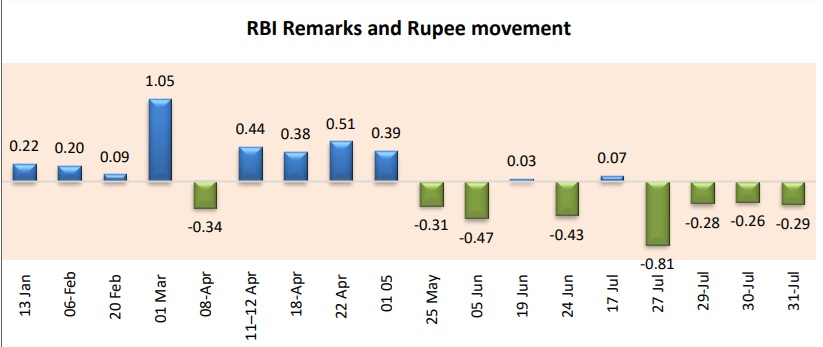
Rupee often exhibited noticeable movements following communication on exchange rate management by RBI. Although the direction and magnitude of these changes varied across events, the observed reactions suggest that market participants closely monitor RBI communication and rapidly incorporate policy signals and guidance into exchange rate expectations For instance, after Governor reiterated on 1 March 2026 that the rupee is determined by market demand and supply, with the RBI intervening only to curb excessive volatility, the rupee recorded one of the largest movements in the sample Governor's remarks on 27 July 2026 reiterating that the rupee was not overvalued and was arguably undervalued on both nominal and real effective exchange rate (REER) metrics coincided with a movement of 0.81 paise appreciation
FCNR (B) Inflows may be sitting at $30 bn level by 31 July
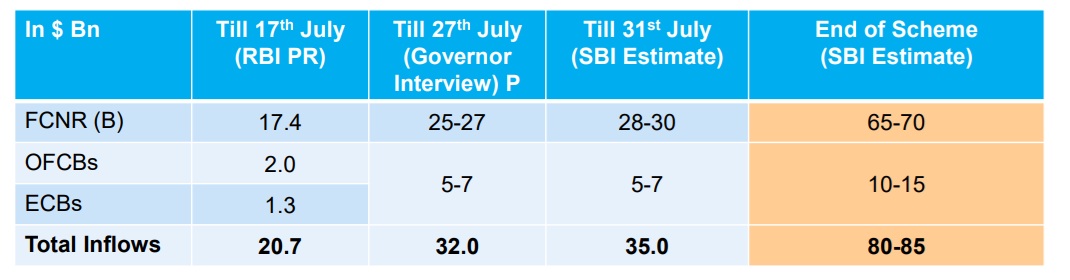
FX Reserves will surge BUT with a lag Source: RBI; SBI Research FCNR(B) deposit numbers are captured by RBI and becomes a part of Foreign Currency Assets (FCA) with a clear lag (we believe as large as 10 days), with the assumption that a large part of foreign exchange reserves is being recouped and adding to RBI foreign exchange coffers And hence there is no concomitant increase in FX reserves (or basically in FCA) and FCNR (B) inflows So far (till 24 Jul), FCA has increased by $12.5 billion (since 8 June)
We expect $5-6 bn inflows for the week ended 31st July’26
Decline in Forward position reveal some insights on likely course of intervention
As the total outstanding Forwards gravitated over US$100 Bn (net short), the Central Bank is clearly showing deft maneuverability in altering the outstanding composition, with a focus on alleviating the pressure along the short/near end
INDIA MACROS
Q1 FY27 growth could surge to 7.0% Source: RBI, CEIC, MOSPI, OEA, Vahan Dashboard, SBI Research ❑ In the last three policies, RBI downgraded Q1 FY 27 GDP growth projection from 6.9% to 6.6% due to war in middle east ❑ However, now we believe that situation has changed and Q1 growth print may be much better that anticipated ❑ Our preliminary estimate indicates that Q1 GDP may clock 7.0% growth
CPI inflation may be well within RBI’s target range
Till Apr’26, imported inflation was benign as impact of high global oil prices had not transferred to Indian consumer through petrol/diesel prices ❑ Consequently, we now expect CPI trajectory (as of now) may indicate more than 5.0% inflation for the next 2 quarters (Q1 FY27 settled at 3.9%)…FY27 projections currently at 5% though well under RBI’s target range
Industry & Personal Loans is contributing to 63% of Incremental Credit Growth
❑ The sectoral incremental credit growth data during Apr-June, 2026 indicates that ‘industry and personal loans’ has contributed ~63% of the incremental credit growth
❑ Among industry, ‘Petroleum, Coal Products and Nuclear Fuels’, ‘Infrastructure (especially Power)’, ‘Chemicals’, and ‘All Engineering’ are contributing 50% of the incremental industry credit
❑ Among personal loans, 42% (Rs 742 bn out of Rs 1738 bn) is contributed by ‘loans against gold jewellery’ alone
Monsoon 2026: Progress So Far…So Good
Despite a sluggish start and a 40% rainfall deficit in June 2026, July surplus showers reduced the overall nationwide shortfall to roughly 13% only…Except a few foodgrains producing states (Bihar, AP, etc.) all other states exhibited excellent rainfall in July (the most prominent month of sowing) IMD predict below-normal rainfall (less than 94% of LPA) over the country during the second half of the Southwest Monsoon season (Aug-Sep)
A Positive IOD may bring ‘Positive Sentiments’ to the Economy
El Niño has been underway since mid-June and continues to strengthen, with further intensification likely in the coming months. The strength of El Niño, in addition to the typical life cycle of an El Niño, suggests may persist into autumn 2027 However, this is the first week (as of 26 July) that the IOD has reached the positive threshold (+0.4 °C), with sustained values above this threshold required before an event is considered established
Sufficient reservoir storage level…Kharif Sowing is also going good
Kharif Sowing At present India has sufficient storage at important reservoirs (~equal to normal, though less than last year), the situation may improve as the monsoon progresses Kharif sowing (so far) is only 4.7% lower than the 2025 levels indicating better harvest and subsequently minimal/no impact on food inflation going forward However, a late El Niño may impact the Rabi crops
We expect surplus core liquidity may reach Rs 9 lakh crore at the end of Sep’26
❑ System liquidity is at surplus now at Rs 1.30 lakh crore and core liquidity at Rs 4.99 lakh crore. Government cash balance at Rs 3.66 lakh crore ❑ We expect Surplus Core liquidity may reach ~ Rs 9 lakh crore at the end of Sep’26 supported by Rs 6.2 lakh crore from Forex Swap, and a fall on CIC of Rs 400 bn while Forex sale of Rs 2,000 bn
Coming MPC: The signal is in the risk hierarchy
Base case communication read Guarded hold, not an easing hint Current backdrop has made soft language costlier: oil volatility, rupee pressure, external-flow caution and higher inflation projections make an explicitly dovish message less likely.
The MPC may keep rates unchanged, but tone can still reprice expectations: “policy space” is easing-friendly; “vigilance” is curve-protective
