Female proprietary enterprises have a 2.44% lower probability of accessing formal credit than male proprietary enterprises. Registered enterprises have average loan amount of Rs 5 lakhs compared to just Rs 75000 for unregistered enterprises
FinTech BizNews Service
Mumbai, 4 June 2026: The State Bank of India’s Economic Research Department has come out with a research report , titled "Empowering enterprises through digitalization and formalization: expanding the role of formal credit through the prism of ASUSE 2025 Unit level analysis." The special report has been authored by Dr. Soumya Kanti Ghosh, Group Chief Economic Adviser, State Bank of India.
The unincorporated non-agricultural sector plays a prominent role in the economy by generating employment, supporting livelihood, and contributing to the overall economic activity
❑ We find that Information and Communication Technology / ICT adoption is associated with a 76% increase in the labor productivity, highlighting the role of the digital technologies in improving enterprise performance
❑ Beyond such productivity gains, ICT adoption increases the likelihood of firm registration on average by 84 percentage points, in the sector-wise impact of ICT adoption is positive and statistically significant across manufacturing (64 percentage points, Trade 82 percentage points, and other services 86 percentage points)
❑ Registered enterprises have 6.90 percentage points higher probability of having credit as compared to the non-registered enterprises
❑ Female proprietary enterprises have a 2.44% lower probability of accessing formal credit than male proprietary enterprises. Moreover, registered enterprises have average loan amount of Rs 5 lakhs compared to just ~ Rs 75000 for unregistered enterprises
❑ Government-linked registration systems are associated with deeper formal business practices such as access to loan from formal sources. Udyam Assist-registered enterprises score 15.92 points followed by Udyam registered enterprises (15.45 points) and GST registered enterprises (13.51 points) respectively as compared to unregistered enterprises…Further, average loan amount for unregistered enterprises is approximately Rs 3 lakhs, while it is Rs 5.5 lakhs for registered and ~ Rs 10 lakhs for Udyam and Udyam assist registration
❑ We recommend for affordability of ICT technologies, creating a score card for Udyam registered enterprises and also the provision for maintain audited bookkeeping as key mechanisms to formalize the enterprises
Understanding ASUSE 2025: Purpose and coverage
❑ Annual Survey of Unincorporated Sector Enterprises (ASUSE) is conducted by the National Sample Survey Office (NSSO) under the Ministry of Statistics and Programme Implementation (MoSPI) to collect detailed information on India’s unincorporated non-agricultural enterprises
❑ The survey provides insights into the structure, employment, ownership, digitalization, productivity, financial
characteristics, and operational conditions of enterprises operating outside the corporate sector
❑ ASUSE covers unincorporated enterprises engaged in manufacturing, trade, and other services activity, excluding agricultural activities
❑ The survey includes both rural and urban areas across India and captures information from proprietary and partnership establishments, self-employed enterprises, and household-based economic units
❑ Objective: Integrated survey on economic and operational characteristics of unincorporated non-agricultural
enterprises in manufacturing, trade and other services sectors to supplement the corporate sector data. It generates estimates at multiple temporal and geographic levels
❑ The period of the ASUSE 2025 was from 1st January 2025 to 31st December 2025. The survey period was divided into four sub-rounds of three month duration
ASUSE 2025: Survey framework
❑ ASUSE follows a stratified sampling design and collects data through detailed schedules covering: Identification particulars; Enterprise characteristics & Employment details; Ownership and registration status; Expenses and receipts; Fixed assets; Information and communication technology usage; Financial indicators and operational constraints
What is an Unincorporated enterprise?
❑ An unincorporated enterprise is an enterprise which is not registered under the Companies Act and is owned by an individual, household, or a group of individuals (NSSO)
❑ These enterprises operate without a separate legal entity distinct from their owners
❑ The unincorporated non-agricultural sector occupies a pivotal position in the Indian economy by generating substantial employment and contributing significantly to gross domestic product and overall socio-economic development
❑ Beyond supporting the livelihoods of millions, the sector also complements the organized economy through the supply of goods and services, thereby strengthening domestic production and value chains
❑ “Unincorporated/Informal” definition is based on the legal structure, whereas “MSME” definition is based on enterprise size and turnover
Share of informal sector employees :
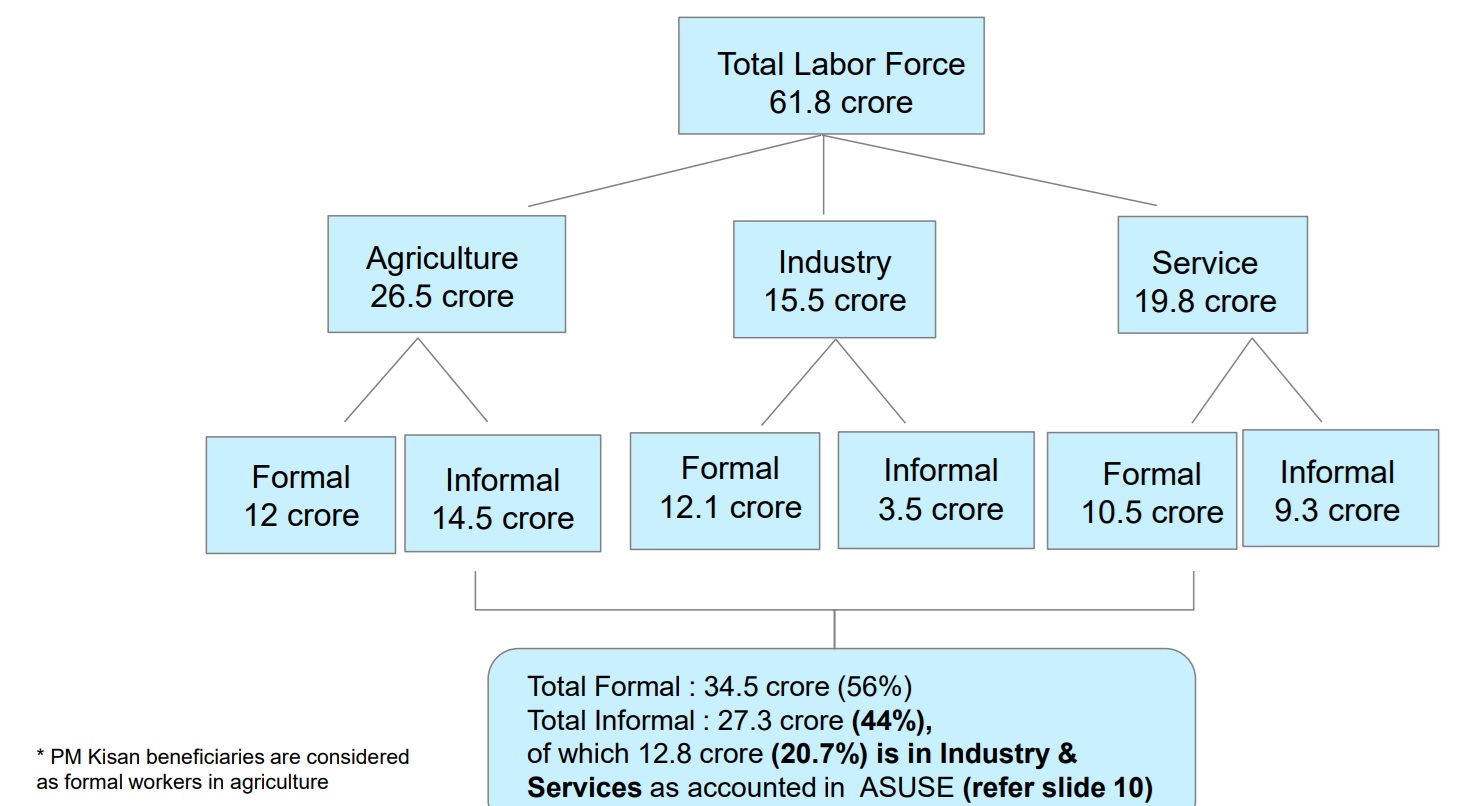
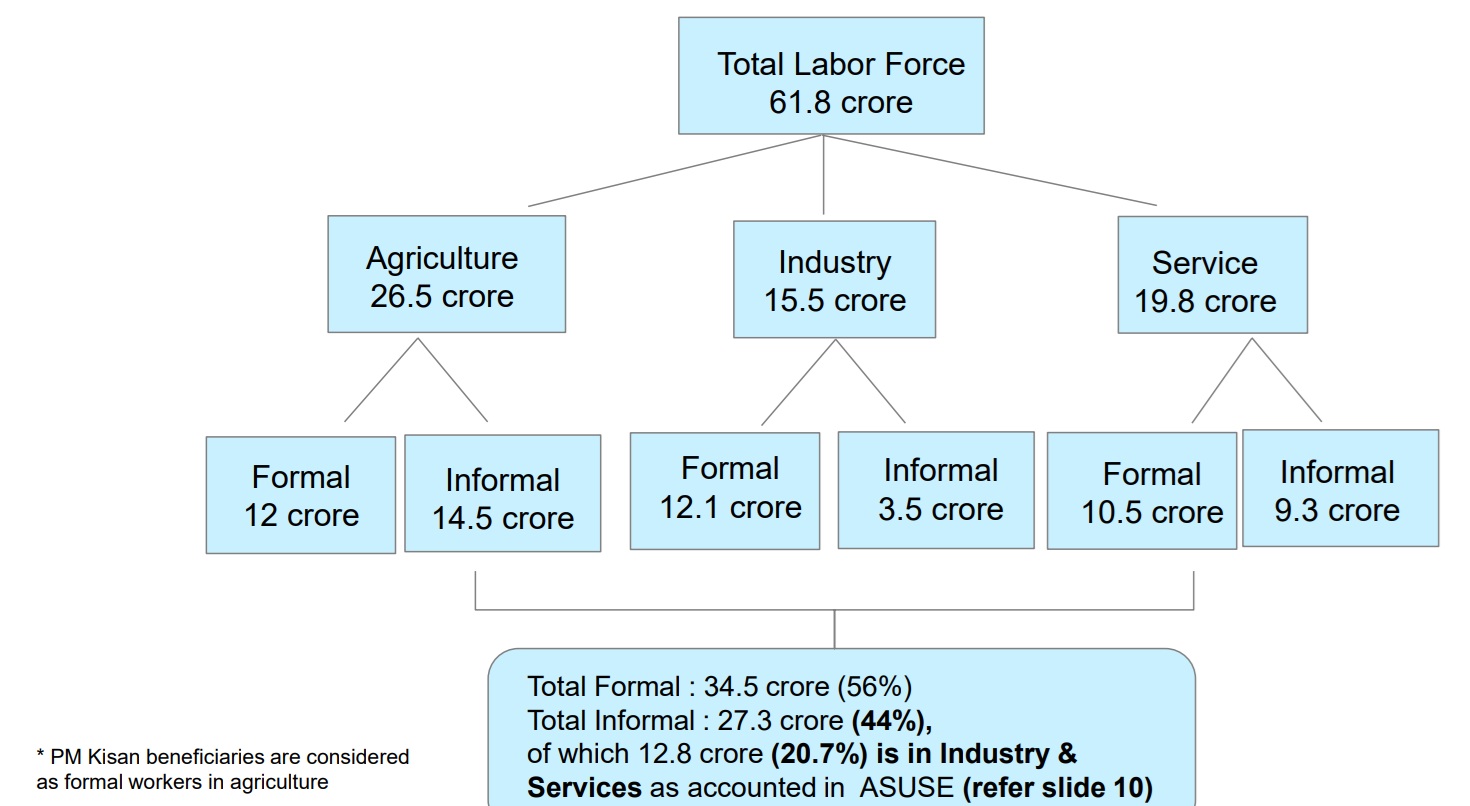
Combining PLFS and ASUSE ❑ Taking worker population ratio from the PLFS and workers in non-agri sector from ASUSE, we estimate the total informal sector employment as 27.3 crore, which is 44% of the total labor force for FY25
7.9 crore unincorporated establishments are surveyed in ASUSE 2025
❑ Unincorporated establishments have risen from 7.34 crore in 2023-24 to 7.92 crore in 2025 registering a growth rate of 7.9% compared to 2023-24
❑ Rural enterprises grew by 19.1% (from 3.56 crore to 4.24 crore), while urban enterprises registered a stronger growth of 25.2% (from 2.94 crore to 3.68 crore)
❑ The faster growth in urban areas suggests increasing entrepreneurial dynamism, expansion of service-oriented, and nonfarm activities, although rural India continues to host the majority of enterprises
The growing contributor of the unincorporated sector to GVA
❑ The share of the unincorporated sector in total GVA increased from 9.9% in 2022-23 to 11.2% in 2025 ❑ Contribution rose steadily over the period, reflecting expanding economic activity. Indicates the growing importance of micro and small enterprises in the state’s economy
Sector wise share of GVA
❑ The sectoral composition of GVA remained broadly stable across the survey rounds with other services emerging as the largest contributor to the unincorporated non-agricultural sector
❑ The share of the other services increased from 41% in 2022-23 to 44% in 2023-24, before moderating slightly to 42% in 2025
❑ Trade remained the second largest contributor, accounting for 36%, 35%, and 37% of GVA across the years
❑ The share of the manufacturing declined from 23% in 2022-23 to 21% in both 2023-24 and 2025
❑ These trends indicate a gradual shift in value creation towards service-oriented activities
6% growth rate in number of workers in ASUSE 2025 over ASUSE 2023-24
❑ Number of workers have risen from 12.06 crore in ASUSE 2023-24 to 12.8 crore in ASUSE 2025
❑ The rural employment grew by 14.5% (from 5.24 crore to 6 crore), while urban employment increased by 18.7% (from 5.73 crore to 6.80 crore)
❑ The faster pace of urban employment growth points to the expanding importance of urban informal enterprises in generating livelihood opportunities
❑ The simultaneous increase in both the number of enterprises and workers indicates that the sector continues to act as a critical source of employment and economic resilience
Emoluments per hired workers increased by 17.4%...
❑ Emoluments per hired workers increased from Rs 1.25 lakh (2022-23) to Rs 1.47 lakh (2025). Recorded a 13% growth in 2023-24 and a further 3.9% growth by 2025
❑ Overall increase of 17.4% over the period from 2022-23 to 2025, reflects improving earnings and productivity in the unincorporated sector
Uttarakhand gives highest per capita emoluments to the hired workers in unincorporated enterprise
❑ Uttarakhand has highest per capita emoluments given to hired workers in unincorporated enterprise as per ASUSE 2025, followed by Kerala, and Telangana
❑ Odisha and Uttar Pradesh fall at the bottom of the ladder among major states in case of per capita emoluments ❑ Meanwhile, Uttar Pradesh hires maximum number of workers in unincorporated enterprises, followed by Maharashtra and Tamil Nadu
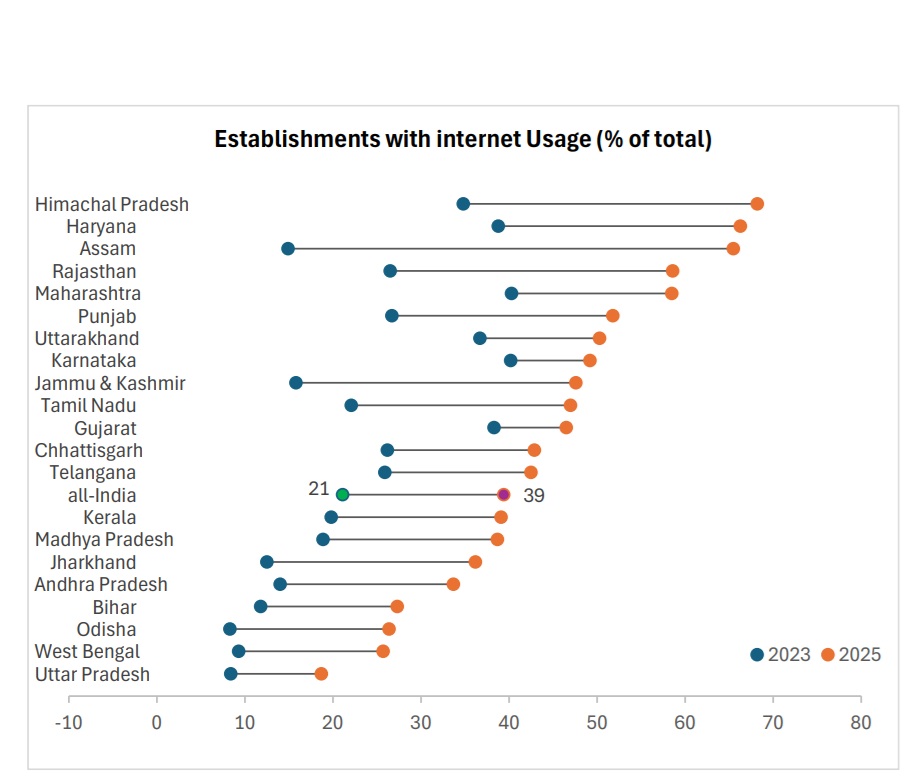
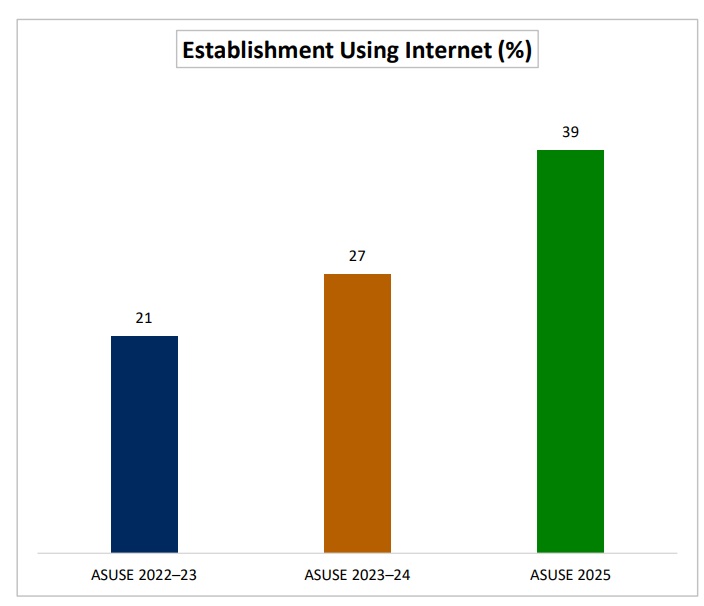
All major states have higher internet usage in 2025, with maximum usage in Himachal Pradesh
❑ Himachal Pradesh has highest internet usage among the unincorporated enterprises, with 68.2% of the establishments using internet in 2025
❑ This is followed by Haryana and Assam
Microdata processing and common ID construction
❑ The ASUSE 2025 unit-level data were provided in text file format, with separate text files corresponding to different blocks of the survey schedule
❑ A total of 16 test files were extracted using Stata, where each file contained information related to a specific block of the questionnaire
❑ The extracted text files were converted into structured Stata datasets for further analysis
❑ Data cleaning and formatting procedures were carried out to ensure consistency across all block-level datasets ❑ To uniquely identify each establishment and enable merging across files, a common enterprise identifier was constructed
The common identifier was then used to merge the block-level datasets and created a consolidated enterprise-level database for analysis
❑ The final merged dataset was used for analyzing employment, enterprises characteristics, ICT adoption, productivity, and operational indicators of unincorporated enterprises
How Digitization / ICT-Driven are driving Productivity Gains and Formalization Transitions in Unincorporated Enterprises
Why ICT matters for labor productivity?
❑ Rapid digitalization and the growing adoption of ICT are transforming the function of enterprises across sectors
From effort to efficiency: Mapping productivity and digital transformation…
❑ Labor productivity measures the output produced per worker in an enterprise, indicates efficiency of workers, utilization of resources, and operational performance of firms. Higher labor productivity implies workers are generating greater output and firms are operating more efficiently
❑ The labor productivity is calculated as:
𝐿𝑎𝑏𝑜𝑢𝑟 𝑃𝑟𝑜𝑑𝑢𝑐𝑡𝑖𝑣𝑖𝑡𝑦 = 𝐺𝑟𝑜𝑠𝑠 𝑉𝑎𝑙𝑢𝑒 𝐴𝑑𝑑𝑒𝑑 (𝐺𝑉𝐴)
---------------------------------------
𝑁𝑜. 𝑜𝑓 𝑊𝑜𝑟𝑘𝑒𝑟𝑠
We construct an ICT index using the Principal Component Analysis (PCA) by taking 21 variables related to the use of ICT by the establishment from Block 13 of the questionnaire and internet usage by the establishment in the Block 2….The ICT index serve as a proxy for the level of enterprise digitalization and a higher ICT index values indicates that greater adoption of digital technologies and higher digital integration within firms
❑ Such PCA transforms multiple dimensions of digital adoption into a single measurable indicator of enterprise digitalization ❑ The control variables used in the analysis are capital intensity, firm age, ownership type, size of the workers, educational level, industry, and sector
Productivity increases across ASUSE rounds…
❑ The rise in GVA per worker and GVA per establishment indicates improving enterprise productivity and operational efficiency, alongside the growing scale of economic activity in the sector
How ICT is shaping a rapid increase in labour productivity in unincorporated enterprises
We estimate a regression model to explore how ICT is shaping labour productivity in unincorporated enterprises 𝑙𝑛(𝐿𝑃𝑖) = 𝛼 + 𝜃𝐼𝐶𝑇𝑖 + ∅𝑋𝑖 + 𝛿𝑠 + 𝛾𝑡 + 𝜀𝑖
❑ Where 𝛿𝑠 and 𝛾𝑡 captures the sector fixed effect and state fixed effect
Regression analysis indicates that ICT adoption increases the labor productivity on average across all firms
❑ More precisely, one-unit increase in the ICT adoption index is associated with nearly a 76% increase in labor productivity, while firm age and capital intensity improve productivity by ~11% and 7%, respectively, holding all other factors constant
❑ This suggest that enterprises with greater digital adoption, higher capital availability, and longer operational experience tend to achieve better productivity efficiency, highlighting the important role of digital transformation, capital deepening, and enterprise maturity in improving productivity within the informal sector
ICT also pushing rapid formalization across enterprises
❑ ICT is not only a productivity-enhancing technology, but also a mechanism that pushes firms towards formalization ❑ Digital firms are more integrated into formal systems (payments, compliance, visibility)
❑ A simple logit regression model with firm registered under any act/authority as the dependent variable shows that one-unit increase in ICT adoption increases the likelihood of firm registration on average by 84 percentage points, holding all other factors constant, highlighting the strong role of digital adoption in facilitating formalization ❑ Sector-wise estimates further reveal that the impact of ICT adoption is positive and statistically significant across manufacturing (64 percentage points), trade (82 percentage points), and other services (~86 percentage points). The effect is strongest in other service sector, suggesting that digitally enabled service enterprises are more likely to integrate into formal institutional frameworks
❑ The ICT adoption lowers the transaction costs associated with formalization by improving access to digital payments, recordkeeping systems, and compliance mechanisms, while simultaneously increasing the benefits of operating within formal markets through better access to credit, markets, and institutional networks
Tracing the path of enterprise formalization
The share of enterprises registered under statutory act/authority has shown a steady upward movement across successive ASUSE rounds
❑ Registration increased from 36.8% (2022-23) to 37.2% (2023-24), further reaching 37.5% in ASUSE 2025 ❑ Although the increase appears gradual, it signals an expanding integration of enterprises into formal institutional frameworks, supported by improving digital adoption, financial access, and policy outreach within the unincorporated sector
Formalized firms show better access to institutional credit…
❑ Although ASUSE covers unincorporated enterprises, this does not mean that all enterprises are completely outside the formal system. An enterprise may be unincorporated in the sense that it is not registered as a company, but it may still be registered under some Act, local authority, license, or regulatory framework. Therefore, registration in ASUSE can be interpreted as an important first step towards enterprise visibility, documentation, and formalization
❑ A simple linear probability model / LPM result shows that registered enterprises are associated with a 6.90 percentage-point higher probability of having formal credit after controlling for rural/urban location, workers, and owned fixed assets. When estimated separately by broad activity sector, the registration effect remains positive and statistically significant in all three sectors: 5.80 percentage points in manufacturing, 4.84 percentage points in trade, and 7.83 percentage points in other services
Government linked registration enabling more formalization
❑ To examine whether government-linked registration mechanisms are associated with enterprise formalization, we construct a formalization practice score using 3 indicators: account in the establishment’s name, audited books of accounts and online business activity
❑ The score ranges from 0 to 100, with higher values indicating a greater degree of formalized business practice. The weighted descriptive results show a clear gradient across registration categories
❑ The coefficients from the model show a clear formalisation gradient. Other registered enterprises have a score 3.42 points higher than unregistered enterprises, while GST-registered enterprises score 13.51 points higher, Udyam-registered enterprises score 15.45 points higher, and Udyam Assist-registered enterprises score 15.92 points higher. This suggests that government-linked registration systems are associated with deeper formal business practices such as separate enterprise financial identity, better accounting discipline, digital finance use, and online business activity
❑ Presently, Udyam registration remains self declaration based, while Udyam Assist was brought to help bring informal enterprises into formal ambit of priority sector lending. Thus, the government may create a formalization passport post registration which will better help in priority sector lending
Udyam/Udyam Assist Portal registration significantly improving loan access…
❑ To examine whether Udyam and Udyam Assist registration provide an additional credit advantage beyond ordinary registration, we estimate a log-linear loan amount model among registered enterprises with positive formal loan amounts
❑ The kexplanatory variable is equal to 1 if the enterprise is registered under either Udyam Registration or Udyam Assist, and 0 for other registered enterprises. The model controls for rural/urban location, broad activity sector, number of workers, and owned fixed assets
❑ Udyam/Udyam Assist registered enterprises have approximately 41% higher formal loan amounts than other registered enterprises. Further, average loan amount for unregistered enterprises is approximately Rs 3lakhs, while it is Rs 5.5 lakhs for registered and ~ Rs 10 lakhs for Udyam and Udyam assist registration
❑ This suggests that Udyam and Udyam Assist registration may enhance credit visibility and improve the scale of institutional credit accessed by enterprises, even among firms that are already registered.
Women emerging as enterprise leaders
❑ The share of female-headed proprietary establishments increased steadily from 23% in 2022-23 to 26% in 2023-24, and further to 27% in 2025, indicating a gradual strengthening of women’s participation in enterprise ownership and management
Registration helping female proprietors through higher loan amount…
❑ Our estimates indicate that female proprietary enterprises have a 2.44% lower probability of accessing formal institutional credit than male proprietary enterprises.
❑ However, when the analysis is restricted to female proprietary enterprises, registration emerges as an important enabling factor. Among female proprietors, registered enterprises have a 5.6% higher probability of formal credit access than unregistered female proprietors. Further, registered enterprises have average loan amount of Rs 5 lakhs while it is just ~ Rs 75000 for unregistered enterprises
❑ This suggests that although female proprietors face lower formal credit access however steps such as registration is helping female enterprise in availing formal credit.
A suggested roadmap for the government action plan…
Digital Infrastructure • Improve affordable internet access, digital payment infrastructure, and common service centers in enterprise clusters
Digital Skills • Provide hands-on training in local languages on digital payments, bookkeeping, online marketing, and registration
Formalization • Conduct Udyam/GST registration camps and reduce compliance costs for newly formalized micro firms
Credit Access • Promote cash inflow-based lending using digital transaction histories instead of relying only on collateral
Market Access • Help small firms sell through e-commerce platforms, government procurement portals, and local digital marketplaces
Targeted Inclusion • Priorities women-owned, rural, and very small enterprises through special digitalization and credit schemes
Monitoring • Use ASUSE data to identify sectors, regions, and enterprise groups where digital adoption is still low
