India needs massive manufacturing at a massive level. Without industrial scale, military ambition and strategic autonomy remain slogans rather than capability: Major Gaurav Arya
FinTech BizNews Service
Mumbai, April 10, 2026: The global economy is under strain from intensifying geopolitical tensions in West Asia and the disruptions they have triggered across supply chains. Rising energy prices and shortages of key industrial inputs have heightened inflation fears and pushed up risk premiums in oil markets, clouding the global growth outlook. In this environment, can India’s macroeconomic fundamentals, previously underpinned by strong growth and low inflation, prove resilient to these external shocks?

Major Gaurav Arya (Retd.), Editor-in-Chief of Chanakya Forum, argues Beijing is quietly cashing in on chaos, and India must ramp up defence spends to 3.5% of GDP to keep up
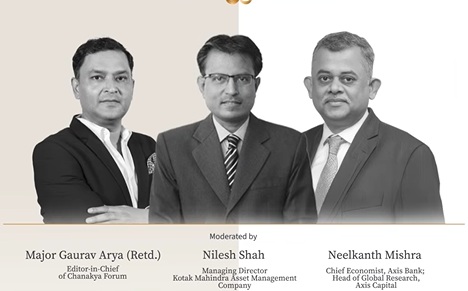
Kotak Private recently hosted the second edition of Take & Counter Take, featuring eminent speakers - Neelkanth Mishra, Chief Economist, Axis Bank and Head of Global Research, Axis Capital, and Major Gaurav Arya (Retd.), Editor-in-Chief of Chanakya Forum, to examine a timely and critical question in the context of recent global developments: Is India’s growth story resilient to geopolitical shocks?
The real winner of the West Asia conflict is China, Major Gaurav Arya said at Kotak Private Banking’s Take and Counter Take (TACT), arguing that Beijing is extracting strategic gains without firing a shot.
Speaking at the invitation-only forum curated by Kotak Private, Arya told the audience that while attention remains fixed on Israel, Iran and the United States, China is accruing advantage quietly and methodically. “Everyone is looking at Israel, Iran and the United States,” he said, “but the country that actually benefits is China.” The conflict, he added, fits into a longer, colder struggle in which China exploits instability to weaken rivals, tighten its grip over energy routes, and stretch Western focus across too many theatres at once.
That advantage, Arya warned during the TACT session moderated by Kotak AMC managing director Nilesh Shah, exposes India’s own vulnerabilities. China, he said, has spent three decades building manufacturing scale, logistics depth and military capacity without distraction, while India has relied too heavily on goodwill and moral positioning. “They kept quiet, they kept building their economy, and one day people woke up to realise they had the biggest navy in the world,” Arya said. For India, the implication was blunt. “You need massive manufacturing at a massive level,” he said, adding that without industrial scale, military ambition and strategic autonomy remain slogans rather than capability.
Major Gaurav Arya (Retd.)
“Everyone is looking at Israel,
Iran and the United States, but
the country that actually
benefits is China.”
“If the Prime Minister asked me
for one recommendation, it
would be this- defence has to
be at 3.5% of GDP. There is no
other way.”
“The world is not structured
anymore. If you are not
prepared, you will pay the
price.”
"The biggest learning for the
Indian military will be how can
you turn the Malacca Strait into
a Strait of Hormuz? A
significant part of Chinese
trade passes through Malacca
and that will be the target."
The second edition of Take and Counter Take paired Arya with economist Neelkanth Mishra to examine whether India’s growth story can remain resilient amid geopolitical shocks. Shah steered the discussion away from headlines and towards consequence, pressing the panel on what prolonged conflict means for capital flows, supply chains, security and state capacity. Mishra set the economic frame, arguing that India is better prepared today than in past crises, while Arya focused on the security externalities that balance sheets and market models tend to underweight.
‘India must brace for more terror attacks’
Those externalities, Arya said, will not stay confined to West Asia. He was unequivocal on blowback. “There will be 100% more terror attacks,” he said. “Lone wolf attacks, sleeper cells — in India, in Europe, in America. This is inevitable.” Modern wars, he argued, do not end at borders but diffuse through networks, ideology and proxies, pulling distant countries into the arc of violence whether they choose it or not.
For India, that reality sharpens the case for hard choices at home. Arya returned repeatedly to defence expenditure, calling current levels inadequate for the risks ahead. “If the Prime Minister asked me for one recommendation, it would be this,” he said. “Defence has to be at 3.5% of GDP. There is no other way.” Moral authority, he added, does not substitute for deterrence. “There is no friendship without fear,” Arya said, arguing that the ability to project power — economic, diplomatic and military — determines whether a country shapes events or absorbs their fallout.
His warning circled back to China. Beijing, Arya said, is willing to absorb pain, invest patiently and exploit asymmetry, whether through choke points, supply chains or proxy conflict. India, by contrast, still treats strength as episodic rather than systemic. “China will not let you survive by goodwill alone,” he said. “They respect power. That power comes from industry, from defence manufacturing, from economic strength.”
India, Arya said, still has the window to act, provided it aligns growth, manufacturing and security as parts of the same strategy. The West Asia conflict, in his telling, is less a distant war than a rehearsal for the kind of disorder that will define the coming decade. “The world is not structured anymore,” he said. “If you are not prepared, you will pay the price.”
(Kotak Private is a proposition offered by Kotak Group across multiple entities in the Group. Investment services (distribution and referral) are offered by Kotak Private Banking, housed in Kotak Mahindra Bank).
