Call for indigenous compute capacity, strong public–private collaboration and differentiated skilling pathways across education levels.
FinTech BizNews Service
Mumbai, 5 January 2026: The Ministry of Electronics and Information Technology (MeitY), the IndiaAI Mission, the Government of Assam and IIT Guwahati are hosting a two-day Working Group Meeting in “Human Capital” at the IIT Guwahati campus. The meeting convened senior policymakers, academic leaders, industry experts and practitioners to advance national deliberations on education reform, workforce transition and inclusive, human-centric AI adoption. The two-day meeting (5–6 January 2026), chaired by Prof. T. G. Sitharam, serves as a key thematic precursor to the India AI Impact Summit 2026, scheduled to be held in New Delhi from February 15–20, 2026, and is expected to inform national-level deliberations and policy outcomes.
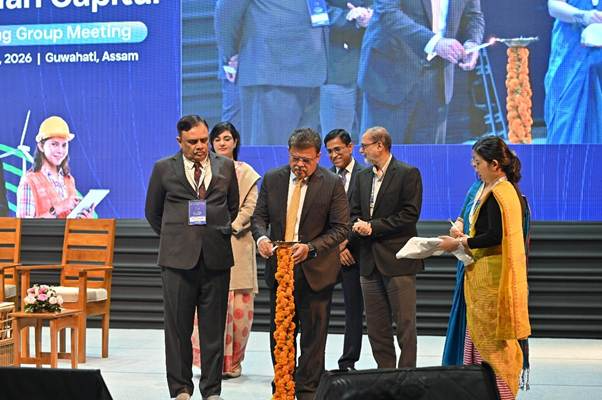
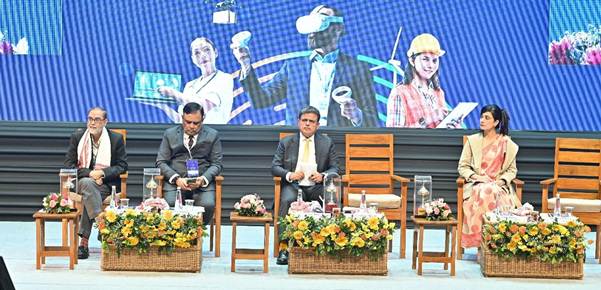
The opening session featured addresses by Shri Syedain Abbasi, IAS, Special Chief Secretary, Government of Assam, Shri K. S. Gopinath Narayan, IAAS, Principal Secretary (IT), Government of Assam, Prof. T. G. Sitharam, Chair, Human Capital Working Group,
Prof. Devendra Jalihal, Director, IIT Guwahati, and Ms. Shikha Dahiya, Joint Director, IndiaAI, MeitY; and Speakers highlighted the centrality of human capital in India’s AI journey and emphasised the need to move beyond conventional skilling models towards lifelong learning, augmentation and institutional readiness.
Welcoming the gathering, Prof. Devendra Jalihal, Director, IIT Guwahati, highlighted the institute’s role as a convening platform for policymakers, academia, industry and students to shape future-ready human capital in the age of AI. He underscored IIT Guwahati’s commitment to working at the intersection of technology, education and society, noting strong student participation as a reflection of growing interest in inclusive AI ecosystems.
Ms. Shikha Dahiya, Joint Director, IndiaAI, MeitY, outlined the vision of the India AI Impact Summit 2026, highlighting its focus on human capital, democratisation of AI resources and inclusive, responsible AI adoption, particularly for the Global South. She underscored the role of the IndiaAI Mission in building future-ready human capital through initiatives spanning compute capacity, indigenous datasets and models, and nationwide AI skilling and capacity-building efforts, noting that outcomes from the Guwahati deliberations would directly inform global-level discussions at the Summit.
Prof. T. G. Sitharam, Chair, Human Capital Working Group, underscored that the transition to an AI-enabled economy must be inclusive and people-centric, with human capital at its core. He emphasised the need to move beyond fragmented skilling efforts towards lifelong learning ecosystems that prioritise adaptability, judgement and human-centred capabilities alongside technical skills, noting that technological progress must ultimately translate into dignity, opportunity and resilience.
Shri K. S. Gopinath Narayan, IAAS, Principal Secretary (IT), Government of Assam, highlighted that the integration of AI represents a fundamental shift in how economies and societies function, with far-reaching implications for human capital. He stressed the importance of prioritising human augmentation over automation, cautioning that unchecked technological change could widen inequalities across sectors and regions, and emphasised continuous learning, micro-skilling and AI literacy as essential public capabilities.
Shri Syedain Abbasi, IAS, Special Chief Secretary, Government of Assam, observed that while AI hype mirrors past technology cycles, this moment is fundamentally different as AI increasingly functions as an autonomous agent. He warned that the concentration of AI capabilities among a few global players could exacerbate inequities and threaten India’s traditional IT and outsourcing-led employment model, calling for indigenous compute capacity, strong public–private collaboration and differentiated skilling pathways across education levels.
The inaugural session concluded with a vote of thanks by Shri Ashwani Kumar, IAS, Director, IT Department, Government of Assam, who expressed gratitude to the Human Capital Working Group for its thought leadership and to IIT Guwahati for providing an academic platform that bridges research, policy and real-world impact. He acknowledged the IndiaAI Mission for its continued support in advancing India’s national AI agenda.
Ms. Shikha Dahiya also presented an overview of the India AI Impact Summit 2026, highlighting its multi-day programme and noting that it will culminate in leaders’ plenaries and working group outcomes in New Delhi, with a focus on democratising AI resources, enabling indigenous models and amplifying Global South perspectives.
A key highlight of Day 1 was the keynote address on “Democratizing Competency in the Age of AI” by Prof. Gautam Barua, Former Director, IIT Guwahati, which examined the structural shift from education systems designed to produce individual experts towards models that enable large-scale human augmentation through domain-specific AI tools. The address emphasised the importance of sovereign, sector-aligned AI systems that raise baseline human capability while ensuring transition security and social protection for workers impacted by automation.
This was followed by a panel discussion on “Gender-Responsive Strategies for the AI Transition”, which examined the impact of AI on women in the workforce. The discussion highlighted risks related to automation of entry-level roles, widening wage gaps, data and algorithmic bias, and unequal access to AI skilling, while underscoring the need for inclusive design, explainable AI, adoption-led reskilling and ecosystem-driven policy interventions to ensure equitable and people-centric AI transitions. Moderated by Ms. Arpitha Desai, Associate Vice President, The Asia Group, the panel was attended by Ms. Tulika Pandey, Scientist-G, Ministry of Electronics and Information Technology, Government of India (Virtual); Mr. Sanjay Kukreja, Head of AI, eClerx; Ms. Urmi Tat, Manager, Public Policy and Government Affairs, Salesforce; Dr. Tanu M. Goyal, Senior Fellow, ICRIER; Prof. Dhruba Kumar Bhattacharyya, Vice Chancellor, Tezpur University; and Prof. Ratnajit Bhattacharjee, Head, MFSDS & AI and Head, MCENSSR, IIT Guwahati.
The day continued with a panel discussion on “Redefining Education for the Cognitive Age”, which examined how AI is reshaping learning objectives, pedagogy and assessment systems. Panellists discussed the shift from rote-based instruction to cognitive, process-oriented learning; the role of AI in personalising education while reducing administrative burdens on teachers; the need for community-tested, human-centric AI tools; and closer alignment between education systems and rapidly evolving industry skill requirements, emphasising adaptability, critical thinking, collaboration and lifelong learning as core capabilities for the AI era. Moderated by Mr. Subhodeep Jash, Senior Vice President, The Asia Group, the panel was attended by Mr. Venkatesh Reddy Mallapu Reddy, Chief Officer and President, ConveGenius; Mr. Siddhant Sachdeva, Co-Founder, Rocket Learning; Mr. Parminder Singh Kakria, Vice President, Government Affairs, Kyndryl; Prof. Anupam Basu, Former Director, NIT Durgapur; and Prof. Shyamanta M. Hazarika, Head, Mechanical Engineering, IIT Guwahati.
The Human Capital Working Group Meeting at IIT Guwahati will continue tomorrow with focused deliberations on education reform, workforce transition, lifelong learning systems and gender-responsive strategies for the AI era, culminating in the consolidation of key recommendations to inform national policy outcomes. As a thematic precursor to the India AI Impact Summit 2026 in New Delhi, the Guwahati convening reinforces the Government of India’s commitment to building inclusive, human-centric AI ecosystems under the IndiaAI Mission, aligning regional perspectives with national priorities for Viksit Bharat 2047.
